Vision Out, Value In: The Rise of Pragmatic Trading
Los informes de mercado se publican únicamente en inglés. El resto del sitio sí está disponible en su idioma.

Why More Market Players Are Letting Go of Predictions and Embracing Pragmatic Risk Management
Those who’ve been reading our updates since the start of Get Fair Dairy know we’ve always kept a sharp eye on commodity prices and have loved trying to predict the future moves of these prices. From butter, cheese to powders, price discovery has long been the heartbeat of our updates and the biggest demand from our partners, from producers to end users and trade. But over the past few years, our conversations with partners have shifted. Less about “where is the price going?”, and more about “how do we protect ourselves when it does?”
The market’s obsession (and our own) with outguessing tomorrow’s price is giving way to something far more grounded: risk mitigation. The ability to predict the market is no longer the competitive advantage it once was. Instead, it’s the ability to navigate the market—with less exposure, more flexibility, and fewer surprises—that is defining the best-in-class players.
Strategy Over Speculation
With the evolution of risk management tools, the key focus for strategic buyers is no longer about beating the market. It’s about not getting beaten by it. Purchase managers now secure more and more physical volumes well in advance—even when they believe prices might come down. Why? Because what matters isn’t buying at the absolute bottom. It’s locking in margin, managing volatility, and keeping the finance team from waking up in cold sweats.
In these cases, the physical transaction is only part of the story. The actual value to the buyer is increasingly locked in before or after the physical purchase—through paper positions, futures, options, or index-linked contracts. That flexibility allows businesses to stay agile, and frankly, stay in the game, even when the market throws its usual curveballs.
Producers Are Playing Catch-Up—And Catching On
This shift isn’t just on the buy side. Producers are adapting too. Long-term fixed-price contracts are becoming a relic of a simpler (and slower) time. Today, selling based on indices or covering exposure through forward contracts on paper is a way to keep sales fluid and risk manageable.
In this environment, producers are less focused on timing the top and more focused on maintaining reliable offtake. Forward contracts are increasingly seen not as speculative bets, but as hedging tools that create predictability, both in sales planning and cash flow. And as weather continues to wreak havoc on milk output and processing schedules, outright forward sales become harder to justify and riskier to execute.
What we’re seeing instead is a rise in short-cycle pricing. Weekly and monthly commitments based on volume needs, with pricing mechanisms that reflect spot or indexed averages. It’s faster, it’s messier, but it’s also more in tune with how volatile the supply side has become.
Not All Markets Are Created Equal
Naturally, some dairy commodities are more ready for this shift than others. SMP, SWP, and Butter have been at the front of the risk management evolution—thanks to deeper liquidity, exchange-based instruments, they are more seen as a commodity and a history of volatility that forced innovation early.
Cheese, however, is still catching up. With less standardized specs, more fragmented demand, and less paper market infrastructure, cheese contracts are often still stuck in the “old world” of pricing. But that’s changing, fast. The push toward digital trading platforms, real-time price indices, and algorithm-driven trading desks is accelerating across the board. It’s no longer a question of if cheese will catch up—it’s when, and how fast.
The Bottom Line: Vision Is a Luxury. Risk Management Is a Necessity.
In today’s market, fortune does not favor the bold. It favors the prepared. More and more players are stepping away from the crystal ball and leaning into structures that prioritize resilience over brilliance. Buying at the bottom or selling at the top may still earn bragging rights at the bar, but real value lies in consistency, margin protection, and sleep-filled nights.
The shift we’re witnessing isn’t a trend—it’s a transition. And if the current pace of change is anything to go by, this new way of trading may very well become the standard before some players even realize it.
Get Fair Dairy 2.0: Servicing Both Sides of the Shift
At Get Fair Dairy, we’ve always aimed to sit at the crossroads of tradition and innovation. And with these market dynamics changing, so are we.
While we continue to facilitate day-to-day trade for the bulk of the market, we’re also preparing for what comes next. After the summer, we’ll roll out a more structured approach to how we serve partners—one that matches the complexity of today's market with the clarity of three focused pillars:
🔹 Get Fair Dairy Brokering
Still the core of what we do: bringing buyers and sellers together. But with more focus on tailored deals and less on broad-spectrum trading. Day-to-day updates will shift to weekly, more detailed market reports. At the same time we will be launcing dedicated WhatsApp groups to service our most active trading partners. We will have a future with fewer blast email messages to inform you about each market transaction or change. Instead, we’ll highlight executed trades in a weekly summary sent directly to our partners. Less noise, more signal.
🔹 Get Fair Dairy Exchange
A new digital platform (yes, another one—but with a purpose), fully functional without the need to contact a physical broker. Designed for short-term trades of spot volumes at market prices, this tool will focus on liquids, butter, powders, and cheese—centered around a three-month collection timeframe. It's about servicing you for your less strategic needs and helping you fulfil spot opportunities swiftly. And by being able to target specic groups in our markets, you don't need to feel overexposed to the full market. Less transparency on every individual trade, but broader visibility and reach for market participants. Think access without the overexposure.
🔹 Hedge Fair Dairy
Our new sister company. Built to help partners navigate the growing world of price risk management. From index-based contracts to tailored long-term agreements, Hedge Fair Dairy will focus on supporting players who don’t yet have a playbook for managing paper exposure—but know they need one.
These changes will come starting September 2025. We will update you on the changes ahead in the next weeks and months. But if you already have some questions, feel free to reach out.
Back to the Market:
When Risk Management Meets a Bullish Market Surge
Last week may have been short, but it certainly wasn’t dull. Volumes were there, volatility returned, and if you blinked, you may have missed another €150 jump on butter. A perfect backdrop to illustrate the shift: market participants trading less on prediction, and more on protection.
Let’s zoom in.
Butter Breaks €7500 — And Keeps Going
On the fat side, futures broke through the €7500/t mark — and didn’t stop there. We saw physical volumes change hands at those levels as well, and for some special origins, even higher prices were confirmed, reportedly above €7650 DAP. Cream prices pulled the market upward, and buyers, despite previous talk of resistance, caved quickly to secure volumes further out.
What’s striking here isn’t just the price — it’s the behavior. We’re seeing buyers commit well above their previously stated ceilings. But this isn’t a case of panic buying. It’s strategic. It’s structured. Many of these buyers seem to have already hedged their risk on paper, and are now simply aligning their physical positions. Vision might have suggested waiting. Risk management said: lock it in.
We expect to start the week with sellers for:
- 12 loads of NL/DE/BE butter For July-September at € 7550
- 12 loads of Irish butter For July-September at € 7450
- 4 loads of Polish Lactic butter for June at € 7400
- 2 loads of Salted Sweet Cream butter at € 7200
Cheese Steady, But No Rush
On cheese, prices are also ticking up — especially for prompt delivery. We traded some mozzarella up to € 4400 and Gouda up to € 4450. But unlike butter, the cheese market isn’t showing the same forward urgency. There’s little indication of panic, and definitely no FOMO (yet). Volumes are not overflowing the market, stocks seem manageable, but most Q3–Q4 interest is cautious. This is a classic case of divergence: price strength, yes — but not driven by forward interest but nearterm tightness. It seems for cheese that again, buyers and sellers seem more focused on managing short-term operational risk than gambling on long-term price trends.
Proteins: Liquids Run Hot
The most aggressive moves? Liquid proteins. SMC has surged nearly €800 in just a few weeks. Spot liquidity is thin, and traders report deals well above official quotations of €1900, which are still lagging behind reality.
Interestingly, the spike in liquids hasn’t yet spilled over to SMP. But with no downward pressure in sight, the tone is clearly stable to slightly firmer, and cautious buyers may start layering in coverage soon — especially if this disconnect with SMC holds.
In addition, we’re seeing more and more partners turn their attention to the spread between protein sources. The difference in value between sweet whey and skimmed milk proteins has become too large to ignore. Based on current SWP pricing, the SMP market is starting to look structurally undervalued. This makes the upside for SMP look increasingly attractive, while downside risk seems to be shrinking.
And that’s where the current mindset kicks in again: it’s no longer just about market direction — it’s about positioning correctly within the protein complex. Whether physical or paper, the tools are there to play the spread, not the guessing game.
Conclusion: A Market That’s Growing Up
The dairy market is maturing. Slowly but surely, the days of crystal ball forecasting and “gut feel” trades are being replaced by structured risk strategies, spread plays, digital dealmaking, and margin-conscious execution. Buyers are securing product not just for price, but for peace of mind. Sellers are shifting from prediction to protection. And market conversations are sounding less like weather forecasts — and more like portfolio reviews.
At Get Fair Dairy, we’re not stepping away from the market’s day-to-day. But we are stepping into its future. Whether you’re navigating the next load of butter, planning your protein position, or preparing for 2026 contract structures — we’re building tools, insights, and partnerships to help you do it smarter.
Want to know how these changes will benefit your strategy? Or how to better manage volatility, spreads, or forward pricing?
👉 Reach out. Let’s talk.
We’ll be happy to walk you through what’s coming next — and how you can use it to your advantage
Más desde la mesa
Our Long View Before Our Long Break 
Our Long View Before Our Long Break
Last week the market found a bit of stability. After lower trades on cheese, the cheese market traded slowly up, although a real rally remains absent. Butter prices did dip a bit further, although at the start of this week we see some strength on the back end of the curve. And on powder, our bullish feeling just doesn't go away — and now we can find some confirmation in the market as well.
Dairy Carry Has a Shelf Life 
Dairy Carry Has a Shelf Life
Last week was bearish across the board — every product we broker leaned the wrong way. Powders lost more momentum, cheese slipped well below €3,000 for some products, and butter continues to impress with just how much keeps showing up. Supply, supply, supply.
Summer Shopping or Summer Sale? 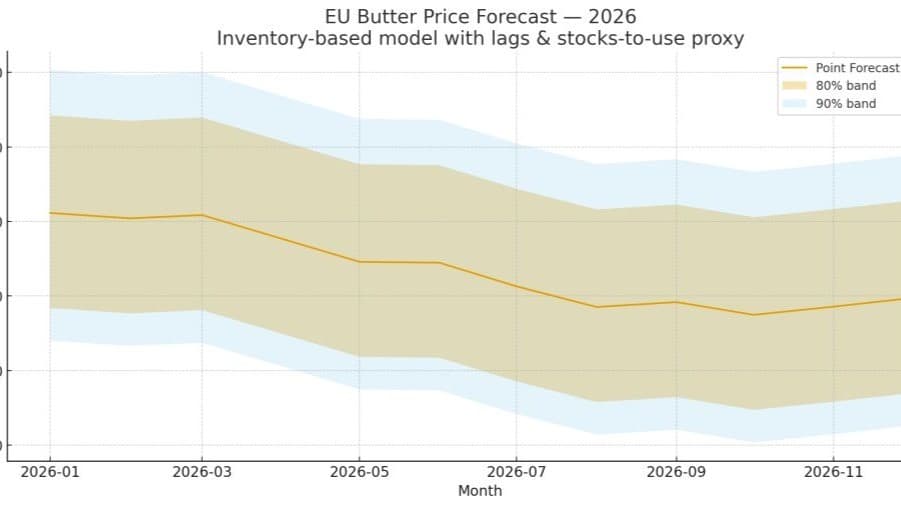
Summer Shopping or Summer Sale?
Last week was again a bit of a bearish week for the entire dairy industry. With cream prices under pressure and milk intake still strong, we keep seeing a market that has more supply than demand. Butter prices took another step lower, cheese prices cracked, and the powder market gave back a bit of its gains again.
El informe semanal
Recíbalo antes de que esté en cualquier otro sitio
Cada informe de mercado, directo a su bandeja de entrada en cuanto se escribe. Mantequilla, queso, polvo, líquidos — elija lo que realmente negocia.
Aproximadamente semanal · Gratis · Baja cuando quiera