Rangebound Prices, Rising Risks
Los informes de mercado se publican únicamente en inglés. El resto del sitio sí está disponible en su idioma.

Last week we saw the market trade... sideways once again. Let’s not make this update a repetition of what we’ve been writing for a few weeks now, but butter prices once again stayed within the familiar ranges. Irish butter traded roughly between €7100 and €7250. Polish butter moved slightly higher: just above €7000 for sweet cream and a little over €7100 for lactic. NL/DE/BE prices showed limited Q3 trades around €7300 after testing the upper range of our bandwidth at €7375.
Gouda prices didn’t budge, still quoted between €4250 and €4300. Mozzarella lost a bit of momentum above €4300, though buying interest remains solid around €4250. And powders? Around €2300 there are sufficient buyers, while sellers are holding out for levels above €2400.
But then Friday brought a curveball: the US President surprised markets again with talk of a potential 50% import tariff on all products coming from the EU. Will this finally shake the EU commodity market into motion? Or will we shrug and continue sideways in what has become a very well-balanced market?
Let’s see what this short week (with holidays on Thursday and Friday) has to offer.
🇺🇸 Trump’s 50% Tariff Threat: Noise or Real Risk?
First, on Trump. Our initial reaction? Oh S8^$#IT! The 20% tariff shock announced back on April 1st had already rattled nerves. So what could a 50% tariff do?
Interestingly, while financial markets twitched, the reaction was muted compared to the first tariff wave. It seems Trump’s scare tactics have lost a bit of their edge. A 50% tariff feels extreme—even for him. But if we’ve learned one thing, it’s this: with Trump, everything is possible. Even if he follows through, the big question is: for how long? His negotiation tactics are predictable, and the market already seems to price in a pivot—or at least a softening—of Friday’s tough talk.
Still, does this mean zero impact for dairy? Not quite.
Nobody knows what the US President will actually do. That’s why the current window, running until July 2nd, during which EU products can enter at the 10% tariff, was being seized aggressively. Already on Friday, we heard from partners that containers due to ship in the coming weeks are being put on hold (and not just dairy).
It turns out that frontloading goods into the US was a smart move—though it likely stops here. Even if the 50% tariff doesn’t materialise, the uncertainty is enough to kill risk appetite. As one partner said, “Product now on the boat will arrive after July 2nd—and will face either 10% or 50% tariffs, that insane uncertainty. From now on, Nobody’s shipping more without clarity.”
🧀 Will Product Boomerang Back to the EU?
So on cheese and butter, we may see some product that was US-bound come back to find new homes in the EU. Especially goods slated to ship in the next 2–3 weeks are likely to be rerouted.
Add to that the fact that the euro gained 2.5% vs the USD —making EU goods more expensive for USD-paying buyers—and it’s easy to see how exports have suddenly become less attractive. The US, meanwhile, continues to perform strongly on export markets. Their internal prices rose, but they remain highly competitive on butter and cheese despite the rally.
🥛 Liquid Peak Behind Us, But Drought Raises New Questions
On the milk side, Germany’s collections have started to lose the momentum seen in previous weeks. That’s raising some concern among our partners active in the liquid trade.
Higher prices for SMC and cream have lifted spot milk values, with raw milk in BE/NL nearly touching 50ct, and France and Germany seeing increases of 5–6ct. Cream prices also gained significant ground, clearly moving above €8000, with reported prices ranging from €8200 to €8400.
At the same time, the weather has turned: after an exceptionally dry spell, rain returned in recent days. In our homes, this led to two trapped kids bouncing off the walls without their trampoline—but out in the fields, the showers were overdue. With some more rain predicted this week, we expect many happy farmers to reappear, and hopefully quieter weekends at home once the sun returns.
🧊 Stock Building? Maybe.
One of the big themes last week was stock building.
We started 2025 with historically low stock levels—especially for butter. Yet despite the high prices, few dared to carry significant volumes. That may now be changing. More and more partners report that EU warehouses are starting to fill up. That’s not surprising: July traditionally marks the seasonal stock peak. The key question is: what are they actually filled with?
We don’t yet see hard proof of large-scale stock accumulation. But subtle signs are emerging:
-
Since last summer, we saw frantic last-minute buying to meet contracts. This month, it feels more like traders are closer to offloading unwanted product.
-
Previously, sellers only offered late in the month. Now, volumes are available from day one.
-
End users are delaying pick-up: May contracts are being pushed to June. Some even ask to postpone pre-summer deliveries into late Q3.
Is that unusual? Not dramatically. But taken together, it does suggest the market is no longer as tight as it once was.
🧈 Butter: Sideways Again
As mentioned, the butter market was sideways again last week. There was some bullish sentiment midweek as cream prices surged, but that faded by Friday.
At higher levels, producers are willing sellers. NL/DE/BE producers are happy to book Q3 at €7350, while Irish sellers are locking in sales at €7250–€7300. By Friday, we saw a clear push from Irish sellers to move June stocks at lower levels—but most buyers had already switched to weekend mode.
If the US enforces the 50% tariff, that may become the biggest threat to EU butter markets. We'll also be watching cream—sunny weather boosted prices and demand in recent weeks, but colder, wetter forecasts could support milk yields and slow fresh consumption. That might also explain the recent dip in German collections.
Expected offers:
- 6 loads Irish butter for Q3 at €7250 FCA Ireland
- 6 loads NL/DE/BE butter for Q3 at €7350
- 4 loads Polish Sweet Cream butter for prompt at €7125
- 6 loads Polish Lactic butter for June at €7200
- 6 loads Irish lactic for June at €7200
🧀 Cheese: Losing Momentum
The mozzarella rally has cooled. After hitting €4350 for Q3, the same “eager sellers, hesitant buyers” dynamic as in butter has reappeared.
Other cheeses remain stagnant. Cheddar is barely moving, and Gouda is still hovering between €4250–€4350. There’s little urgency from either side.
Retail demand remains steady. The loudest complaints come from foodservice, and export players continue to struggle with weak demand and currency shifts.
Expected offers:
- 6 loads Mozzarella for Q3 at €4350
- 2 loads Mozzarella for June at €4320
- 6 loads Gouda for Q3 at €4450
💨 Powders: Sideways, Despite GDT Surprise
The recent strong GDT result for powders caught many (us included) off guard. But let’s be real—no one’s calling this market bullish just yet.
SMP remains just under or just over €2400. Higher SMC prices limit downside pressure, but sales at €2450 are rare. Internally, the EU powder market is still weak, with limited drivers for a breakout.
🎯 Conclusion
The EU dairy market continues to hum along a tightrope—calm on the surface, but with undercurrents that could break the pattern. Trump’s tariff threat, changing weather, firming raw milk and cream prices, and creeping signs of easing tightness all introduce new variables.
For now, the price bands hold. But the balance feels more delicate than ever.
Mutatis mutandis — the market may soon shift.
Más desde la mesa
Our Long View Before Our Long Break 
Our Long View Before Our Long Break
Last week the market found a bit of stability. After lower trades on cheese, the cheese market traded slowly up, although a real rally remains absent. Butter prices did dip a bit further, although at the start of this week we see some strength on the back end of the curve. And on powder, our bullish feeling just doesn't go away — and now we can find some confirmation in the market as well.
Dairy Carry Has a Shelf Life 
Dairy Carry Has a Shelf Life
Last week was bearish across the board — every product we broker leaned the wrong way. Powders lost more momentum, cheese slipped well below €3,000 for some products, and butter continues to impress with just how much keeps showing up. Supply, supply, supply.
Summer Shopping or Summer Sale? 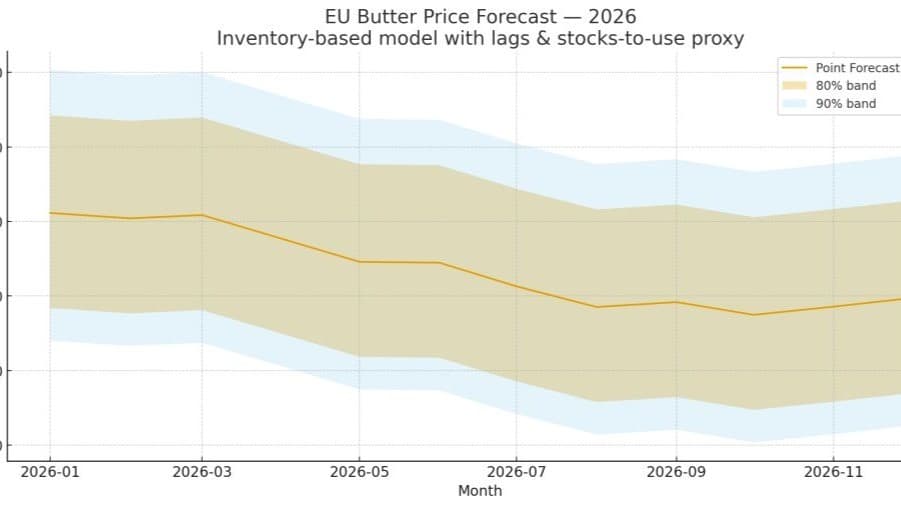
Summer Shopping or Summer Sale?
Last week was again a bit of a bearish week for the entire dairy industry. With cream prices under pressure and milk intake still strong, we keep seeing a market that has more supply than demand. Butter prices took another step lower, cheese prices cracked, and the powder market gave back a bit of its gains again.
El informe semanal
Recíbalo antes de que esté en cualquier otro sitio
Cada informe de mercado, directo a su bandeja de entrada en cuanto se escribe. Mantequilla, queso, polvo, líquidos — elija lo que realmente negocia.
Aproximadamente semanal · Gratis · Baja cuando quiera