Bullish Buts and Bearish Buyers
Los informes de mercado se publican únicamente en inglés. El resto del sitio sí está disponible en su idioma.

Yesterday the market started off very quiet from our side. We spent the entire day repeating the same conversation with all our partners. Most people we speak to have become a lot more bullish than they have been over the last weeks, although most keep adding a big.... but! And even though we like big buts (and we cannot lie) the arguments given are all the same,"What about demand?". Of course, we also still have a few bearish partners who are looking at the market with disbelief. The funny thing remains that most bearish partners all want/need to buy product. So the question remains why they are bearish? Does their market view fit their position as a buyer, or do they really believe that prices will come off again?
At the moment there is only one real argument we hear from our bearish partners, and that is that demand is weak. We have used this argument before as well, but somehow the weaker demand hasn't had the bearish effect on prices we would have expected it to have. Other partners have placed some question marks on the "weaker demand argument". So far data hasn't really shown less consumption in the EU yet, and previous periods of economic headwinds and high prices haven't cut consumption by a lot in those periods. And with a growing world population, the weaker demand argument is still questionable.
But! The biggest but from the bullish partner's side is also linked to the fear of lower demand. Even though they see a more bullish market they have a hard time selling volumes to their customers. It does seem that buyers are better covered forward and that some sectors are performing a bit worse than others. However, overall demand seems to be better than the anecdotal stories made us believe. We do hear that cheese graters who supply the food service have had big pushback from their buyers orders are slowing a bit down, and retail for cheese isn't as booming as in previous Q4 periods. Those who sell premium butter and cheese brands to retail also experience much lower sales, and it's not clear whether the decline in sales on branded products is compensated by the higher sales in private label sales. Those who sell powders on the export markets have fierce competition from the US and NZ and admit they have a hard time selling any product out of the EU further out to SE Asia, China or the Middle East. Only North Africa seems to be buying a bit in the EU for close by, but their appetite has shirked a bit as well.
One of our partners stated: "Sellers tend to look at the demand from their customers, but the real issue is consumption among consumers". His argument is that anecdotal data from single buyers (or even a group of buyers) are a misrepresentation of how the actual consumption is.
The most bullish argument we see is the slowdown in milk production growth year over year. With still a big decline in France and a slowdown in the Netherlands and Germany as well production in Q4 might for the first time this year be lower than the year before. Estimations from our partners differ from a very small plus of 0.2% growth to a decline of more than 1%. We do expect that if commodity prices continue to rise the decline for the next 6 months might be less than some producers are forecasting right now. This could potentially lead to more spot offers in the next months and a bit of pressure on the spot market for liquids.
Once liquids move significantly lower we expect more sellers to come back to the market, especially producers should come back as they have the biggest quantities to sell. We would expect that suppliers will not want to wait for prices for liquids to trade equivalent to the commodity prices as most know that once prices drop significantly from the second half of November the way until February is almost guaranteed. But that said, we might need to wait 3-4 more weeks before we get there, and in the meantime, all commodities might have found their way towards much higher prices.
We know that most of our buyers are always bearish, and most sellers are always bullish. But the fact we have so many bullish people in our network that have nothing to sell (so no advantage of claiming a more bullish market) makes us think the market is more bullish rather than bearish. We do share the concerns about the big buts in the market, but as long as the supply side seems more relaxed than the buyer side we expect prices to keep moving higher. Because with a few buyers and no sellers, the market can only move in one direction.
Más desde la mesa
Our Long View Before Our Long Break 
Our Long View Before Our Long Break
Last week the market found a bit of stability. After lower trades on cheese, the cheese market traded slowly up, although a real rally remains absent. Butter prices did dip a bit further, although at the start of this week we see some strength on the back end of the curve. And on powder, our bullish feeling just doesn't go away — and now we can find some confirmation in the market as well.
Summer Shopping or Summer Sale? 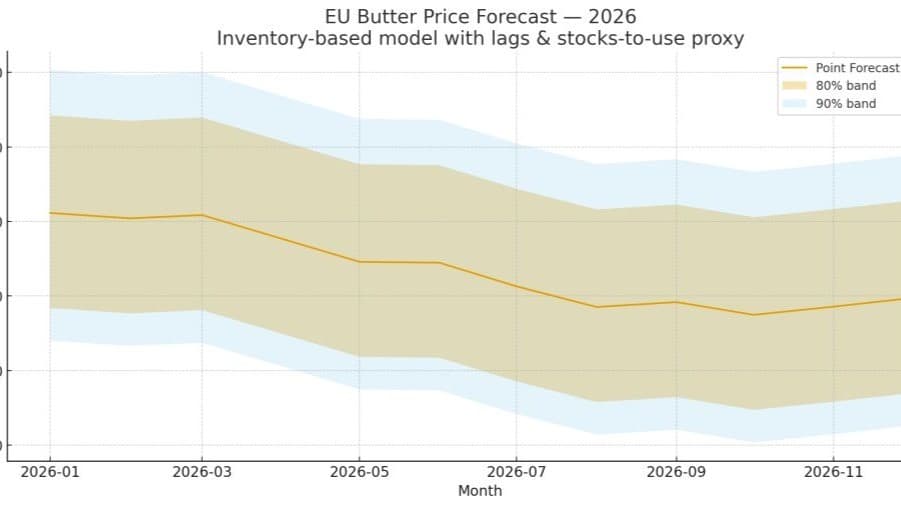
Summer Shopping or Summer Sale?
Last week was again a bit of a bearish week for the entire dairy industry. With cream prices under pressure and milk intake still strong, we keep seeing a market that has more supply than demand. Butter prices took another step lower, cheese prices cracked, and the powder market gave back a bit of its gains again.
The Agro Gravity Effect 
The Agro Gravity Effect
Last week was a strange week from our side. With relatively low activity and a lot of customers on the move due to Eucolait, activity came as quickly as it went away again. Tuesday's GDT put the market on hold, but when the results came out, a bit of downward trading occurred. The same went for Eucolait.
El informe semanal
Recíbalo antes de que esté en cualquier otro sitio
Cada informe de mercado, directo a su bandeja de entrada en cuanto se escribe. Mantequilla, queso, polvo, líquidos — elija lo que realmente negocia.
Aproximadamente semanal · Gratis · Baja cuando quiera