Waiting For Directions
Los informes de mercado se publican únicamente en inglés. El resto del sitio sí está disponible en su idioma.

Last week the market didnt really show much direction. Prices from the beginning of the week of butter and cheese were roughly the same as prices at the end of the week. Only SMP prices slightly improved although demand wasn't overwhelming. Mid-November in the previous years has been a game-changer for the market. Christmas demand peaks while milk collection in easter EU dips. And with Ramadan early this year and Turkey still actively looking, the spread between supply and demand in Europe couldn't be bigger. The big question remains, what happens after this week?
For this week we still expect a tight market for all commodities. We expect to see more buyers in the market (especially for quick collections) and we expect sellers to remain inactive for at least this week (and maybe next week as well). And although the market has been in a big imbalance between buyers and sellers, it always leads to surprising moves every year. A few factors we will be watching this week:
Turkey Demand: Will they accept higher prices?
Turkey has been in the market for the last few weeks, but the shipment period in which they need to ship products (mainly butter) will close soon. It seems early December collections are the latest possibility. We hear negotiations are hard at the moment as prices for butter above € 5300 fca are hard to accept, while offers below that price are even harder to find. We see no reason for sellers to go down in price and therefore believe prices between € 5300 and € 5500 will get accepted and will boost spot prices for butter as well. The increase in price depends on the simultaneous moves on cream
Cream: Can it remain up?
Cream prices usually start to top off and drop in mid-November, taking out the momentum for products with a lot of fat. We haven't found data from previous years where cream prices in December were quoted higher than cream prices in November. Usually, cream tops in the first weeks of November as Christmas production is running at its highest at this point. Most partners therefore expected the previous weeks that creamprices would rally, but as they were already trading roughly € 1000,- above the butter equivalent it seems the increase was not needed. But even if cream prices would drop back € 1000,- in the next week(s) pressure on butter prices is not expected directly, or at least not due to higher butter production. Cream at € 6000,- still gives a better valorization than producing butter. Only when cream prices would drop back quickly below € 6000,- we expect butter production to increase and prices to drop. The psychological effect of dropping cream prices might influence the butter price quicker as we know sentiment sometimes is a stronger driver than fundament.
Ramadan orders: Can it create an end-of-year rally?
Ramadan starts this year at the beginning of March, and therefore most product needed for Ramadan production needs to arrive in February latest. We expect the final shipments will need to be made between now and mid-January. Some of our partners expect an end-of-year rally as it seems a lot of buying remains to be done. Europe seems to be the preferred supplier for the product.
Milk collection Deficit YoY: bullish sentiment
We have already seen it in the previous weeks, but it started to impact the sentiment more and more. Reported milk collection numbers for this year are in a negative territory YoY. With milk prices above 60ct last year milk production exploded in Q4 in most countries posting the best milk results in years. This year with a milk price between 40ct and 43ct producers are not as enthusiastic as they were a year ago. Therefore milk production is dropping below last year's numbers creating a bullish sentiment among producers. We agree that less milk should normally lead to higher commodity prices, but we are a bit on the fence this year for two reasons.
- milk collection might be down on last year, its up on the year before and in a lot of countries still up on the five-year average. Reported solids are quite ok creating a smaller deficit YoY than the headline numbers suggest. In addition, we think the good grass season and relatively low feed prices v.s. an increasing milk price will still create a positive scenario for milk production.
- demand usually increases every year, therefore less milk is always bullish. But with all the feedback we have been getting over the last months, it seems consumption is down. We know this is a hot discussion topic and there are plenty of partners who don't agree on the "lower demand" take. But the high prices of earlier this year ( cheese prices above € 5000,- and butter prices above € 7000 and SMP prices above € 4000 ) the hit on demand has already been taken earlier this year. Even though prices have come down, retail prices have only in recent months started to correct down. But lost consumption is hard to get back and will take time. The effects might only be visible in Q1-2 this year. In addition, we think the fear of a recession will continue to negatively impact consumption in the next year.
Overall, there are still plenty of moving parts in the market that can trigger a price rally or a sell-off. We therefore think the start of the weak will be as cautious as the end of last week. Partners are ready to jump on any train, they just want to see the train take a certain direction so they can follow. Happy Trading to all this week!
Más desde la mesa
Our Long View Before Our Long Break 
Our Long View Before Our Long Break
Last week the market found a bit of stability. After lower trades on cheese, the cheese market traded slowly up, although a real rally remains absent. Butter prices did dip a bit further, although at the start of this week we see some strength on the back end of the curve. And on powder, our bullish feeling just doesn't go away — and now we can find some confirmation in the market as well.
Dairy Carry Has a Shelf Life 
Dairy Carry Has a Shelf Life
Last week was bearish across the board — every product we broker leaned the wrong way. Powders lost more momentum, cheese slipped well below €3,000 for some products, and butter continues to impress with just how much keeps showing up. Supply, supply, supply.
Summer Shopping or Summer Sale? 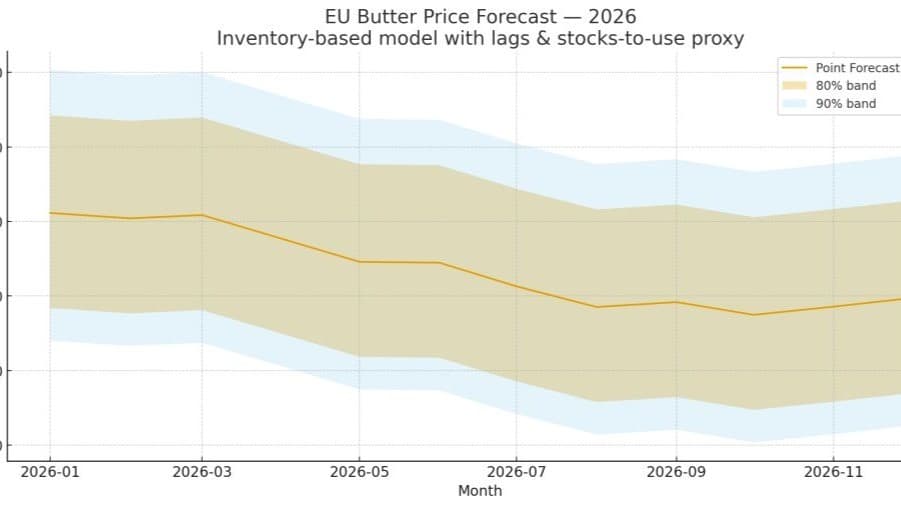
Summer Shopping or Summer Sale?
Last week was again a bit of a bearish week for the entire dairy industry. With cream prices under pressure and milk intake still strong, we keep seeing a market that has more supply than demand. Butter prices took another step lower, cheese prices cracked, and the powder market gave back a bit of its gains again.
El informe semanal
Recíbalo antes de que esté en cualquier otro sitio
Cada informe de mercado, directo a su bandeja de entrada en cuanto se escribe. Mantequilla, queso, polvo, líquidos — elija lo que realmente negocia.
Aproximadamente semanal · Gratis · Baja cuando quiera