Trump’s Tariffs Take Their Toll
Los informes de mercado se publican únicamente en inglés. El resto del sitio sí está disponible en su idioma.

We’re now just one day into the new world where Trump’s latest round of tariffs is beginning to shake the foundations of the world wide trade. And already, the market reaction is telling. Global commodity sentiment has turned bearish. Oil prices have plummeted by more than 7%, and most major commodities are following suit. Simultaneously, the USD is weakening against the Euro, and global stock markets are diving. The Dow Jones and S&P 500 are both down nearly 4% at the time of writing, and several other indices are faring even worse. The ripple effect is global—everyone is feeling the sting. The U.S. has now slapped a blanket 20% import duty on all EU-origin products. It's still early days, and it's difficult to quantify the exact impact on the EU dairy market after just 24 hours—but the initial tone is unmistakably bearish.
Currency Shifts: A Rapid Slide
One of the easier and more immediate consequences to track is the FX shift. The USD has weakened noticeably against the Euro. We’ve gone from roughly 1.08 to 1.108, after even touching 1.114 earlier today. For the EU SMP market, where export deals were already a tough sell, this move just tightened the screws further.But it's not just about the Euro. Inside the EU, we’re seeing shifts too. The Polish Zloty weakened from 4.16 to 4.23 against the Euro. On an average butter contract, that’s a price shift of over 10 euro cents—just due to FX. While this won’t immediately disrupt internal supply and demand dynamics, it’s a different story for products that rely on exports. A 3–4% currency move has a big impact in those cases.
Demand Under Pressure
The bigger question mark lies with demand. It’s harder to see immediate changes in EU dairy demand, but the concern isn’t internal—it’s external. The economies of our major trade partners are taking hits, and with that comes a justified concern over their continued buying appetite. Countries that rely heavily on oil revenues, for instance, are about to feel the pinch. There's a reason we often see long-term correlations between oil prices and dairy. In fact, many of our partners are worse off than the EU. China, Vietnam, Taiwan, South Korea, and Japan are all facing even steeper tariffs. If the U.S. follows through on its threat to increase duties for countries that retaliate, we're looking at the full playbook of a classic trade war. And historically? Trade wars have never exactly been bullish for commodities.
Tariff Anticipation Already Played Out
Interestingly, some effects were already baked in. For instance, EU butter exports to the U.S. were unusually high over the past five months. The same goes for Italian cheese—Grana Padano prices have been sky-high, largely due to tight stock levels. It now seems that some exporters were front-running the tariffs and quietly placing volumes in the U.S. pre-emptively. That’s likely what kept the market tight, but with the tariffs now in place, that demand will vanish—and the tightness with it. Stock building should now accelerate.
More Product, Fewer Buyers
Let’s not forget why the U.S. is doing all this. President Trump isn’t aiming to be the world’s biggest buyer anymore—he wants to be the world’s biggest producer. But if the largest dairy-consuming nation starts buying less, sellers will need to find new markets—and fast. Curiously, it’s not like the U.S. has been a bad dairy partner. In 2024 alone, the U.S. exported about five times more dairy than it imported. If buyers retaliate with tariffs on U.S. dairy, the impact will ricochet back to U.S. producers, further depressing global prices.
Overall Sentiment: Bearish
The overall sentiment? Deeply bearish. Sure, a few optimistic voices still point to tight supply as a price support. And yes, we agree—if supply remains tight, prices can hold. But currently, we don’t see that tightness materializing. Speaking to German producers its seems they all have the same talking points; bluetonge, droughts and tight stocks. We dont just want to dismiss these arguments, but they belong in the *if this, than that* collum.
Global supply seems robust. Milk volumes is some countries are (slightly) down, but milk solids are up. The world is producing more milk from fewer cows—an efficiency story. But once we hit peak productivity per cow, supply might struggle to keep pace with longer-term demand growth.
In the near term though? Markets—especially in the EU—feel heavy.
In summary:
- Global demand expected to slow due to trade war
- EU weakened by a softer dollar
- Exports to the U.S. now significantly curtailed
- Internal EU demand also dampened due to external exposure
- Market uncertainty is freezing forward buying activity
Butter: A Buyer’s Market Emerges
The EU butter market is shifting. What’s been a tight market for months is now seeing sellers outnumber buyers. While there’s still some tightness for nearby deliveries, post-week 15, things begin to loosen rapidly. Stocks are expected to build, and sentiment is turning with it.
In Eastern Europe, strong retail demand keeps cream prices elevated, but the underlying commodity prices are weakening. We’re seeing sellers for sweet cream around €7,200, while buyers hover just above €7,000. In Ireland, May–June offers are at €7,150 FCA, but buyers have stepped back to €7,050. NL/DE/BE producers are now offering around €7,300, with trades even concluded at €7,200 for April. H2 offers will need to come down sooner rather than later.
End users have largely locked in their Q2 needs—and many have already forward-covered Q3 and Q4. They now seem content to sit on their hands, waiting for prices to return to their comfort zone: €6,800–€7,000. That’s where we expect the market to find support. Until then? A slow, steady slide.
Meanwhile, on the CME, prices keep declining. EU buyers who were initially keen on cheaper U.S. butter are now hesitant, unsure whether retaliatory tariffs could target U.S. dairy in return.
We offer:
- 4 trucks Irish butter May at €7,225 FCA NL
- 6 trucks Irish butter May–June at €7,150 FCA IE
- 6 trucks Irish butter Q3 at €7,150 FCA IE
- 6 trucks NL/DE/BE butter Q3 at €7,200
- 5 trucks frozen Arla DK/SE butter April at €7,270
- 4 trucks Polish sweet cream April at €7,175
We have buyers for:
- 4 trucks Irish butter May at €7,150 FCA NL
- 6 trucks Irish butter May–June at €7,050 FCA IE
- 6 trucks Irish butter Q3 at €7,050 FCA IE
- 6 trucks NL/DE/BE butter Q3 at €7,075
- 2 trucks frozen Arla DK/SE butter April at €7,150
- 3 trucks Polish sweet cream April at €7,075
Powder: All Eyes on Sellers
Cheese? No major action this week—so let’s skip straight to powder. The powder market has been mostly quiet. A strange GDT result sparked a short-lived push by sellers to raise prices, but it didn’t stick. We’re seeing weaker SMC trades, more barriers for EU exports, and not much to indicate a turnaround anytime soon. Those more bullish on SMP point towards chances for EU producers to sell more powders to countries who now buy US product. Many countries are expected to retaliate with higher import tariffs. The question is, those countries reliant on US dairy products, will they impose sharper dairy import prices. For countries without internal dairy production that seems unlikely from our side.
Yes, CME prices had shown a modest recovery in the past couple of weeks—but the latest signals are again bearish. If U.S. prices fall further and the USD stays weak, EU sellers will likely need to price below €2,400 to remain competitive and attract buyers.
We have an offer for
- 100-150mt of Irish smp at € 2380 FCA IE
- 200mt of Uelzena sp at € 2425 FCA DE
- 300mt EU codex at € 2400 fca NL
Más desde la mesa
Our Long View Before Our Long Break 
Our Long View Before Our Long Break
Last week the market found a bit of stability. After lower trades on cheese, the cheese market traded slowly up, although a real rally remains absent. Butter prices did dip a bit further, although at the start of this week we see some strength on the back end of the curve. And on powder, our bullish feeling just doesn't go away — and now we can find some confirmation in the market as well.
Dairy Carry Has a Shelf Life 
Dairy Carry Has a Shelf Life
Last week was bearish across the board — every product we broker leaned the wrong way. Powders lost more momentum, cheese slipped well below €3,000 for some products, and butter continues to impress with just how much keeps showing up. Supply, supply, supply.
Summer Shopping or Summer Sale? 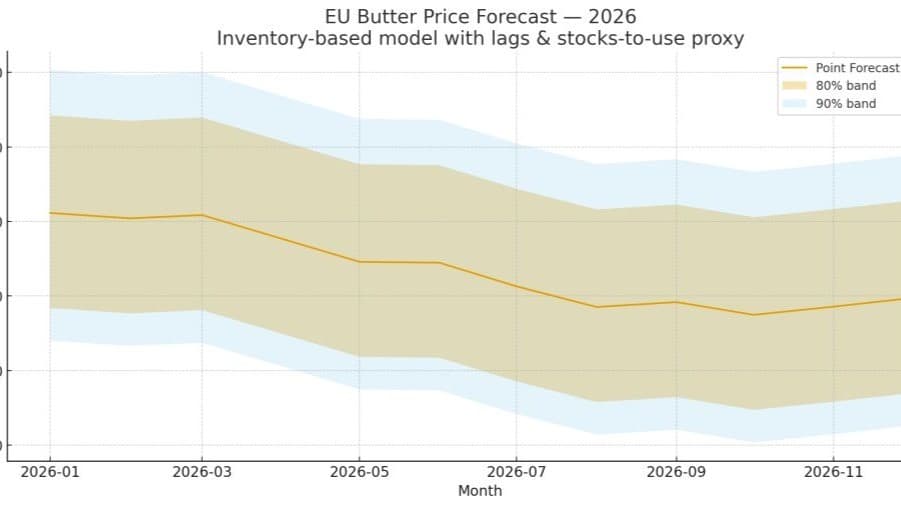
Summer Shopping or Summer Sale?
Last week was again a bit of a bearish week for the entire dairy industry. With cream prices under pressure and milk intake still strong, we keep seeing a market that has more supply than demand. Butter prices took another step lower, cheese prices cracked, and the powder market gave back a bit of its gains again.
El informe semanal
Recíbalo antes de que esté en cualquier otro sitio
Cada informe de mercado, directo a su bandeja de entrada en cuanto se escribe. Mantequilla, queso, polvo, líquidos — elija lo que realmente negocia.
Aproximadamente semanal · Gratis · Baja cuando quiera