The Expensive East and the Weaker West
Los informes de mercado se publican únicamente en inglés. El resto del sitio sí está disponible en su idioma.

The market yesterday showed a bit more activity. It remains difficult to conclude business, but we see that partners are nearing each other a bit more. The overall conclusion seems to be that market prices will remain stable as long as there are no major events in the market. The only thing that does raise a bit of attention is the rising prices in the east of Europe.
Prices in Eastern Europe for the last months have consistently traded at the same level or even at a premium v.s. Western EU product. In the past Eastern EU products always traded with a firm discount compared to Western EU products and that gap got smaller over the last years. As quality improved and internal demand grew as well, the price discount grew smaller each year. But now we see that prices in Poland, and Lituany are more often trading above western EU prices. This is while milk production in the eastern part of the EU is also still rising. Poland has roughly 1.5-2% more milk compared to last year, we would have expected a bit more pressure on their stocks.
Speaking to partners who are located in Eastern Europe, we aren't getting simple answers, most of them also don't seem to understand the change in prices themselves. Butter at the moment is trading for first-class Polish product around € 4500 while Western EU product is available roughly €250 cheaper. Gouda and Mozzarella are also roughly € 100-200,- more expensive compared to NL/DE origin and powders are even offered roughly € 300-€400 above Western EU prices. The question remains if the dairies are having any sales at these prices. Because unless you are committed to Eastern EU products, buyers could find a much cheaper alternative in the west of Europe.
The fact that Eastern Europe isn't producing discounted products should give the producers in Western Europe a bit more time to hold their sales. Normally it's cheap product from Ireland or Poland that is dragging commodity prices down. But with Irish milk production still lagging last years and Eastern European prices well above those of Western EU partners it seems the biggest threat to lower prices comes from Holland, Denmark, Germany and France.
Its offers from French SMP producers, Danish cheese producers and German butter producers that is pushing commodity prices down in Western Europe. Sure cheaper material from Ireland is also available, but this mainly seems to come from traders, not so much producers. And although most of our partners expect Irish products to come to the market in Q4, we haven't seen the producers calling us to help them with their surpluses.
Más desde la mesa
Our Long View Before Our Long Break 
Our Long View Before Our Long Break
Last week the market found a bit of stability. After lower trades on cheese, the cheese market traded slowly up, although a real rally remains absent. Butter prices did dip a bit further, although at the start of this week we see some strength on the back end of the curve. And on powder, our bullish feeling just doesn't go away — and now we can find some confirmation in the market as well.
Summer Shopping or Summer Sale? 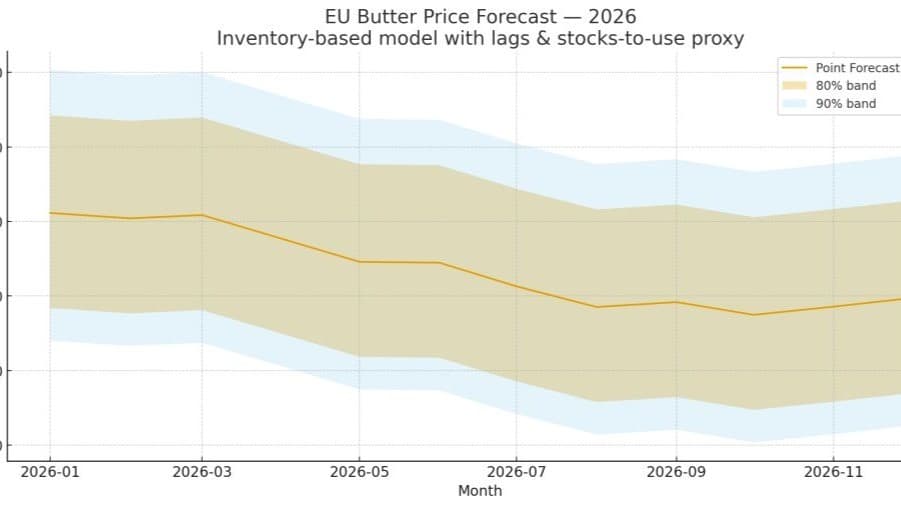
Summer Shopping or Summer Sale?
Last week was again a bit of a bearish week for the entire dairy industry. With cream prices under pressure and milk intake still strong, we keep seeing a market that has more supply than demand. Butter prices took another step lower, cheese prices cracked, and the powder market gave back a bit of its gains again.
The Agro Gravity Effect 
The Agro Gravity Effect
Last week was a strange week from our side. With relatively low activity and a lot of customers on the move due to Eucolait, activity came as quickly as it went away again. Tuesday's GDT put the market on hold, but when the results came out, a bit of downward trading occurred. The same went for Eucolait.
El informe semanal
Recíbalo antes de que esté en cualquier otro sitio
Cada informe de mercado, directo a su bandeja de entrada en cuanto se escribe. Mantequilla, queso, polvo, líquidos — elija lo que realmente negocia.
Aproximadamente semanal · Gratis · Baja cuando quiera