

Structural Changes or Season Pressure?
Los informes de mercado se publican únicamente en inglés. El resto del sitio sí está disponible en su idioma.

Last week was one of the busiest trading weeks of the year so far in terms of brokering volumes—though let’s be honest, it was really just one product stealing the spotlight. Cheese and powders meandered along without much enthusiasm, while butter took another step down. The increasing pressure on producers, combined with buyers eager to secure deals at slightly lower levels, created the ideal conditions for the market to meet in the middle. Looking at our numbers, we expect this activity to persist. The real question is: will cheese and powders follow suit? Most of our counterparts seem to be searching for that answer in Dubai this week. Meanwhile, we’re stuck under the familiar grey Dutch skies—no sunshine, no rooftop cocktails, and no breathtaking skylines. But rest assured, we’ll stay tuned to the latest sentiment our partners bring back.
Looking back at last week, it was, yet again, a "butter" week. Over 2,000 mt of butter changed hands via us, with seasonal milk growth piling more pressure on producers to start moving product. At the same time, buyers showed no hesitation in picking up these offers, with prices just below €7,000 fitting their budgets perfectly. This dynamic explains the high trading volumes—not just with us, but also among producers and traders, all reporting exceptionally strong sales. Looking ahead, we anticipate more of the same. Cream prices could push a little harder in February and March, but we expect buyers for Q2, Q3, and Q4 to keep interest steady, providing a solid floor for butter prices. However, if demand for February and March continues to fade faster than new offers emerge, we could see further downward corrections.
As for the other products we broker, we expect (or at least hope) that activity picks up soon. The cheese market, in particular, seems poised for a sprint. Around this time last year, activity surged at Gulfood when the market realized it was significantly undersupplied. Given recent trends, we wouldn't be surprised to see a similar pattern in cheese. Production appears to have picked up slightly—Germany reported a 5% increase in week 6 compared to last year—which means additional supply should start showing up soon. Meanwhile, our export-focused partners foresee a slowdown in EU cheese exports, as US and Oceania-origin cheese is coming in cheaper than EU product. Internal demand remains cautious, with buyers hesitant to commit too far ahead due to uncertain forecasts.
On the powder side, the bulls and bears we’ve been debating with all seem to agree on one thing: stability. The weaker US dollar is making it increasingly difficult for EU sellers to capitalize on price advantages, and we’re hearing more reports of US product surfacing in Southeast Asia. At the same time, producers are still trying to clear March offers, while buyers are looking more toward Q2 and Q3. Last week’s GDT Pulse showed SMP price growth slowing, while WMP saw another solid increase. However, when compared to the last full GDT event, the bullish momentum appears to be losing steam. If EU exports slow down, SMP prices could easily slide back toward the lower end of their long-term downtrend.
GDT: Bears Making a Comeback?
Looking ahead to the GDT, we suspect the bears might be sharpening their claws. Butter futures are looking weaker, and we anticipate that EU Solarec product will trade significantly lower than in the previous event. Adding to the competition, US-origin butter(82%) has been popping up in multiple offers at prices between $6,350 and $6,500 CFR, pretty much anywhere in the world. Since US butter typically doesn’t venture into export markets, it might take some time for those channels to fully activate. But for buyers willing to switch, the EU and NZ now have a fresh competitor to contend with. AMF on the GDT is likely to tick slightly higher again, but we’re skeptical it will close the gap to butter.
As for powders, both SMP and WMP are expected to trade slightly lower. WMP looks overdue for a correction, and SMP faces increasing pressure from both EU and US competition. That said, we don’t expect a major drop—just a minor adjustment. And when it comes to Mozzarella, let’s just say we wouldn’t be shocked by another stable outcome. Overall, we anticipate this week’s GDT will lean bearish, with prices slipping 1–2% compared to the last event. And who knows—perhaps that will be enough to nudge sentiment at Gulfood in a slightly more bearish direction.
Butter: Going into contango
After months of backwardation, the market finally appears to be shifting back into contango. Prices for Q3 and Q4 are now trading higher than Q2, and the premium buyers have been paying for February and March over Q2 is evaporating fast. Polish butter is already seeing lower prices for nearby delivery compared to later periods, and we expect a similar trend to develop for NL/DE/BE butter. The only exception might be Irish butter for March, as stocks remain low and aren't expected to build until April.
Our overall view on butter remains bearish. By the end of last week, cream prices had slipped below €8,000, and we’d be genuinely surprised if they manage to stay above that level in the coming weeks. With cream prices dipping towards €7,500, we should start seeing more pressure on sellers, particularly in Eastern Europe. The silver lining? Solid end-user demand for butter in the €6,700–€6,900 DAP range for Q2, Q3, and Q4. As long as these buyers remain active (and they will), we expect a firm price floor for February and March between €6,400 and €6,500.
One persistent bearish signal is the availability of cheaper US butter as said we can offer significant volumes at $ 6400 CFR EU or Asia. If that trend continues to weigh on NZ butter prices, EU exporters shouldn’t hold their breath for major export opportunities. And just to keep things interesting, Trump is once again making noise about tariffs, likely targeting EU dairy from April onward (though he hasn’t explicitly spelled it out yet). Our Irish partners, who move 30,000–40,000 mt annually, will have some strategizing to do.
Cheese: Weaker fat prices are pushing expectations down
As for cheese, the spread between buyers and sellers over the last few weeks has been holding at roughly €150, with neither side feeling an urgent need to move. Buyers are in no rush to buy, and while sellers have been equally patient, pressure has been slowly building. Looking at February volumes, we still see some supply available, but buyer activity has been notably quiet. Cheese production has been up year-over-year for the past three weeks (at least in Germany), and these additional volumes should start to (slightly) impact the supply-demand balance soon.
We also have several partners who specialize in cheese exports. As one put it, "It’s not that we’re losing volume in every market, but our export buyers now have more alternative sources. While we’ve been pushing prices higher alongside our European producers, we’ve either had to backtrack or risk losing sales to other production regions." He went on to point out that with weaker butter prices and still relatively high whey prices, he expects more milk to be directed into cheese production—potentially leading to slightly lower prices in the coming months.
That being said, our longer-term outlook on cheese isn’t all that bearish. Demand remains strong, and we expect it to hold firm throughout the year. However, as we approach the EU peak, we may see some seasonal pressure on prices—similar to what’s happening in the butter market.
Powders: A Weaker dollar means weaker prices
As for powders, last week we continued to see relatively strong demand for non-standardized SMP around the €2,400 level. Buyers seem convinced that at these levels, it’s a safe bet. However, sellers remain firm at €2,550, with ample volume still available. This gap reflects the market’s confidence that, barring any major supply chain disruptions, the powder market remains well-balanced.
While we’re not particularly bullish on this week’s GDT results, we also don’t expect a complete collapse. As Oceania winds down its production season, the EU remains an attractive sourcing option. The biggest threat to EU powder prices? A highly volatile USD. Leading up to Trump’s inauguration, the USD gained strength, but the effect has been short-lived. Those more familiar with the US market suggest that it is in Trump’s best interest to weaken the USD to boost exports. And if there’s one thing we’ve learned, it’s that when he wants something, he finds a way to get it—more often than not. A weaker USD would mean ongoing pressure on EU prices, in our view.
Más desde la mesa
Our Long View Before Our Long Break 
Our Long View Before Our Long Break
Last week the market found a bit of stability. After lower trades on cheese, the cheese market traded slowly up, although a real rally remains absent. Butter prices did dip a bit further, although at the start of this week we see some strength on the back end of the curve. And on powder, our bullish feeling just doesn't go away — and now we can find some confirmation in the market as well.
Dairy Carry Has a Shelf Life 
Dairy Carry Has a Shelf Life
Last week was bearish across the board — every product we broker leaned the wrong way. Powders lost more momentum, cheese slipped well below €3,000 for some products, and butter continues to impress with just how much keeps showing up. Supply, supply, supply.
Summer Shopping or Summer Sale? 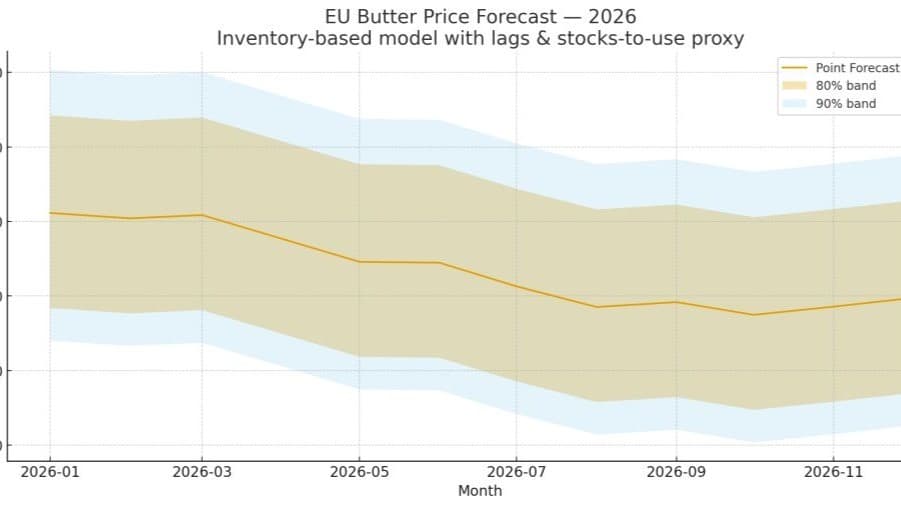
Summer Shopping or Summer Sale?
Last week was again a bit of a bearish week for the entire dairy industry. With cream prices under pressure and milk intake still strong, we keep seeing a market that has more supply than demand. Butter prices took another step lower, cheese prices cracked, and the powder market gave back a bit of its gains again.
El informe semanal
Recíbalo antes de que esté en cualquier otro sitio
Cada informe de mercado, directo a su bandeja de entrada en cuanto se escribe. Mantequilla, queso, polvo, líquidos — elija lo que realmente negocia.
Aproximadamente semanal · Gratis · Baja cuando quiera