Last Update of 2022
Los informes de mercado se publican únicamente en inglés. El resto del sitio sí está disponible en su idioma.

After writing many updates over the last few months, today's update will be the last update of 2022. We are writing the updates with great pleasure, but it remains a time-consuming effort. We expect the markets to calm down a bit towards the end of the year, and we think the tone of our updates will remain the same, bearish! For the next three weeks, we will still be here to help everyone out with their demands and offers, and we will be closing our business between the 10th of December and the 2nd of January.
But we are closing with the last update about 2022 with a final view from our side for the weeks to come. Yesterday again was a bearish day with lower trades for butter, smp and cheese. But what are the biggest factors to watch over the next 6 weeks?
The Milkintake
Yesterday we saw the latest number for the French, German and UK milk intake. France is ahead compared to last year 1.6% and Germany and the UK are up 3.1%. We see that milk intake keeps growing quickly, helped by the softer weather and the high milk price. We hear some co-ops are experiencing a 5% plus compared to last year and in Ireland, some Co-ops that should see the milk intake dry up around this time of year are still seeing a steady milk intake. If the milk intake continues to grow towards 5% it means that a lot of co-ops will need to push out a lot more commodities.
The Export Markets
The EU needs the export markets to balance their excess milk intake, and with such a rapid increase we might need it harder than ever. But at the moment NZ and the US are in strong competition for those markets that are still showing some steady demand. The strength of the USD will have a big impact on our export position. NZ and US milk intake also seems to be increasing at the moment, so these regions will need to export their excess commodities just like the US. The fight for export demand might add more volatility to the market. And where in the previous year high transport prices (especially container prices at $ 12000-14000,-) were making exports from the US extremely expensive, now we see these prices back to the long-term average price of $ 2000,- a container
Internal demand
"Retail sales are strong!" It is one of the most heard responses from producers to keep their sales price high. But the latest numbers we hear are indicating that demand is starting to slow down. Orders are getting pushed towards the new year and new orders are put on hold. Maybe the Christmas demand will be still ok (people want to celebrate in these dark times, and we haven't had a normal Christmas in the last two years. But after Christmas, we fear EU demand will be weak. Several of our partners are confirming us that they are still waiting for their regular customers to come to them. Either they are postponing unusually long, or their demand has been decreasing much faster.
Claims and Cancelations
One of the biggest indicators of a bearish market is the number of claims and cancellations. In bearish markets, we see much more claims than in bullish markets. There are several reasons for this. Because of the higher availability of products, some products age, and therefore might lose a bit of quality. This is mainly the case for cheese as some cheese needs to be processed within 7-21 days. But when prices go down as fast as we are seeing in this market, the gap between purchased prices and spot prices can be up to € 2000,- per mt (€ 44.000,- per truckload), leading to renegotiations and cancellations.
Spot price liquids
And last but not least the price of spot milk is one we would follow closely. The price for spot milk has been holding the market steady over the last weeks, but we expect this market to break in the upcoming weeks. Once prices for SMC, Cream and raw milk start to go down, this can go down fast. We remember markets where in 2017 the price of cream lost about € 2000,- per mt in the period of 2 weeks. Once demand is gone, these markets are extremely volatile and a great indicator for what will happen for the market in Q1 (and Q2).
So for now we would like to thank you for reading our updates this year. We have counted, and we wrote more than 200 updates. Next year we will be trying to write a few more ;). For now, we wish all our readers who we don't talk to on a daily basis a warm and healthy holiday season, good luck with the trading strategies for the weeks that will follow and we hope to see all of you back in 2023.
Have a good day, happy trading and Bey Bey!
Más desde la mesa
Our Long View Before Our Long Break 
Our Long View Before Our Long Break
Last week the market found a bit of stability. After lower trades on cheese, the cheese market traded slowly up, although a real rally remains absent. Butter prices did dip a bit further, although at the start of this week we see some strength on the back end of the curve. And on powder, our bullish feeling just doesn't go away — and now we can find some confirmation in the market as well.
Dairy Carry Has a Shelf Life 
Dairy Carry Has a Shelf Life
Last week was bearish across the board — every product we broker leaned the wrong way. Powders lost more momentum, cheese slipped well below €3,000 for some products, and butter continues to impress with just how much keeps showing up. Supply, supply, supply.
Summer Shopping or Summer Sale? 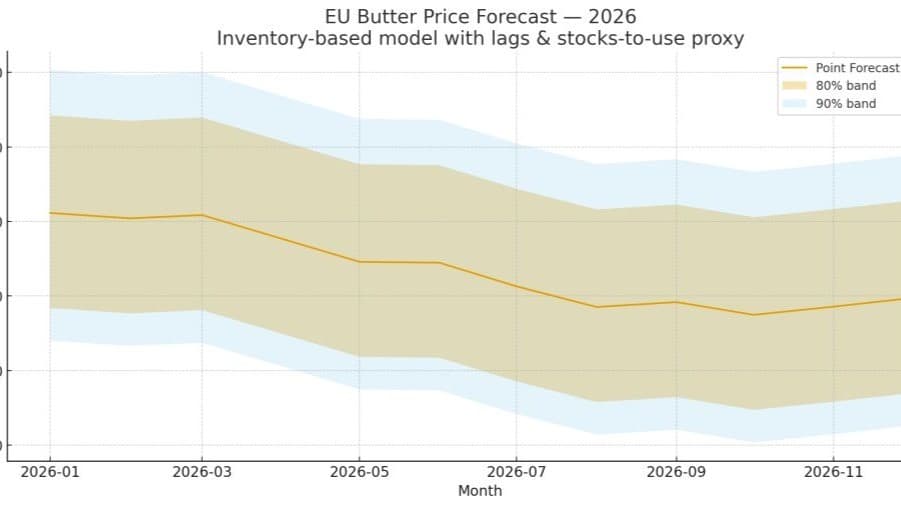
Summer Shopping or Summer Sale?
Last week was again a bit of a bearish week for the entire dairy industry. With cream prices under pressure and milk intake still strong, we keep seeing a market that has more supply than demand. Butter prices took another step lower, cheese prices cracked, and the powder market gave back a bit of its gains again.
El informe semanal
Recíbalo antes de que esté en cualquier otro sitio
Cada informe de mercado, directo a su bandeja de entrada en cuanto se escribe. Mantequilla, queso, polvo, líquidos — elija lo que realmente negocia.
Aproximadamente semanal · Gratis · Baja cuando quiera