Between Tight Supply and Rising Milk
Los informes de mercado se publican únicamente en inglés. El resto del sitio sí está disponible en su idioma.

Last week, the market took a slightly more bearish turn. Still, the true bears argue we haven't seen a real correction yet. Meanwhile, short-term tightness—lingering since August—hasn't fully disappeared, giving bulls confidence that high prices could stick around. With Easter only three weeks away and the flush season shaping up strong, the stage is set for some dynamic weeks ahead. Excellent weather across Western Europe should start reflecting in milk volumes soon. On April 1st, we have the next GDT tender, and the following day, the US president is expected to clarify his stance on tariffs against EU partners. Plenty to unpack.
US Tariffs: Uncertainty Meets Preparation
While we can't predict if, how fast, or on which products new US tariffs will land, it seems clear they would reduce trade flows between the EU and the US. Many EU producers—dairy and beyond—appear to have anticipated this. Stock has been built up across the Atlantic to buffer the initial disruption. This likely explains the prolonged market tightness we've seen. But if exports slow down, EU inventories can start building faster.
More stock in the US, less in the EU—for now.
Stocks: Prompt Still Tight, But Pressure Building
We still face low availability for certain prompt deliveries, especially Irish butter on the continent. German and Dutch brands remain tight too. Poland is beginning to show more stock, with improved availability for prompt deliveries across most origins. On the cheese side, Mozzarella is easing, and Gouda and Edam are slowly following suggesting a bit more availability for closeby. What felt like extreme tightness three weeks ago is beginning to give way to slight downward pressure.
Milk Volumes on the Rise
The price pressure largely comes from production. Milk volumes are improving across the EU. Some countries still show year-on-year deficits, but overall, the bloc is now producing more than last year. Germany is recovering, France is catching up, and with higher solids nearly everywhere, commodity production is expected to pick up fast.
Spot prices for raw milk are under pressure. Producers are starting to reconsider their liquid contracts as their conservative forecasts—fueled by fears of bluetongue and declining cow numbers—may have been too cautious. Cream prices are still firm this week at €8600-€8700, but longer-term contracts for April-May are already being made below €8500. With favorable weather, further pressure on milk markets seems likely.
GDT Expectations: Mild Correction Ahead
We expect a slightly bearish GDT outcome. US butter and SMP/NFDM are applying competitive pressure. SMP and WMP prices are likely to correct between 0.5% and 2%. EU Butter may settle between €7300 and €7400 in Q2, with April possibly trading slightly above. NZ butter continues to outperform our expectations, while AMF lags—we still expect a likely correction in both directions. On mozzarella, we expect a 3-4% correction. Overall, we see the GDT tender finishing between -1% and -2%.
FMD: Monitoring the Spread
Foot-and-mouth disease continues to spread in Slovakia and Hungary, though it remains concentrated in a relatively small area. We’re watching developments closely and will provide updates as they emerge.
Butter: Bearish Signals, Persistent Tightness
The butter market shows mixed signals. High prices, slower demand, rising production, slower exports, and increased imports all point to a bearish trend. Yet, buyers still outnumber sellers, and stocks remain low. Prompt buyers will still need to pay upwards of €7300, but those with time can afford to wait. With peak EU butter production at 5500 MT/day—and higher from April to July—even 2-3 weeks of lower sales can flip the market from deficit to surplus quickly.
Cream price movement will likely be the key trigger for a further price slide, but this week might be too early. We expect last week’s prices to hold briefly.
Butter Market Levels
Sellers
- 6 trucks Irish butter Q3 at €7300
- 6 trucks Irish butter May-June at €7350
- 6 trucks Polish Sweet Cream butter April at €7300
- 6 trucks Polish Sweet Cream butter Q2 at €7250
- 6 trucks NL/DE/BE butter Q3 at €7300
Buyers
- 6 trucks Irish butter Q3 at €7100
- 6 trucks Irish butter May-June at €7150
- 6 trucks Polish Sweet Cream butter April at €7100
- 6 trucks Polish Sweet Cream butter Q2 at €7050
- 6 trucks NL/DE/BE butter Q3 at €7200
Cheese: Easing Into Softer Terrain
More sellers entered the cheese market last week. Mozzarella—due to its short shelf life—is seeing price pressure first. Gouda and Edam are starting to follow. Most sellers still hope for last-minute April buyers, while demand is shifting toward May and June.
Forwards remain tricky: sellers want premiums, buyers want discounts. Cheese pricing often mirrors butter trends, and with a bearish butter outlook, cheese is likely to soften too.
Buyer Interest
- 4 trucks Mozzarella for April at €4150
- 6 trucks Gouda 48% Q2 at €4225
- 2 trucks Gouda 48% April at €4250
Powders: Calm Before the Correction?
The powder market starts the week quietly. Sentiment from CME and NZX isn't bullish. Within the EU, demand is sluggish above €2400. While stock levels aren't alarming yet, slowing exports and domestic demand during peak season could trigger a correction. Without strong export support, EU buyers may need to stabilize the market—we would expect them to build a floor around the €2100 mark. Should GDT results come in surprisingly bearish, current EU prices between €2350-€2400 may not hold for long.
Conclusion
The dairy market stands at a crossroads: increasing milk volumes and cautious buyers are setting the stage for a softer tone, but persistent tightness in some segments and global uncertainty keep volatility high. With flush season and trade policy shifts ahead, agility will be key.
This is a moment to stay sharp, stay close to the data, and act with timing rather than impulse.
Más desde la mesa
Our Long View Before Our Long Break 
Our Long View Before Our Long Break
Last week the market found a bit of stability. After lower trades on cheese, the cheese market traded slowly up, although a real rally remains absent. Butter prices did dip a bit further, although at the start of this week we see some strength on the back end of the curve. And on powder, our bullish feeling just doesn't go away — and now we can find some confirmation in the market as well.
Dairy Carry Has a Shelf Life 
Dairy Carry Has a Shelf Life
Last week was bearish across the board — every product we broker leaned the wrong way. Powders lost more momentum, cheese slipped well below €3,000 for some products, and butter continues to impress with just how much keeps showing up. Supply, supply, supply.
Summer Shopping or Summer Sale? 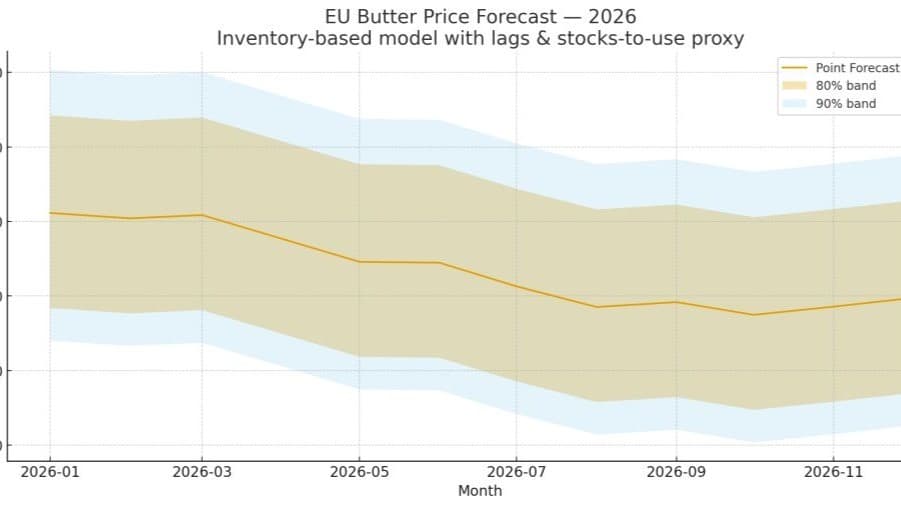
Summer Shopping or Summer Sale?
Last week was again a bit of a bearish week for the entire dairy industry. With cream prices under pressure and milk intake still strong, we keep seeing a market that has more supply than demand. Butter prices took another step lower, cheese prices cracked, and the powder market gave back a bit of its gains again.
El informe semanal
Recíbalo antes de que esté en cualquier otro sitio
Cada informe de mercado, directo a su bandeja de entrada en cuanto se escribe. Mantequilla, queso, polvo, líquidos — elija lo que realmente negocia.
Aproximadamente semanal · Gratis · Baja cuando quiera