Bears Break the Butter Market
Los informes de mercado se publican únicamente en inglés. El resto del sitio sí está disponible en su idioma.

Lately, we don't have the time to write a report for Friday anymore, but the rollercoaster in the butter market over the past two days has compelled us to shed some light on the situation. In a stunning revelation, the dairy market decided that sky-high butter prices weren't sustainable—who would've guessed? Prices for Q1 plummeted €450 to €6,800 in just one day, and Q2 is trending almost €350 lower, with the lowest price trading at €6,500. There's no denying the bear market now. December prices seem to be taking the biggest hit. Those in urgent need for the product this week still paid €7,750 yesterday, but prices declined quickly. Next week's loading dropped to €7,550 for fresh products and €7,300 for frozen goods. But prices for week 52 nosedived more than €650 to well below €7,000.
And of course, with lower prices, the finger-pointing heats up again. Traders are being slapped with the market manipulation card, and even our inboxes and WhatsApp are buzzing with accusations aimed at our platform and market trade information. It seems sellers adore a transparent market when prices are on the rise but are quick to dismiss the business done on physical and future markets by brokers when the trend isn't their friend. Realistically, the market over the next months needs to find support for the expected oversupply in December and Q1 and is likely to find that below the prices of Q2. Even with cream prices still well over €10,000, the market produces more block butter than it apparently knows what to do with.
Why this bear trend is different
We've seen bearish moves over the last nine months before, and admittedly, they were caused by speculative traders anticipating a change in the supply and demand balance. But with every bearish move, producers watched the market with a relaxed smile. "We're happy to see the sellers dig their own grave," we recall one producer telling us. The clear imbalance between supply and demand made them feel comfortable, and low stocks and low milk forecasts put them at ease to wait with sales.
Since the start of the recent price decline, for the first time, we're seeing and hearing a change in this pattern. Speaking to producers, they acknowledge the likelihood of a correction and are proactively offering to us, the end-users and the trade. Surely their target price lies a bit higher than the prices we are seeing traded today. They are debating the prices levels, not the price direction. Add to the fact that we see more availability nearby than expected, many sellers and producers seem eager to drop their prices faster than they did in earlier rallies.
So, with producers and traders in consensus that the market should trade lower—all chasing the same buyers—the main question is how big the uncovered demand for Q1 is and how long the buyers who aren't done purchasing are willing to wait. Every week they postpone purchases might add to the pressure on the sales side of the market.
Chasing the bid
Remember when the buyers were stubborn and didn't want to accept higher offers? We recall conversations with sellers secretly enjoying the fact that buyers were hunting the lower offers while they increased theirs every day. As discussed in the article The Five Stages of a Buyers Grief we detailed the emotional fases buyers who saw prices increase by the our dealt with these markets. "But karma is a b***h," one of our buyers replied today. After paying prices well over €8,000 for November, he feels it's payback time. We feel the sellers will be chasing the buyers' bids over the next few weeks.
Finding Balance?
We know we'll get some strong replies to this market update as it feeds the bearish sentiment. But we've been vocal about our bullish outlook when the signals were clearly bullish. For us, the signals now clearly point to short-term bearishness. That said, we want to advise buyers not to expect the market to drop to levels of the past. The market has never taken so little stock into the new year, and even if the EU improves its supply and demand balance by 40,000 mt in 2025, we still expect a tight Q4 next year. Getting too greedy might bring back that same karma that's biting the greedy sellers—buyers beware.
We expect to have the following markets:
| Product | Origin | Volume | Period | Price | Incoterm |
|---|---|---|---|---|---|
| Lactic Unsalted Fresh/Frozen | Irish | 88 | Week 52 | € 7000 | FCA NL |
| Lactic Unsalted Fresh/Frozen | Denmark | 44 | Week 52 | € 7150 | FCA NL |
| Sweet Cream Unsalted Frozen | Irish | 88 | Dec | € 7300 | FCA NL |
| Lactic Unsalted Fresh/Frozen | Arla DK | 66 | Q1 | € 6900 | FCA NL |
| Lactic Unsalted Fresh/Frozen | NL/DE/BE | 66 | December | € 7300 | FCA NL |
| Lactic Unsalted Fresh/Frozen | NL/DE/BE | 132 | Q1 | € 6900 | DAP NL |
We Expect to have Buyers for
| Product | Origin | Volume | Period | Price | Incoterm |
|---|---|---|---|---|---|
| Lactic Unsalted Fresh/Frozen | Irish | 88 | Dec | € 6650 | FCA NL |
| Lactic Unsalted Fresh/Frozen | Irish Winter | 66 | Q1 | € 6600 | FCA NL |
| Lactic Unsalted Fresh | NL/BE | 132 | Q1 | € 6800 | FCA NL |
| Lactic Unsalted Fresh/Frozen | Arla DK | 66 | Q1 | € 6700 | FCA NL |
| Lactic Unsalted Fresh/Frozen | NL/DE/BE | 66 | Q1 | € 6750 | FCA NL |
Más desde la mesa
Our Long View Before Our Long Break 
Our Long View Before Our Long Break
Last week the market found a bit of stability. After lower trades on cheese, the cheese market traded slowly up, although a real rally remains absent. Butter prices did dip a bit further, although at the start of this week we see some strength on the back end of the curve. And on powder, our bullish feeling just doesn't go away — and now we can find some confirmation in the market as well.
Dairy Carry Has a Shelf Life 
Dairy Carry Has a Shelf Life
Last week was bearish across the board — every product we broker leaned the wrong way. Powders lost more momentum, cheese slipped well below €3,000 for some products, and butter continues to impress with just how much keeps showing up. Supply, supply, supply.
Summer Shopping or Summer Sale? 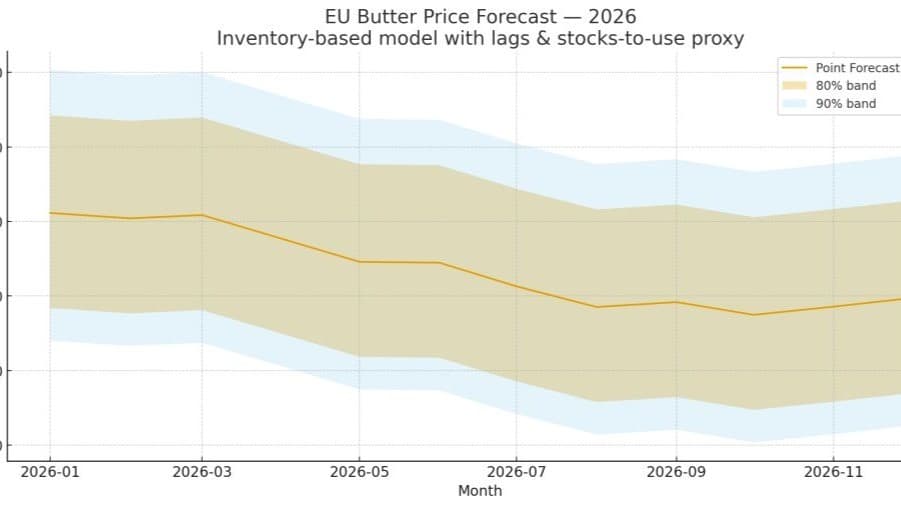
Summer Shopping or Summer Sale?
Last week was again a bit of a bearish week for the entire dairy industry. With cream prices under pressure and milk intake still strong, we keep seeing a market that has more supply than demand. Butter prices took another step lower, cheese prices cracked, and the powder market gave back a bit of its gains again.
El informe semanal
Recíbalo antes de que esté en cualquier otro sitio
Cada informe de mercado, directo a su bandeja de entrada en cuanto se escribe. Mantequilla, queso, polvo, líquidos — elija lo que realmente negocia.
Aproximadamente semanal · Gratis · Baja cuando quiera