A Perfectly Ballenced Market
Los informes de mercado se publican únicamente en inglés. El resto del sitio sí está disponible en su idioma.

We are back after a few days of easter rest. But the market seems to have decided to take another day off. We didn't broker any volumes and we foresee the market might trade a bit calmer in the weeks to come. Last year the market also calmed down a bit after easter and the extreme volatility only came back after the summer break. We see that most partners (producers, traders, end-user) follow the same logic with the same market views and the same strategy. To break it down:
Producers: Sell the market month per month
Most producers will agree with us that the market feels weak for now, but demand might come back at anytime the feel, and most expect that when demand comes back the market can turn quickly again. China is mentioned most, together with seasonal demand for fresh products due to good weather. Most producers sell conservatively as milk prices have fallen quickly and milk production is expected to shrink in H2 or even quicker some expect. Following that logic prices should pick up in the second part of this year. Therefore they sell as little as they need for June and onward, focusing on their sales on April / May, where they accept lower prices.
End Users: Conservative buyers, but with a long-term view
Demand for close-by has been ok for most of the end users, but down for some. Demand is an issue, but it differs from what our partners sell and where they sell it. But that the demand side is questionable seems clear. For most end users it gets harder to make long-term contracts on decent levels for further out. So while offtake seems to be slowing down in some sectors so most try to buy forward only the minimum volumes, purchasers are buying conservatively, but they are buying! Some industries with more long-term contracts do lock in as much product as possible. Most admit that they see that prices for most commodities are in an attractive historic range. Some even seem to be building a small stock as they also fear the anticipated lower milk intake in H2, causing higher commodity prices.
Traders: Helping producers and End Users
Some might take this remark as a joke, but we honestly see how traders fulfil their role in balancing the markets. They see their partners are willing to buy products for the second part of the year, but there are mainly sellers for April and May. For a product that is easy to store like SMP and butter, it seems the lower prices for April / May give a great opportunity to spread trade and do cash-and-carry. These trades are keeping the spot market from falling below current market prices. We now see H2 demand is creating a floor for April and May prices. Buyers who need fresh products like gouda, mozzarella, young cheddar and cream have fewer options to buy and hold products, but most traders have ways to hedge these sales with physical hedges. But even though these trades are a bit more difficult buying physical butter and SMP is giving support.
What happens when hedges unwind?
Current market views of our partners are keeping the market "clean" in the front months and it makes it possible for buyers to manage their risk further out. Producers are happy, end users are helped out and traders fulfil their role as risk managers / added value partners. The big question is what happens when we come to the periods that are being hedged at the moment. Will fresh-produced products find their way to the market as easy as now? If milk production drops significantly that might be the case, but if milk production keeps strong, we might struggle to get product from the producer onto the market.
For now, we agree with the chosen strategies from most partners, it means the market trades stable with little risk of making the wrong decision for most partners. And after 6 months of fireworks, the market can use a bit of steady trading.
We didn't get any firm bids or offers for our commodities, most partners are in standby mode. But as a rough indication, we see the following markets:
Butter: NL/DE/BE
Q2 € 4500 buyer - € 4650 seller
Q3 € 4600 buyer - € 4800 seller
Butter: Irish
Q2 € 4200 buyer - April € 4400 seller (Q2 € 4500)
Q3 € 4400 buyer - € 4750 seller
Gouda 48%
Q2 € 3150 buyer - April € 3200 seller (Q2 € 3250)
Q3 € 4400 buyer - € 4750 seller
Más desde la mesa
Our Long View Before Our Long Break 
Our Long View Before Our Long Break
Last week the market found a bit of stability. After lower trades on cheese, the cheese market traded slowly up, although a real rally remains absent. Butter prices did dip a bit further, although at the start of this week we see some strength on the back end of the curve. And on powder, our bullish feeling just doesn't go away — and now we can find some confirmation in the market as well.
Dairy Carry Has a Shelf Life 
Dairy Carry Has a Shelf Life
Last week was bearish across the board — every product we broker leaned the wrong way. Powders lost more momentum, cheese slipped well below €3,000 for some products, and butter continues to impress with just how much keeps showing up. Supply, supply, supply.
Summer Shopping or Summer Sale? 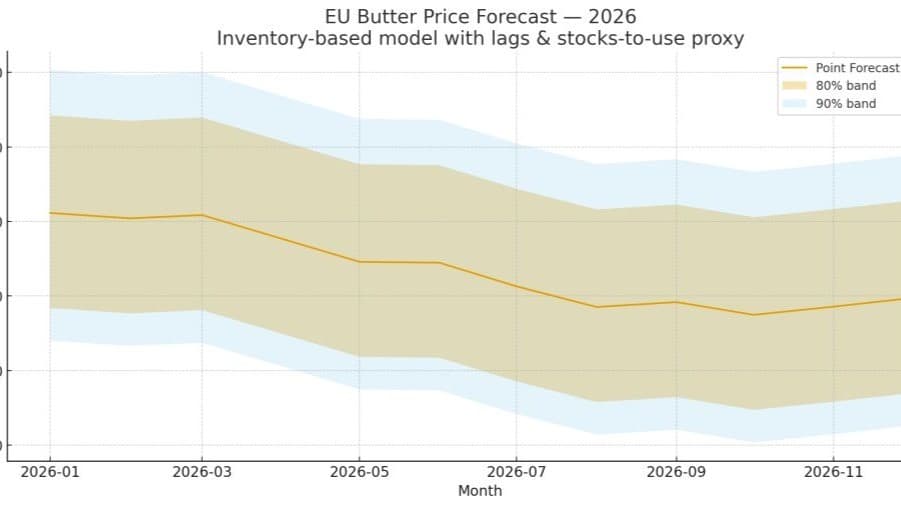
Summer Shopping or Summer Sale?
Last week was again a bit of a bearish week for the entire dairy industry. With cream prices under pressure and milk intake still strong, we keep seeing a market that has more supply than demand. Butter prices took another step lower, cheese prices cracked, and the powder market gave back a bit of its gains again.
El informe semanal
Recíbalo antes de que esté en cualquier otro sitio
Cada informe de mercado, directo a su bandeja de entrada en cuanto se escribe. Mantequilla, queso, polvo, líquidos — elija lo que realmente negocia.
Aproximadamente semanal · Gratis · Baja cuando quiera