Growing Uncertainty Means Growing Risk
Les rapports de marché ne paraissent qu'en anglais. Le reste du site est disponible dans votre langue.

Last week wasn’t exactly the most active one of the year. The market turned slightly bearish, but let’s not pretend we’re headed for the bottom of the price range we have seen this year anytime soon. Butter and cheese remain hovering still above the middle of this year’s trading range — neither collapsing nor rallying. SMP prices continue their slow crawl downward, although support keeps stepping in just in time to prevent any real dive. A bit more milk on the market has put some pressure on spot prices for cream, raw milk, and SMC. But again, let’s not overstate it — no one’s calling this a “very bearish” scenario. What we’re seeing is a market that feels capped on the high end, but equally well-supported on the low. A nice, cozy stalemate.
FMD Spreading
Just when we thought things were stable(ish), the market got a nudge on Friday with news that the FMD (Foot-and-Mouth Disease) outbreak in Hungary earlier this month has now spread to Slovakia. While Slovakia and Hungary together account for just 1.6% of EU milk exports, the concern isn’t about volume — it’s about precedent. That’s now three EU countries to lose their FMD-free status in under three months, and no one can guarantee that’s where it stops. Will this change anything this week? Hard to say. But what we do know is that the risk dial has just been turned up, and our partners are left figuring out how to hedge against it.
We believe that if the FMD problem spreads and exports will come to a slowdown from the EU, more producers will switch to SMP an Butter production as it is the easiest to store. This could have bullish effects on cheese prices, while it can put more pressure on SPMP and Butter. Looking at the production data in Germany from January, we see the producers over there clearly chosen that strategy when they had their FMD outbreak.
Meanwhile, Across the Pond…
Almost forgotten in the FMD headlines: the looming uncertainty from across the Atlantic. Starting April 2nd, the US has indicated it will impose reciprocal tariffs on all trading partners in the name of “fairness.” In the case of the EU — where we like to protect our internal market with hefty import tariffs — this move could force a rethink. The US seems to be nudging the EU to open the doors to cheaper US product. If Brussels doesn’t blink, it’s highly likely we’ll face import tariffs on EU exports heading to the US. Not exactly bullish news.
In fact, we’re already seeing speculation play out: several EU exporters with significant US exposure have front-loaded shipments in recent months, hoping to beat the clock. That might explain some of the tightness we've seen recently — and could very well mean softer export volumes in the near future.
But Wait, There’s More…
Because two risk factors just aren’t enough, there’s also a growing concern that bluetongue will start impacting milk volumes in the coming months. Sure, information is limited for now — but the last thing this market needs is another hit to production. If FMD continues to spread, exports will take a short-term blow, but the real pain could be in long-term EU milk output, which is already struggling to deliver any meaningful year-on-year growth.
Demand: Still the Big Question Mark
On the demand side, things aren’t much clearer. No hard data yet, but we’re hearing the same feedback again and again: customers are getting twitchy. Retail cheese sales are still doing alright, but France is reporting weaker butter sales — especially branded products. Consumers are clearly watching their wallets. Cheese remains relatively steady at retail level, but in foodservice, we’re hearing more and more concern. For now, it’s mostly hearsay… but there’s a pattern forming, and it’s not exactly reassuring.
So, What’s the Strategy?
Our partners are feeling the pressure. And who can blame them? Managing price risk is one thing — the futures market has come a long way in the past decade. But how do you hedge against export bans, tariff regimes that flip overnight, and production shocks with no warning? Uncertainty has become the main theme. And in times like these, sometimes the most rational move is to do… nothing. Wait and see.
Looking at our own brokering volumes — and those of our competitors — it seems that’s exactly what many partners are doing. Because when the market doesn’t make sense, sometimes standing still is smarter than stepping into the fog. The only issue? Postponed decisions have a habit of piling up. And when everyone decides to move at once… well, then we’ll finally get that activity back we’ve been missing, bearish or bullish...
Butter: Lower trades
The butter market last week? Clearly leaning bearish. Prices slid as aggressive sellers dominated most of the week — although by Friday, the mood shifted slightly. The sellers disappeared (off for a long weekend, perhaps?), and buyers stepped back in, lifting futures ever so slightly.
We managed to close a few trades on Polish Lactic butter between €7325 and €7350, while German product traded in the €7425 to €7450 range. That said, markets for Q2 and Q3 across NL/DE/BE product and Irish product are extremely thin. Apparently, no one’s feeling brave enough to build serious forward positions in this climate of growing uncertainty.
So, where’s the bearish pressure coming from?
It’s a mix of factors. Cream prices have softened a touch, and the market’s bracing for Irish producers to begin offering Q2 and Q3 volumes in the coming weeks. Meanwhile, producers in the Netherlands, Belgium, and Germany are wrapping up their winter butter runs — which, until now, could still fetch a small premium over future quarters.
But that premium? It’s quickly fading. And when it disappears, so does the incentive to build stock. More butter will likely flow into the market instead. Add to that a steady stream of Ukrainian butter making its way into the EU, and it’s easy to see where the sentiment comes from: supply might outpace demand over the next 3–4 months.
At least… that’s the theory. And in this market, we’ve learned theories are often more solid than actual forecasts.
We expect to start with sellers for
- 6 load NL/DE/BE butter May-June-July at € 7450
- 4 loads of Fresh Sachesnmilch for May - June at € 7500
- 3 loads of Polish Sweet Cream butter at € 7350
- 4 loads of Ukrainian butter DAP NL at € 6850
Cheese: Young but doubtful
The cheese market continues to tiptoe forward — and judging by what’s being collected, it’s still very much a “young” game. Most of the product moving around is fresh, with little sign of producers willing to commit beyond the next 1–2 months. It’s a short-sighted market, and not by choice — more like a reflection of current uncertainty.
Looking at the German figures, production is trailing last year’s levels, which helps explain the lack of long-term commitment. Despite that, the balance between supply and demand has been remarkably stable — just enough product, just enough buyers, and no major panic on either side.
We did see a slight uptick in prices, but let’s be honest: that probably had more to do with rising butter prices than any real cheese-specific dynamics. And now that butter is softening again, cheese seems to be following suit — gently, of course. No drama, just a little dip to remind us that cheese prices still take their cues from cream and butter.
For now, the story is calm. But with little buffer in supply and producers hesitant to plan ahead, any disruption could quickly change the tone.
We expect to start with sellers for cheese for
- 4 loads Gouda for April at € 4500
- 3 loads of Mozzarella April at € 4400
- 6 loads of Goudat for Q2 at € 4500
Powders: Scratching the bottom
Last week, the powder market had a rough ride — no two ways about it. The tone turned increasingly bearish, especially following the GDT auction results, which didn’t exactly inject confidence into global sentiment. By the end of the week, prices may have found some footing (thank you, stronger dollar), which helped improve the EU’s export position ever so slightly. But let’s be honest: with weak internal demand and soft SMC prices, we’re still a long way from anything resembling bullish.
The real elephant in the room? FMD.
For SMP in particular, this is the big concern. If more EU countries lose access to key export destinations, the already heavy market could quickly fall through what little support remains. Yes, we know — this is speculative. But speculation or not, the SMP market is highly exposed to export bans. And it’s not just about winning new business — current contracts could also become a logistical and legal headache if the situation escalates.
Ironically, the SMP market has been the most stable of the dairy complex for months now. But in our view, it's now the one with the highest volatility risk — all thanks to the growing uncertainty around FMD and its potential impact on exports.
Steady on the outside, but creaking under the surface.
Plus du desk
Our Long View Before Our Long Break 
Our Long View Before Our Long Break
Last week the market found a bit of stability. After lower trades on cheese, the cheese market traded slowly up, although a real rally remains absent. Butter prices did dip a bit further, although at the start of this week we see some strength on the back end of the curve. And on powder, our bullish feeling just doesn't go away — and now we can find some confirmation in the market as well.
Dairy Carry Has a Shelf Life 
Dairy Carry Has a Shelf Life
Last week was bearish across the board — every product we broker leaned the wrong way. Powders lost more momentum, cheese slipped well below €3,000 for some products, and butter continues to impress with just how much keeps showing up. Supply, supply, supply.
Summer Shopping or Summer Sale? 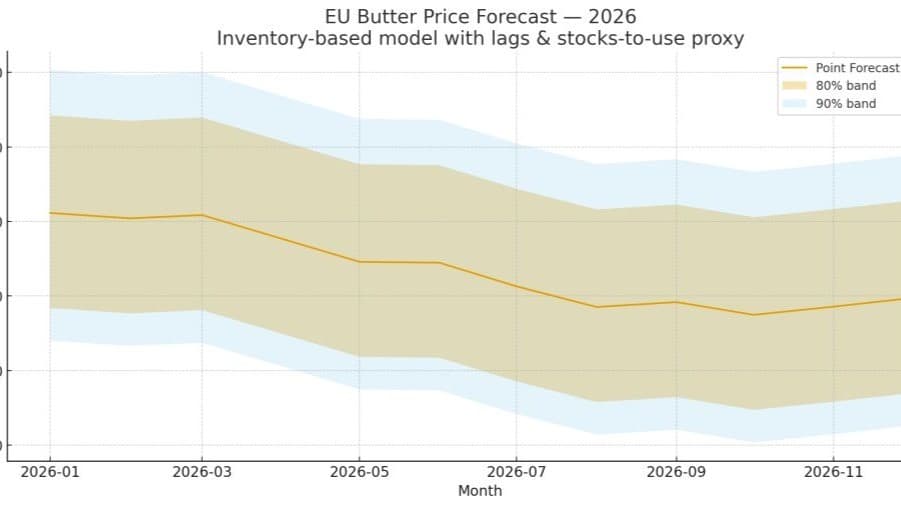
Summer Shopping or Summer Sale?
Last week was again a bit of a bearish week for the entire dairy industry. With cream prices under pressure and milk intake still strong, we keep seeing a market that has more supply than demand. Butter prices took another step lower, cheese prices cracked, and the powder market gave back a bit of its gains again.
Le rapport hebdomadaire
Recevez-le avant tout le monde
Chaque rapport de marché, dans votre boîte dès qu'il est écrit. Beurre, fromage, poudres, liquides — choisissez ce que vous négociez vraiment.
Environ hebdomadaire · Gratuit · Désinscription à tout moment