Sentiment Slips as Supply Mounts
Raporty rynkowe ukazują się wyłącznie po angielsku. Pozostała część serwisu jest dostępna w Twoim języku.

Last week, the dairy market showed more life, though not in the direction some had hoped. After weeks of sideways trading, prices started to ease. While seasoned traders will call the current price change mere noise compared to the volatility dairy can deliver, the tone was unmistakably softer. Cream held firm, but overall sentiment turned bearish. And just as Europe heats up—literally—the question is whether rising temperatures will nudge dairy commodities back into motion. Meanwhile, international uncertainty is piling up fast. Tensions between Iran and the U.S. are pushing oil prices higher, inflation fears are back on the table, and the EU–U.S. tariff deadline on July 9 looms ever closer. On top of that, the cost of vegetable oils is climbing sharply, pulling fat markets into a new pricing dynamic. One might expect this kind of uncertainty to fuel volatility. But so far, it’s had the opposite effect in the EU: a standstill. The key question now, was last week’s dip just a midweek wobble, or the start of a longer, long-anticipated correction?
🥛 More Milk That Should Create Stocks
Let’s start where the market starts: liquids. Last week, raw milk spot prices held steady, though we’ve picked up on growing selling interest for the summer months. Meanwhile, SMC prices cracked—dropping over 10% within days—while cream prices held their ground, even ticking upward in some regions. Warmer weather could be pulling more fat into the fresh sector. If that trend holds, cream prices may remain firm as long as Europe stays hot.
Zooming out, global milk production continues to climb. Latest Market Data shows EU-27 plus the UK reported a 1.9% increase in milk solids year-over-year, and the world’s top five export regions are doing even better, posting a 2.5% increase. That means more milk is looking for a home on the world market. For the EU, that’s a tough ask: current internal EU prices remain uncompetitive for most export markets.
And more milk, in a market that isn’t exactly screaming for more demand or exports, inevitably leads to rising stocks. The latest figures back this up. StoneX Plus shows a clear build in calculated inventories across SMP (+34% YoY), WMP (+28% YoY), and roughly on par with last year cheese (-1,5%). Butter is still lagging at a minus of 13% YoY , but that deficit is closing fast as December the gap was 49%. In fact, forecasts now point to butter stocks surpassing last year’s levels by the end of July, with further builds expected.
From both a supply and demand perspective, last week’s price correction looks set to continue—unless something disrupts supply. Stock tightness is easing, slowly but surely. And unlike last year, a record-breaking second half for EU exports seems unlikely, hampered by elevated EU price levels and shaky international demand.
All eyes now turn to milk flows from Germany, France, Ireland, the Netherlands, and Poland. If production in those regions keeps climbing, market pressure is likely to follow.
🧈 Butter Prices Begin to Soften – A Shift in Sentiment?
Butter prices held firm for weeks, but by the end of last week, they finally began to ease. We’ve already seen sluggish demand for both June and Q3 for some time, but those periods were propped up by stronger appetite for Q4. That support now appears to be eroding—Q4 prices have started to fade, and the silence from buyers for Q3 is only getting louder.
Producers, who until recently were sticking to a month-by-month sales strategy, are clearly backing off that approach. We now see contracts being offered for Q3—and in some cases even beyond, provided they include Q3 volumes.
The increased availability of physical product is also starting to filter through to the futures market. More sellers are stepping in, adding liquidity and softening the curve. Futures traded down around €125 from their highs 1.5 to 2 weeks ago. As we noted in the intro, most butter veterans will rightly argue that a €125 swing is hardly worth flinching over. We agree. But the broader context is shifting too.
We’re seeing more sellers—some even bordering on frustrated—while buyers are hesitant or unable to capitalise on the price dip. Traders aren’t rushing in either, as few are carrying meaningful short positions nearby to benefit from these lower levels.
Taken together—seasonal quiet, a well-covered forward market, and producers still pushing unsold June volumes—this creates a notably more bearish tone. That is, unless cream prices break higher. If cream pushes past €9,000, all bets are off. In a tense market like this, that could flip sentiment fast.
We ended the Friday with the following offers
- 6 loads of NL/DE/BE butter for Q4 at € 7400
- 6 loads of NL/DE/BE butter for Q3 at € 7350
- 6 loads of Irish butter for Q3 at € 7350
- 8 loads of Arla butter (DK/SE) at € 7300 FCA NL
- 4 loads of Polish butter at € 7300 July loading
🧀 Cheese: Ageing product losing value fast
Sellers in the cheese market have resisted lower prices for weeks, but last week marked a noticeable shift. Not only did June and early‑July volumes increase almost daily, but both offers and bids are now trending steadily lower. In a healthy market, these volumes wouldn’t push prices this hard, but weak buyer activity and lacklustre demand are cited as key reasons for the accelerated slide.
🔍 What’s Driving the Downtrend?
-
Milk rerouting to cheese in Ireland: Higher volumes of milk are being channelled into cheese production rather than other dairy streams. It explains the relatively modest butter output increase while milk is increasing fast.
-
Export softness: Q1 data shows cheese exports lagging behind powders and butter in key European markets
-
Foodservice demand ease: Restaurants and hospitality sectors are pulling back, reducing orders.
We expect to start the market with the following offers:
- 4 loads of Mozzarella for June/Early July at € 4200 fca
- 4 loads of Gouda for June at € 4200
- 6 loads of Mozzarella for Q3 at € 4275 (NL/DE/BE/DK/FR origin)
We have a bid for
- 6 loads of Mozarella for Q3 at € 4100 (NL/DE/BE origin)
💨 Powder: Still No Boost in Sight
Despite our continued use of Whey Isolate XXXL Power Boosters, the powder market itself is showing anything but muscle. Prices remain weak, and the market lacks conviction. The growing geopolitical tension in the Middle East isn’t helping—it's hard to see buyers locking into long-term contracts amid such uncertainty.
Meanwhile, New Zealand is ramping up. Early signs for the 2025–2026 season are positive, and expectations for a solid milk flow are building. This sets the stage for more competition, particularly in Southeast Asia—where EU exporters are already struggling to compete on price. Add to that the ongoing strength of U.S. powder exports into the Americas, and it becomes clear: the EU faces headwinds from all sides.
The result? A bleak near-term outlook. Technically, there’s still more upside than downside for EU powders—but that upside may take a frustratingly long time to materialise. And in a market driven by both patience and margin pressure, “eventually” just isn’t good enough.
🧠 Final Thought
What began as subtle softness has now spread across the board. Most liquids remain stable, but fat markets are starting to bend. Cheese buyers are backing off, and powders continue to underwhelm. Add in a global milk supply that’s picking up pace—and a world trading landscape clouded by tariffs, tension, and competition—and the message is clear: sentiment is slipping.
Yes, EU prices are still historically elevated. And yes, fundamentals aren’t collapsing. But the balance is shifting. Without a material shift in demand—or a disruption in supply—markets could continue to drift lower, slowly but steadily. In times like these, the loudest signal isn’t always a crash. Sometimes it’s just the silence of buyers… lasting a little too long.
Więcej z parkietu
Our Long View Before Our Long Break 
Our Long View Before Our Long Break
Last week the market found a bit of stability. After lower trades on cheese, the cheese market traded slowly up, although a real rally remains absent. Butter prices did dip a bit further, although at the start of this week we see some strength on the back end of the curve. And on powder, our bullish feeling just doesn't go away — and now we can find some confirmation in the market as well.
Dairy Carry Has a Shelf Life 
Dairy Carry Has a Shelf Life
Last week was bearish across the board — every product we broker leaned the wrong way. Powders lost more momentum, cheese slipped well below €3,000 for some products, and butter continues to impress with just how much keeps showing up. Supply, supply, supply.
Summer Shopping or Summer Sale? 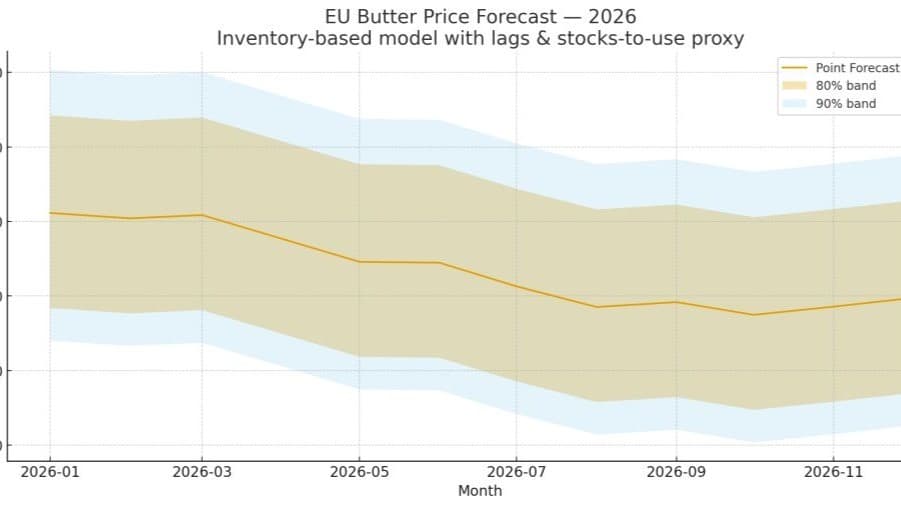
Summer Shopping or Summer Sale?
Last week was again a bit of a bearish week for the entire dairy industry. With cream prices under pressure and milk intake still strong, we keep seeing a market that has more supply than demand. Butter prices took another step lower, cheese prices cracked, and the powder market gave back a bit of its gains again.
Raport tygodniowy
Miej go, zanim trafi gdziekolwiek indziej
Każdy raport rynkowy prosto na Twoją skrzynkę, gdy tylko powstanie. Masło, ser, proszki, produkty płynne — wybierz to, czym naprawdę handlujesz.
Mniej więcej co tydzień · Bezpłatnie · Rezygnacja w każdej chwili