Not a Floor, but a Trampoline!
Raporty rynkowe ukazują się wyłącznie po angielsku. Pozostała część serwisu jest dostępna w Twoim języku.

Last week was a remarkable week for the dairy market. Especially the butter market felt like a real rollercoaster and showed its well-known volatile face. But in the midst of a very volatile butter market the cheese market remained steady and so did the markets for SMP, cream and cheese. Those who visited the Eucolait came back a lot more bullish on the market than those who didn't.
We at Get Fair Dairy look at the market from an EU perspective and get the most feedback from our EU partners. Looking at the EU activity on butter, and SMP in the last months we have become quite bearish. The activity has been low, the feedback from end users have been negative in the last months, and speaking to traders we especially hear bearish stories on SMP exports. But looking at the greater picture we understand those who are a bit more bullish.
Milk: A Bullish Picture
Looking at the fundaments presented last week we see a few things that are cause to be more bullish than we have been. Milk collections in the EU from January until November had been stable v.s. 2022, although the trendline showed a growing gap in the last months v.s. the first months. This indicated we will most likely start the year with YoY less milk compared to the year before. Although less milk is a clear bullish price signal the fact that fat (+0.9%) and protein (+0.7%) content were up YoY over the first 11 months of the year indicates a small problem. The fact we collect less water from the farms should be considered less relevant.
Looking closer at the numbers per country we see the -3,2% of Irish milk being a good explanation for why the Irish milk has been hard to get your hands on. However, the increased Polish milk collections make us wonder why a country with 1,6% more milk has such fewer commodities to offer. From Polish partners, we did hear internal demand had been good, and looking at these numbers that seems to be confirmed.
The milk supply in the major exporting (EU28/US/NZ+AUS/Argentia/Chili/Uruguay/Belarus) countries also seems to be losing momentum. While still being up v.s. 2022 milk production in the first 11 months, we can see the momentum lying well below 2022, 2021 and 2020, if the trend continues the first months of 2024 will be the lowest in the previous 4 years. A side note here is that one of the biggest imports on the world market (China) is now producing more milk than some of the major exporters. We find it hard to make the calculations on how much additional milk from China is being offset by the loss of milk in the major exporting countries.
Butter: A Bullish Balance Sheet
Back in the EU looking at the production last year we see that butte reproduction is up v.s. the year before. But looking more closely it seems most of that butter is produced in the first months of the year, but the last months the butter production has been down v.s. the years before. The bigger gap than normal v.s. cream and butter should be the explanation for this. It seems we will start this year with 25.000mt less of butter compared to last year. Exports last year were strong (up 14% and this seems to be caused by the lower butter prices in the first 9 months of the year (below € 5000). The question from our side is if we can keep the export numbers up with butter prices over € 5000,-. Looking at the US and NZ we see their butter prices increase as well, making the EU still a good partner to look at for butter.
Powders: An Empty Market?
Looking at the powder market we see the balance sheet paints a completely different picture than the current market trades suggest. With roughly 60.000mt less stock we start the year with an empty market. The lower ending stocks can mainly be explained by higher exports and lower production. The internal consumption has been lower than in the previous years and the forecast for this year is again negative. The same can be said for the forecast for exports. It is expected we will export fewer powders now we have not been competitive for a few months already on the export market. But if the SMP production continues its decline v.s. the previous years, the market might still be facing a lot less product during the year, and therefore a quick change in prices might be expected.
Where for butter we would be more bearish only looking at the EU picture we would be much more bullish on the SMP market looking only at the EU balance sheet. The biggest question for SMP is how the export market will react. And with a lot of tensions in the world, that is one of the hardest judgements to make.
Cheese: Still Overpriced
Looking at the cheese market we feel that, even though it has been the best valorizing product for the last few months, we have some corrections to expect. With production expected to be up again this year, the market seems to be depending a lot on good exports to keep the market from overflowing. Last year the EU managed to regain a bit of market share on the international cheese markets, which seems to have a direct effect on the US cheese exports. But with US cheese now being sold well below EU prices and NZ also competing on much lower prices we expect that the regained market share might be lost again this year. If the EU doesn't manage to export its cheese, there is little else to do than drop the price to attract more buyers.
Overal the sentiment last week seemed to be that prices for EU products will be highly dependent on the possibility to export and keep the stock levels low. For butter, the scenario seems much more realistic that exports will lift some pressure of the market than for cheese. For SMP exports are always important and with the outlook that demand might still remain weak for a longer time, SMP prices are expected to trade steady around today's prices. But as the market is much more empty than it has been in years, the SMP market might surprise with a very strong rally once demand shows.
Więcej z parkietu
Our Long View Before Our Long Break 
Our Long View Before Our Long Break
Last week the market found a bit of stability. After lower trades on cheese, the cheese market traded slowly up, although a real rally remains absent. Butter prices did dip a bit further, although at the start of this week we see some strength on the back end of the curve. And on powder, our bullish feeling just doesn't go away — and now we can find some confirmation in the market as well.
Dairy Carry Has a Shelf Life 
Dairy Carry Has a Shelf Life
Last week was bearish across the board — every product we broker leaned the wrong way. Powders lost more momentum, cheese slipped well below €3,000 for some products, and butter continues to impress with just how much keeps showing up. Supply, supply, supply.
Summer Shopping or Summer Sale? 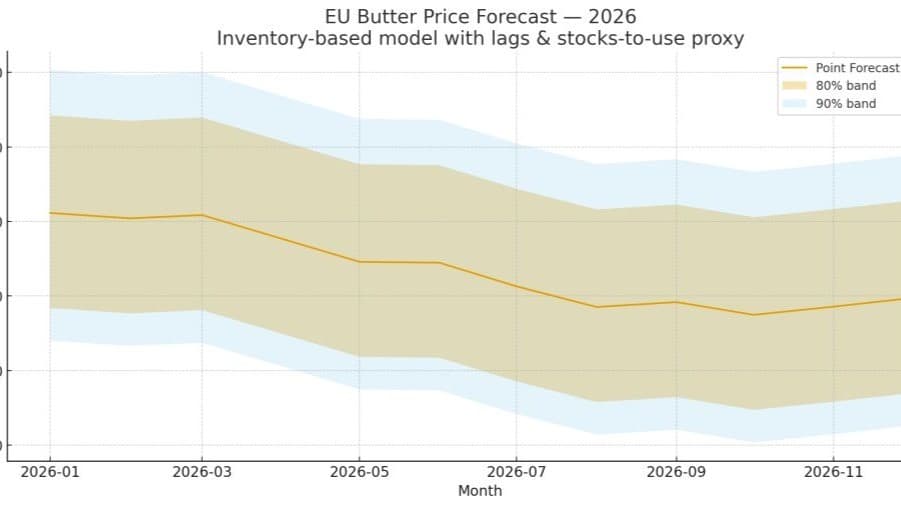
Summer Shopping or Summer Sale?
Last week was again a bit of a bearish week for the entire dairy industry. With cream prices under pressure and milk intake still strong, we keep seeing a market that has more supply than demand. Butter prices took another step lower, cheese prices cracked, and the powder market gave back a bit of its gains again.
Raport tygodniowy
Miej go, zanim trafi gdziekolwiek indziej
Każdy raport rynkowy prosto na Twoją skrzynkę, gdy tylko powstanie. Masło, ser, proszki, produkty płynne — wybierz to, czym naprawdę handlujesz.
Mniej więcej co tydzień · Bezpłatnie · Rezygnacja w każdej chwili