Bullish and Bearish Moves
Raporty rynkowe ukazują się wyłącznie po angielsku. Pozostała część serwisu jest dostępna w Twoim języku.

Looking at the market we see prices trading all over the place. Butter prices in Poland traded lower, cream prices stabilized, butter prices for NL/DE/BE firmed a bit more, Cheese prices declined further and powder prices seemed to grind on the low levels. We have bullish partners confronting us with our bearish reports, while at the same time, bearish buyers claim to be finding lower offers in a bouncing market. It confirms one thing for us, markets can trade in all directions.
The unusual amount of feedback from suppliers confronting us on our bearish outlook made us rethink the framing of our market outlook. We might be focussing a bit too much on the bearish undertones in the market although some bullish signals are also visible.
Poor Demand, And Production Incentives
Our more bearish view on all markets has 2 fundamental pillars. First of all we think the demand side of the market is overestimated. From all sources, we hear demand is down. Europe, North Africa, the Middle East, And SE Asia, are all key export areas for EU dairy commodities. The escalating war in Israel/Gaza, the Red Sea tensions and the economic slowdown in China are all worrying elements for Export demand. We have to admit that most proof we have for poor demand is anecdotal, but also supported by the market trades we see.
Spot SMP prices show big discount v.s. Q2 and Q3
Offering SMP for February / March even well below EU quotations is almost pointless as most buyers have covered their needs long before the quarter started. Export demand has been almost non-existent for months and we still see old material popping up in our trades. Q1-2 2023 is very common in our trades. We also hear that producers for SMP are offering products between € 2350 and € 2400 and SMC prices are trending lower compared to the last weeks.
Cheese In Backwardation
Buyers of cheese have been very focussed on buying month per month in the previous year. But since the start of this year, finding buyers for the same month has been significantly harder. In addition for the first time, we see producers and traders able to offer products for close by. In addition for cheese, we see world market prices under pressure, and we hear EU, US and NZ products competing for the same customers on the export, with EU products losing at the current levels. We now even see that all cheeses we broker are in backwardation for March and Q2. Even the bigger producers doubt if cheese valorization at the current level vs. butter and SMP is sustainable, making them open to discuss forward business at a discount v.s. the currently still reasonably balanced market.
Bouncing Butter, Expensive to Cash and Carry
Butter buyers close by have been picking up their activity a bit in the last few days, pushing the price up for some origins. At prices around € 5000,- we see a significant increase in demand. But most buyers seem to buy because of the low price, not because of their close-by needs. However, we did speak to a few producers today saying some buyers are calling of additional volume for next week and the week after delivery, suggesting better-than-expected demand.
We notice, and we hear the same from our partners, that once prices go up, buyers step out as most seem to be buying to cover their Q2/Q3 needs and find the discount for Feb.March attractive enough to consider buying at these levels v.s. paying the premium for Q2 and Q3. It does indicate that at prices close by around € 5000,- there is solid ground. It does remain questionable how much volume the market can absorb and buy before this € 5000,- floor starts to show cracks. One partner calculated for us the cost of carry amounts to roughly € 50,- per mt per month.
Production Incentives
We reported on this as well yesterday, but its another reason why we are short-term bearish. Milk intake seemed to recover a bit, although cold weather (compared to last year) has now caused the YoY deficit in France and Germany to grow again. But the next weeks seem dry, and sunny and give a perfect condition to produce milk. In addition the milk price paid to farmers v.s. their costs is good. It should incentivise them to maximize production, especially now uncertain times for many in West EU are ahead. We think a market with weak spot demand and weak exports will have trouble processing more milk without pushing down prices.
Bullish after the Peak
But there are some good reasons to be bullish. The reason why we don't focus on them much is that most bullish signals (in our view) will have an effect on our long-term outlook. Long-term is a flexible definition but there are some good bullish signals that should give reason for buyers to not think the way down is endless.
Production of commodities is Down
Looking at the data on production of SMP and Butter over the last months there is good reason to be bullish. It seems the EU is carrying significantly fewer stocks of both products compared to a year ago. For SMP it contradicts a bit with the older parcels that keep crossing our books, but it adds up looking at the supplier's offers. From the suppliers on SMP, we see virtually no older product. We don't hear much about huge stocks in producers' warehouses and goods delivered by producers are sometimes only days old.
The same can be said about butter stocks. Although we do think traders carry a significant amount of stock, we do see that producers carry much less. In Ireland, the situation is still that some producers are waiting for the first milk of the season to finish their 2023 orders. The biggest question surrounding stocks we have with end users. Some claim to be well covered until Q3, but we also hear stories about buyers needing products for next (or even quicker).
It does (to us) seem more likely that the SMP pipelines are a lot more empty than we realize and an uptake in demand might boost SMP prices up quickly again. Producers won't be able to offer anything significant as they carry very little stock. For butter, we expect the scenario, but it is very unlikely to happen during the milk peak as the EU produces much more butter than it needs and stock building is something that happens naturally. Only once the EU starts to eat into these stocks we might see the deficit of products and the impact that might have on pricing.
Production Incentive Will Fade
Looking at the production incentive, we think that will fade into Q3. If prices will (as we expect) continue their bearish descent, milk prices paid to farmers will start to drop starting from March onwards. This won't impact peak milk volumes, but if prices for farmers drop below 40ct after the summer, a 2021 scenario where farmers will step out at the same time stocks start to run low might cause a short squeeze that will drive prices back up to significantly higher levels than we are trading on today.
We know we don't always please everyone with our report, and our reports are not to please, but to inform. And even while informing you about our activities and market views, we realize that we will sometimes miss key information, key insights and key conclusions. As said many times before, we always welcome feedback and we try to incorporate this in our daily reports as open and honest as we can. Many thanks to those reaching out in the previous days debating us on our market view!
Więcej z parkietu
Our Long View Before Our Long Break 
Our Long View Before Our Long Break
Last week the market found a bit of stability. After lower trades on cheese, the cheese market traded slowly up, although a real rally remains absent. Butter prices did dip a bit further, although at the start of this week we see some strength on the back end of the curve. And on powder, our bullish feeling just doesn't go away — and now we can find some confirmation in the market as well.
Dairy Carry Has a Shelf Life 
Dairy Carry Has a Shelf Life
Last week was bearish across the board — every product we broker leaned the wrong way. Powders lost more momentum, cheese slipped well below €3,000 for some products, and butter continues to impress with just how much keeps showing up. Supply, supply, supply.
Summer Shopping or Summer Sale? 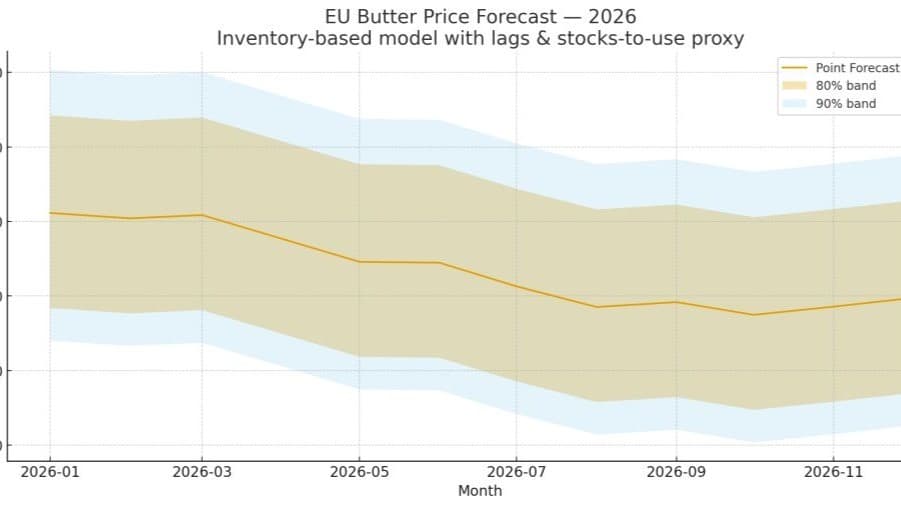
Summer Shopping or Summer Sale?
Last week was again a bit of a bearish week for the entire dairy industry. With cream prices under pressure and milk intake still strong, we keep seeing a market that has more supply than demand. Butter prices took another step lower, cheese prices cracked, and the powder market gave back a bit of its gains again.
Raport tygodniowy
Miej go, zanim trafi gdziekolwiek indziej
Każdy raport rynkowy prosto na Twoją skrzynkę, gdy tylko powstanie. Masło, ser, proszki, produkty płynne — wybierz to, czym naprawdę handlujesz.
Mniej więcej co tydzień · Bezpłatnie · Rezygnacja w każdej chwili