Weekly Update: Both Bulls and Bears Are Right!
Les rapports de marché ne paraissent qu'en anglais. Le reste du site est disponible dans votre langue.

Last week we found the market hard to read. With butter prices trading higher but with very little volume it felt the market had reached its top. But at the same time, we saw Gouda prices trade higher and availability seems to be very tight. SMP and BMP prices meanwhile found a clear way down with international sentiment getting weaker. We have spent a lot of time dealing with people who are extremely bullish, people who are clueless, and partners who are just immensely bearish on the dairy market. And after all the conversations we had, we see ourselves agreeing with both the bulls and the baers. But they can't both be right, right? But it seems that for the first time, we are both bullish and bearish on the market at the same time.
As a broker, we should be impartial in the market and it's true we have no favor for higher or lower prices. If we had a preference it would be for higher prices as we think the farmers deserve better milk prices for their labour. But we will (and have) call the market bearish if we see it, and bullish if that's the direction we see. But at the moment we see more and more data that is telling us the same two stories. Both arguments get stronger, so either a really bearish move for lower prices, or a bullish move for higher prices lies around the corner.
Lower Production fear grows with Bluetongue (Bullish)
Those who expect higher prices all point to the lower milk collection in the EU. In the first months of this year, EU milk production was better than the year before, but since August milk production isn't showing an increase anymore in the EU. With some of our partners, the fear of lower milk production grows now the bluetongue virus in the Netherlands is becoming a real problem. Some will say the virus isn't as serious for cows as it is for sheep, but those dairy farms with infected cows report a significant drop in milk volumes. With the virus spreading fast in the Netherlands a bigger outbreak outside of the Netherlands might have a bigger impact on the production numbers in the EU.
Lower demand from industry, retail and exports (Bearish)
Those who expect lower prices also have strong arguments. Speaking to some big producers in the industry, they all claim to see the same weak demand. One of our partners says it's the weakest demand he has seen in the last 27 years. Those who compete with him in the same industry confirm that demand is very slow. Those who supply retail don't see such dramatic numbers, but we know very few buyers who see an increase in retail demand v.s. last year and most are selling to retail on budget or just below. Export demand isn't great either. Last week we tried booking more business with our export partners, but competition from the US and NZ (mainly on powders) is strong and the EU doesn't seem to win a lot of tenders.
Recession, Stagflation, Shrinkflation and high interest rates (Bearish)
And then we have the looming fear of a worldwide recession caused by high-interest rates. The Dutch Newspaper "Het FD" wrote a nice overview piece about the US economy where over 100 million Americans have a car loan. The default on payment on these loans is at the highest level it has been since they started recording the default rate. Credit card debt is rising fast with interest rates over 21% and now (ex) students need to start repaying their student debt again which has been postponed since the COVID period. And in the next year, big companies need to refinance 5500 billion dollars at the current interest rates. A dark scenario seems to be unfolding. Meanwhile, in the EU more and more governments need to start cutting spending and it's unlikely that EU citizens will have less support from their governments if energy prices will start rising again. Meanwhile, food inflation is still rising in most EU countries. At some point, these factors will have to start impacting consumer behaviour.
Unemployment at a historic low, and looming war! (Bullish)
But all these facts above seem to be offset by the historic low unemployment rate we see both in the EU and in the US. As long as unemployment remains as low as it is right now it seems everyone is able to cope with the fast rising cost of living. Experts do fear the point where the unemployment number will start to rise (if companies won't be able to refinance or go bankrupt due to the high cost of employment, interest rates, and energy... ). In addition, we are dealing with a second war that is boosting the oil price (usually good for dairy prices). The fear of a looming bigger war in the region might push countries into stockpiling in the next months.
We think the bullish sentiment is always strongest in Q4 as most of our partners always experience that demand for products is higher than fresh additional commodity production. Looking for stocks to fulfil that demand can be difficult in a market where stock holders see products go out much faster than they can replenish their fresh stock at t much higher cost price. Therefor we think that the current price direction on cheese (and butter) should continue to firm up in the next week. Q1 usually gives the opposite feeling to partners as most sellers see their stocks grow much faster than they can sell additional products. We still believe that in Q1 we won't see much stock building from buyers as interest rates are high and most already carry sufficient stock. At the current commodity prices, there is little incentive to stock up on high prices therefore we believe Q1 Prices will soften (but only just before we enter Q1)
Plus du desk
Our Long View Before Our Long Break 
Our Long View Before Our Long Break
Last week the market found a bit of stability. After lower trades on cheese, the cheese market traded slowly up, although a real rally remains absent. Butter prices did dip a bit further, although at the start of this week we see some strength on the back end of the curve. And on powder, our bullish feeling just doesn't go away — and now we can find some confirmation in the market as well.
Summer Shopping or Summer Sale? 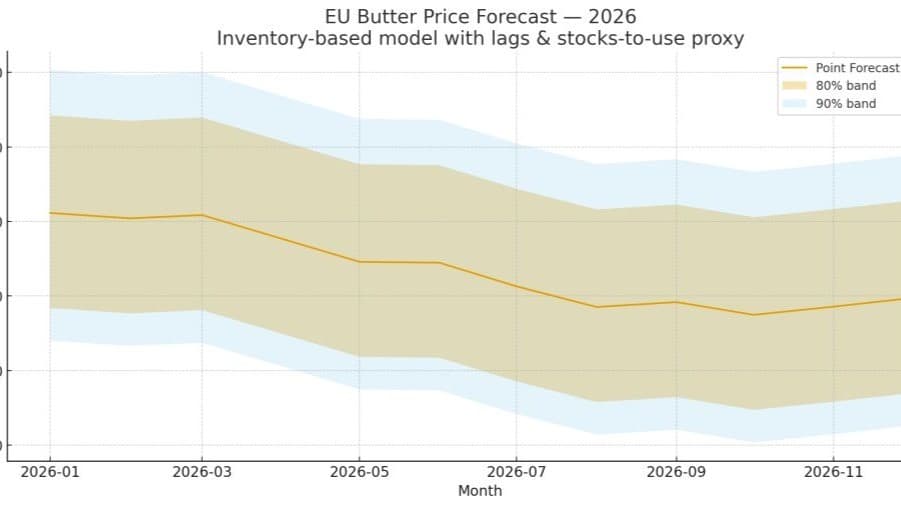
Summer Shopping or Summer Sale?
Last week was again a bit of a bearish week for the entire dairy industry. With cream prices under pressure and milk intake still strong, we keep seeing a market that has more supply than demand. Butter prices took another step lower, cheese prices cracked, and the powder market gave back a bit of its gains again.
The Agro Gravity Effect 
The Agro Gravity Effect
Last week was a strange week from our side. With relatively low activity and a lot of customers on the move due to Eucolait, activity came as quickly as it went away again. Tuesday's GDT put the market on hold, but when the results came out, a bit of downward trading occurred. The same went for Eucolait.
Le rapport hebdomadaire
Recevez-le avant tout le monde
Chaque rapport de marché, dans votre boîte dès qu'il est écrit. Beurre, fromage, poudres, liquides — choisissez ce que vous négociez vraiment.
Environ hebdomadaire · Gratuit · Désinscription à tout moment