Week Update Week 2: What’s Next?
Les rapports de marché ne paraissent qu'en anglais. Le reste du site est disponible dans votre langue.

We are one week into 2023, and it seems that this year won't be less volatile than 2022. With a 10% price drop for cheese and a 5% price drop for butter in the first five days of 2023, the year is off to a bearish start. SMP is also showing bearish signals but this price isn't dropping as hard yet. Prices for all three commodities are now down more than 35% since peaking in the spring of last year. But they are all still up 20% compared to long-term average prices.
We got asked the question last week a lot where we see the bottom for the dairy commodity market and what we think will stop the downtrend. If we knew this we would be switching professions. We have heard the jokes that intervention bags and boxes are being ordered again for SMP and butter, but we can't see the market drop that low. But we can share with you our thoughts about the market dynamics.
Prices of 2021
Our most honest guess would be that we will go back to the levels 2021. We started our brokerage business in August of that year. Until that month, milk collection and consumption looked to be stable and the world export market started to pick up pace. Our first Gouda deal was at a price of € 3000,-, our first SMP deal was at € 2200,- and our first butter deal was at € 3700,-. We are now in 2023 and supply seems to be back at the same level op 2022. Some might argue that demand and export are below the levels of 2021 and that we might go even lower. People who are bullish on the price keep arguing that the cost price to produce commodities lies a lot higher due to inflation. But we still believe that the cost price of a commodity does not determine the market price, only supply and demand do this. We do think that higher on-farm costs will have an impact on the reversal of the market.
Anti-Farmer sentiment
Because being a farmer in western Europe isn't as sexy as it used to be. It has always been hard work, long days, 365 days a year. But in recent years farmers are seen more and more as environmental polluters and animal abusers. In the Netherlands, the plan is to eliminate a significant part of our beloved dairy industries, and in other countries, the same debate is starting. As long as farmers are earning 20ct a litre, we think they will absorb these accusations. But once their income drops significantly (and it will) we think we will see a significant amount stop their business activities. In France, we see that more and more farmers quit their businesses as they are not able to find a successor. France shows that even with higher payout prices, that milk production in the EU will come under pressure in the long run. If prices drop to prices below 40ct in the EU by the summer we think the second part of 2023 can become a copy of that of 2021.
China as a major buyer
A much-heard argument is that we might see the market reverse as soon as China comes back to the market. We agree that they are a dominant factor in the world market. But China has been ramping up its domestic milk production as well. With milk production twice that of NZ and an average growth rate of 6% China sets off the loss in milk production from NZ easily. And with internal demand suffering, but production growing, the import demand of China might not be back as strong as some expect/hope/think. China will be dependent in the next years of imports from the world market. But at the moment the world market is more dependent on Chinese demand to come back to put a break on the worldwide decline of commodity prices.
Inflation and Recession
Inflation seems to have peaked worldwide and we see the year-on-year increases slowing down. It doesn't mean we are out of the woods yet. Looking at the latest notes from the FED it seems that they think that their unprecedented interest hikes might not do the trick quickly enough and they might have to increase rates higher and longer than they intended to. Most specialists seem to agree that this will lead to a recession, but the prediction differs from a mild recession to the biggest recession we have ever seen. We fear that Europe will be hit by one of the biggest recessions we have seen in our lifetime (37 years). If true the jokes about intervention boxes and bags might not be that unrealistic. But let's hope that we will see a mild recession, if this happens we believe that the summer of 2023 might be a copy of that of 2021.
Conclusion?
I think it is safe to say that we haven't reached the bottom of the market yet. Our safest bet is that we will continue to trade down to levels close to, or even a bit below, the levels of 2021. That means most commodities still have 10-20% to go down. How deep we go down depends on a lot of factors, but we think that the biggest impact will come from the co-ops. The quicker they realise that keeping the milk price high will only have a bigger impact on the dairy market long-term the quicker we will see a floor in the market. But we fear that the fight to keep farmers will cause the milk price to decline to slow leading to a market crash below the 2021 levels. In the longer term (9-12 months ahead) we think the commodity prices will start to go up again.
Plus du desk
Our Long View Before Our Long Break 
Our Long View Before Our Long Break
Last week the market found a bit of stability. After lower trades on cheese, the cheese market traded slowly up, although a real rally remains absent. Butter prices did dip a bit further, although at the start of this week we see some strength on the back end of the curve. And on powder, our bullish feeling just doesn't go away — and now we can find some confirmation in the market as well.
Dairy Carry Has a Shelf Life 
Dairy Carry Has a Shelf Life
Last week was bearish across the board — every product we broker leaned the wrong way. Powders lost more momentum, cheese slipped well below €3,000 for some products, and butter continues to impress with just how much keeps showing up. Supply, supply, supply.
Summer Shopping or Summer Sale? 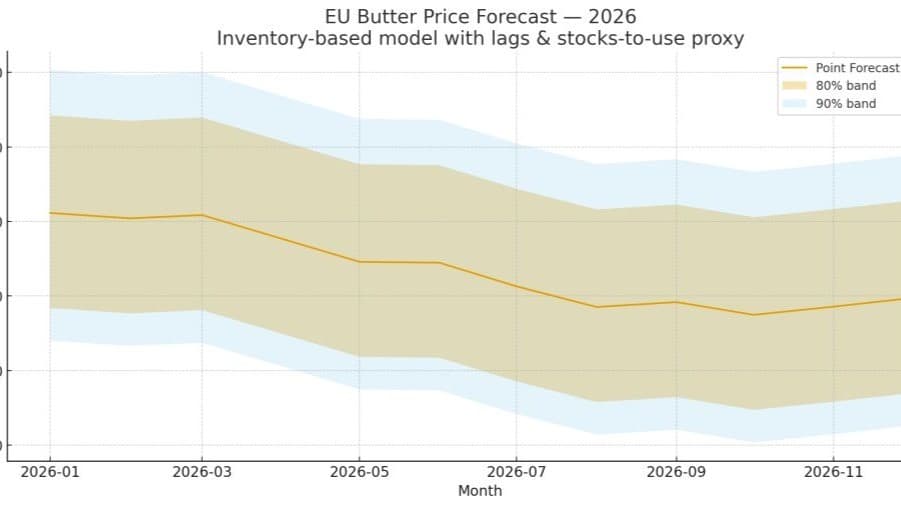
Summer Shopping or Summer Sale?
Last week was again a bit of a bearish week for the entire dairy industry. With cream prices under pressure and milk intake still strong, we keep seeing a market that has more supply than demand. Butter prices took another step lower, cheese prices cracked, and the powder market gave back a bit of its gains again.
Le rapport hebdomadaire
Recevez-le avant tout le monde
Chaque rapport de marché, dans votre boîte dès qu'il est écrit. Beurre, fromage, poudres, liquides — choisissez ce que vous négociez vraiment.
Environ hebdomadaire · Gratuit · Désinscription à tout moment