We Are Back! What Changed?
Les rapports de marché ne paraissent qu'en anglais. Le reste du site est disponible dans votre langue.

We are back! After a long break of six weeks, we are back today with a fully charged battery and lots of energy to continue to help our partners where needed in the ever-changing dairy commodity market. On our break, we had the time to set up some new partnerships and ideas to be a better service partner in the coming years. But more on that in the coming weeks. Now it is time to take a look at the dairy market. What changed in the previous six weeks and what hasn't? What have prices done in the EU and on the international markets? And what do we expect for the week to come? Let's take a look at the dairy market!
While it's true we have taken a break from the dairy market for six weeks, we are also a bit addicted and we stayed in close contact with a few of our partners to keep track of the developments. In the previous weeks, we have seen some price volatility, although it mainly seems to be caused by the lack of liquidity. In Europe, the market dynamics haven't really changed, but internationally we do see some interesting trends. US CME prices have rallied over the last weeks (and have corrected a bit as well) due to lower milk production in July. The main cause seems to be the extreme weather. Meanwhile, on the other side of the world, we see that GDT price action has only been bearish with prices hitting 5-year lows. Global demand and in particular Chinese demand, seems weak. The big question remains, What trend will have the biggest impact?
Milk collections in the EU are still roughly up between 0% and 1%, and consumption remains steady to slightly bearish. Speaking to our partners in the previous weeks, we keep hearing demand for 2023 seems almost non-existent for powders and fat. Only cheese demand seems to remain steady with prices still relatively strong. Looking only at 2023 we would be quite bearish on the near-term price action. We don't see a market where fat and powder prices keep falling and cheese remains expensive. But demand for powders and fat in 2024 remains healthy. We have seen the same pattern for months now. Because as soon as prices drop to year-long average prices, most buyers keep locking in large volumes of their expected demand. Even with the demand outlook is a bit questionable, most buyers keep covering at the long-term average prices in fear of another price rally as seen in 2021/2022. This fear for higher prices has acted as a firm bottom over the previous months, and will most probably remain a steady support for the remainder of this year.
Will Stocks Be The Deciding Factor?
The supply side seems steady enough. Contract prices for farms aren't ideal, but they haven't dropped significantly below cost price. So a quick decline in milk production as seen in 2021 isn't to be expected. At the same time, we also expect buyers to continue to buy forward for the months that will follow supporting a long-term steady milk price outlook. The biggest variable that could influence dairy commodity prices is how stocks might influence the strategy of coops, end users and traders. Compared to a year ago it seems a lot cheaper to keep stock as commodity prices have dropped significantly. However, the cost of carry has increased significantly due to the much higher interest rates. We see partners struggling to find a balance. Those with deep pockets can afford to store cheap products as financing costs don't really apply to them, but those who need to finance their stocks might not have the luxury to take advantage of the current "cheap" spot offers on the market. We also hear the cost of storage keeps increasing.
Listening to our partners we think most still have the possibility to store product. It explains why demand for Q4 has been so hard to find at higher prices. Most traders and end users seem to already have locked-in stocks to satisfy their normal demand in the normally expensive fourth quarter of the year. So far producers haven't been in a hurry to sell products as it seems most of them still expect Q4 demand will show itself and will take the pressure off their books. If this won't be the case in the weeks to come, we might see another sell-off in October, similar to last year when they had the same expectations. For us, this seems the most probable scenario.
Non-Dairy Influence
Looking at the world without our dairy glasses we see the same questions in the world as the dairy market faces. The market is flooded with bearish news about high-interest rates, higher credit card debts, high government expenses, high inflation, a stagnating housing industry and a record of bankruptcies and system failures. But at the same time, stock prices keep rising, unemployment numbers are at the lowest they have been in years. Some people expect the biggest crash of the economy since Lehman, others think the economy can only go up from here... Same as for the dairy market, we are more in the bearish camp, but we would not rule out a longer bullish market.
What we think will influence dairy commodity prices most, and what we will try to follow closest in the weeks to come:
- How does the Chinese economy develop, can it avoid a hard crash? If not, dairy demand might suffer for a long time
- Does the FED keep increasing interest rates? This will influence Europe's competitiveness on the world stage.
- EU stocks of butter and SMP near the end of the year.
And now we are back we invite you all again to give us a call, send us an email or contact us via WhatsApp. We want to hear your thoughts on the market and what you expect. And if you are ready to place a bid or offer, we invite you to place a bid or offer via our marketplace or give us a call to discuss your needs.
Plus du desk
Our Long View Before Our Long Break 
Our Long View Before Our Long Break
Last week the market found a bit of stability. After lower trades on cheese, the cheese market traded slowly up, although a real rally remains absent. Butter prices did dip a bit further, although at the start of this week we see some strength on the back end of the curve. And on powder, our bullish feeling just doesn't go away — and now we can find some confirmation in the market as well.
Summer Shopping or Summer Sale? 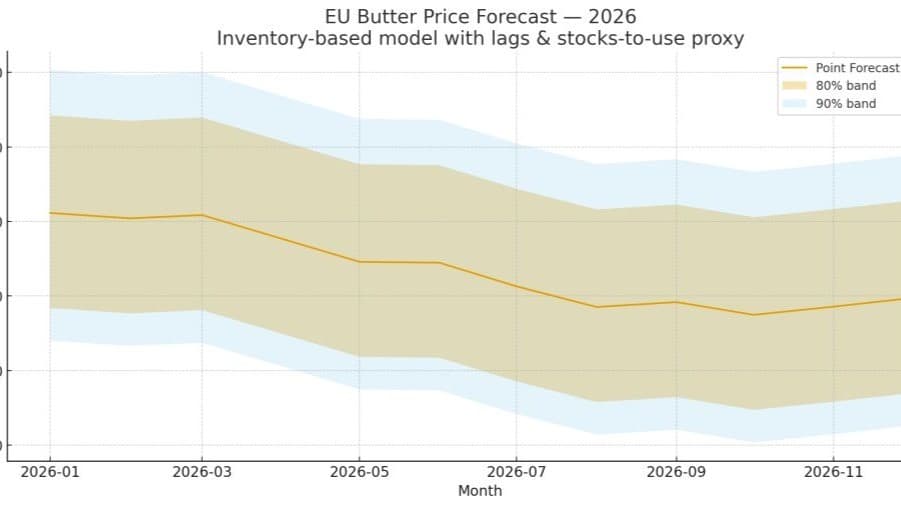
Summer Shopping or Summer Sale?
Last week was again a bit of a bearish week for the entire dairy industry. With cream prices under pressure and milk intake still strong, we keep seeing a market that has more supply than demand. Butter prices took another step lower, cheese prices cracked, and the powder market gave back a bit of its gains again.
The Agro Gravity Effect 
The Agro Gravity Effect
Last week was a strange week from our side. With relatively low activity and a lot of customers on the move due to Eucolait, activity came as quickly as it went away again. Tuesday's GDT put the market on hold, but when the results came out, a bit of downward trading occurred. The same went for Eucolait.
Le rapport hebdomadaire
Recevez-le avant tout le monde
Chaque rapport de marché, dans votre boîte dès qu'il est écrit. Beurre, fromage, poudres, liquides — choisissez ce que vous négociez vraiment.
Environ hebdomadaire · Gratuit · Désinscription à tout moment