The Dairy Tightrope: Rising Prices and Unpredictability
Les rapports de marché ne paraissent qu'en anglais. Le reste du site est disponible dans votre langue.

Last week, we took a short break but returned on Friday to catch up with a few of our regular partners. At first glance, prices seemed stable, but after speaking with our partners, it became clear that the week was anything but. The butter market has been extremely volatile, trading as high as €7,500 for Q2, only to drop back below €7,300 by the end of the week. Cheese prices firmed up (riding on butter’s coattails), while SMP continued its downward trend. With a relatively firm GDT (from a European perspective) and the news that German dairy products can now be exported to China if heat-treated—despite the country losing its FMD-free status—the market is set up to be bullish. But before we get too carried away, FMD has now been detected on a Hungarian farm, adding a fresh dose of uncertainty to the EU market. And let’s not forget trade wars, tariffs, a weaker USD, and increasing US-China tensions, all of which add more fuel to the fire of market unpredictability. So where is this market heading? Let’s unpack.
FMD: Here We Go Again
Let’s tackle the most concerning issue first: the new FMD case. So far, our partners seem to be taking it more calmly than they did when the first case was found in Germany. One partner optimistically called it an "isolated incident" and expressed hope that the Hungarian government would contain it as effectively as the Germans did in January. We’re slightly less optimistic. The German case was in water buffalo, potentially making detection a false positive due to vaccinations. For us it still feels the German case was imported, where that seems less likely in the Hungarian case. The Hungarian farm is located uncomfortably close to the Slovakian and Austrian borders, and if containment fails, the impact on EU exports could be far more significant than the German case. We fear exports partners won't see this as a local problem, but as an EU problem. But let’s not speculate too much—we’ll wait and see how this unfolds.
Trade Wars & Tariffs: The Currency Game
The ongoing trade wars seem to be having the biggest impact on the USD. Last week, the exchange rate shifted from 1.035 to 1.085—a significant move with major consequences for EU exports. The trade dispute with China has led to fewer US exports heading east, and now that Canada has also been hit with a 250% tariff, global trade flows are shifting rapidly. More US products are finding their way onto traditionally EU-minded export markets, which is already influencing EU SMP and butter. So far, cheese markets remain relatively untouched—but give it time.
Liquids: Tight & Expensive
For the past two weeks, the tighter-than-expected spot market for liquids has pushed prices higher. Raw milk prices jumped back above 50ct (55ct in France), while SMC prices remained relatively stable around €2,200. However, the real market shock came from cream, which surged unexpectedly. Milk collection in Germany is showing seasonal improvement, but it remains below last year’s levels. France isn’t faring any better. Ireland looks set for a strong milk season, but their extra production hasn’t yet impacted the EU market. Poland and the UK are reporting surpluses compared to last year, but not enough to meet today’s spot demand.
Despite some suppliers confidently predicting €9,000 cream prices three weeks ago, we never expected to get anywhere near that. Yet, in just two weeks, prices jumped from €7,800 to €8,800 (some claim even higher). The retail industry appears to be driving demand, reinforcing the theory that German retail promotions, combined with lower contracted prices, have fueled this surge. Those involved suggest we could see another strong week ahead. Will we surpass €9,000? Hard to say.
Butter: Tight & Expensive
The butter market is moving far beyond what we would have forecasted. Last week, NL/DE/BE-origin butter traded as high as €7,500. Our forecast a few weeks ago was closer to € 6500,-. Although prices dipped below €7,300, by Friday, the market still felt far from well-supplied. Buyers are easy to find, but sellers are extremely reluctant. If cream prices remain above €8,800 this week, we expect butter to trade back up to €7,500. That being said, there seems to be plenty of product available at this price level, creating a bit of a ceiling.
We’ve also seen cheaper butter entering the market from outside the EU, particularly Ukrainian butter offered as low as €6,700 FCA Poland, though buyers remain scarce. We also brokered some Q2 deals for US butter at $6,200 for 82% CIF Rotterdam. These additional volumes should start easing the tight market later this year. However, for Q1, imported butter didn’t significantly impact stocks. That effect should only be felt later in the year.
Putting it all together, the market appears poised to trade higher for longer than we expected. We underestimated the slow stock buildup, coupled with weaker-than-expected milk production in Germany and France. The rapid price increases of last year have also made buyers more cautious, leading them to secure coverage at higher levels rather than waiting for dips. The old strategy of "we can always buy expensive" has been largely replaced with "we can always buy more if prices drop," creating demand at both high and low price points.
In the long run, this will likely result in weaker buying activity in the second half of the year. But for now, our short-term outlook remains bullish, though we doubt prices will break significantly above €7,500 with the new milk season approaching.
Cheese: High Demand at Higher Prices
Curiously, the cheese market sees more buyers emerge as soon as prices spike. When prices dip, buyers are perfectly content to delay purchases. But now that prices are rising (thanks to higher fat and spot milk prices), they’re suddenly eager to lock in contracts at higher levels. A bold strategy.
Gouda prices have climbed to roughly €4,250-€4,400, while Mozzarella has rebounded from sub-€4,000 levels to over €4,200. As with butter, relatively tight stocks and disappointing German and French milk production seem to be driving these increases. Most partners we spoke to agree that supply, rather than demand, is the real driver. If supply improves, prices could ease again—especially as EU prices are no longer competitive on the world market.
Powders: Weak Demand, Weak Prices
On the powder side, prices are dictated more by demand than supply. While some argue that world supply is making EU products less attractive to international buyers, EU stocks themselves don’t appear problematic. The real issue is lackluster demand.
Last week, EU suppliers dropped their price offers from €2,500+ to as low as €2,400, with some partners even reporting lower levels. If the USD continues to weaken, we expect EU stocks to build before prices fall further. Unlike before, there isn’t much price support below €2,400, but we don’t see producers rushing to sell lower either. If prices remain subdued and seasonal milk starts adding pressure, we could see further declines.
In the short term, bearish sentiment is more likely to come from traders than producers. But long term? Unless global market potential improves, we could be looking at significantly lower prices by the end of Q2.
Volatility is the only certainty in this market. While prices may continue their erratic climb, structural weaknesses are hard to ignore. Supply constraints, fluctuating demand, and external shocks will keep traders on their toes, ensuring that no one gets too comfortable. Those who navigate this turbulence with agility and foresight will come out ahead—while the rest will be left scrambling. The next few months will separate the cautious from the reckless, the prepared from the reactive. As always, expect the unexpected.
Plus du desk
Our Long View Before Our Long Break 
Our Long View Before Our Long Break
Last week the market found a bit of stability. After lower trades on cheese, the cheese market traded slowly up, although a real rally remains absent. Butter prices did dip a bit further, although at the start of this week we see some strength on the back end of the curve. And on powder, our bullish feeling just doesn't go away — and now we can find some confirmation in the market as well.
Dairy Carry Has a Shelf Life 
Dairy Carry Has a Shelf Life
Last week was bearish across the board — every product we broker leaned the wrong way. Powders lost more momentum, cheese slipped well below €3,000 for some products, and butter continues to impress with just how much keeps showing up. Supply, supply, supply.
Summer Shopping or Summer Sale? 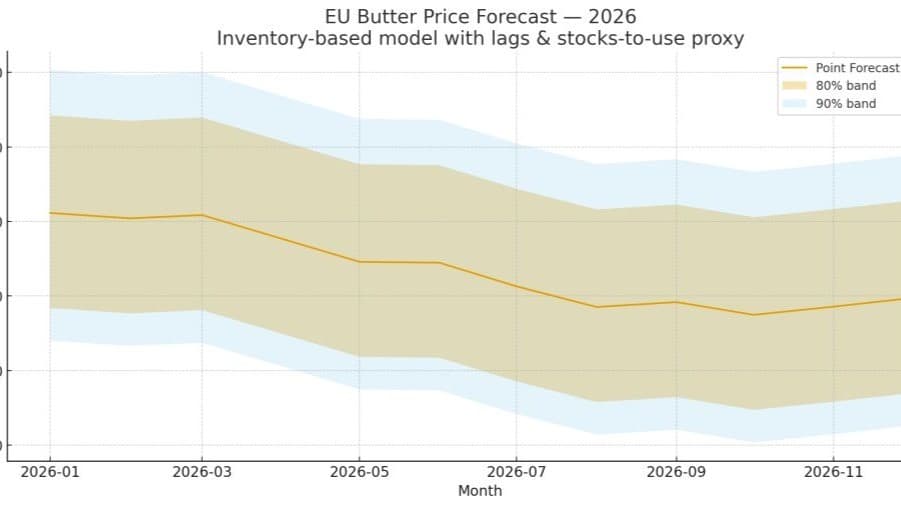
Summer Shopping or Summer Sale?
Last week was again a bit of a bearish week for the entire dairy industry. With cream prices under pressure and milk intake still strong, we keep seeing a market that has more supply than demand. Butter prices took another step lower, cheese prices cracked, and the powder market gave back a bit of its gains again.
Le rapport hebdomadaire
Recevez-le avant tout le monde
Chaque rapport de marché, dans votre boîte dès qu'il est écrit. Beurre, fromage, poudres, liquides — choisissez ce que vous négociez vraiment.
Environ hebdomadaire · Gratuit · Désinscription à tout moment