Stock it, or Sell? A New Dillema.
Les rapports de marché ne paraissent qu'en anglais. Le reste du site est disponible dans votre langue.

We start the week with a short update as the flu has reached the Get Fair Dairy Household and kept from doing anything else but watching Netflix, Amazon Prime and HBO (Big TIp! The White Lotus). We did have a lot of time to think about the dairy market, but it gave us more headaches than in the previous weeks. The market prices start to near levels where the downside is very small, so we would expect strategic buyers to come to the market. But it's an article we read in a dutch newspaper that causes us to doubt this will happen.
During the last few years, the world was faced with an almost infinite amount of money. Lending money was free and companies grew much harder than ever before. Investments were made without thinking and a warehouse, new buildings, and new lines were created almost without a proper business plan, because what else do you do with all that money? But this era has come to a quick halt now central banks have increased the interest rates at the fasted rate we have ever seen! And although it seems the US is slowing down its hikes, Europe is still expecting to continue its aggressive hikes.
The article we read stated that the era of investing without a good building business plan is over. Financial controllers are taking over and are managing the risk of investment and a proper forecast of the ROI is needed again. Companies that grew hard are now cutting their spending, letting 20-30% of their newly hired staff go and some are even pulling the plug! This is mainly seen in the tech and platform industry. But as the (dairy)production industry is a highly intense cash business analysts foresee these sectors are to follow quickly.
This fitted perfectly with some of the conversations we had during last week (and the weeks before). We have had several talks with traders who needed to increase their average earnings per trade as costs in their companies have been growing quickly last year. Not only interest rates are up, but staff costs, energy but also insurance cost are shooting up. As an example they gave me the simple trade of buying 100mt of butter, storing it for three months and selling it to their customer. In this particular trade the trader needed € 70,- an additional margin compared to a year or two years ago. Stocking and financing goods have become much less attractive due to higher costs. The warehouse is asking for higher costs to take the goods in and out (higher labour cost) and is asking more to store the good (energy costs are up). In the meantime, he is paying a much higher interest rate to finance the product he is stocking, money his company can better spend on turning a purchase into immediate sales. We also see that "neutral" financing costs are becoming a part of the deals again. Paying at 14 days and being paid in 30 days suddenly is an issue again.
A similar story we got from a producer who would normally now stock a lot of the product he is producing. Especially his winter butter he would be able to sell at a premium later in the year. But the butter he is producing at the moment is costing him still 60ct litre and he is able to sell it at roughly 37-40 cents per litre. But he needs to finance and stock the goods as well. He told us selling the goods at a discount today makes more sense than storing the goods, the problem is finding the companies that want to store these goods for him. That is why more and more producers are selling their raw milk in favour of producing commodities By selling liquids they have the quickest financial return on their milk contracts with the farmers.
The biggest opportunity seems to lie at the end users' side. As their sales contracts are still at relatively high prices and their purchase prices are dropping like a stone, they have some additional money to spend. As one end user told us, this is going to be their best quarter ever. But as this same end user told us, they have some gaps to fill from last year. So even for them, it doesn't seem as obvious to buy the product at the current market levels. Even if it seems we are reaching a bottom, some purchases are just too heavy to take for these companies without a guaranteed quick offtake.
Then who will buy the stocks to release them later in the year? It seems the EU might make a bit of margin after this summer. Because at the current rate, we drop prices, we might see the intervention programs buy up the goods to take them off the market for a few months, only to release them when the market needs them. But as said in a previous update, it will be a hard story to explain to buy up goods from producers to protect the pay-out price to farmers who have had the best year of their existence. Let's hope it will not come this far and the dairy sector finds a way to deal with the current oversupply situation in combination with high financing costs.
Plus du desk
Our Long View Before Our Long Break 
Our Long View Before Our Long Break
Last week the market found a bit of stability. After lower trades on cheese, the cheese market traded slowly up, although a real rally remains absent. Butter prices did dip a bit further, although at the start of this week we see some strength on the back end of the curve. And on powder, our bullish feeling just doesn't go away — and now we can find some confirmation in the market as well.
Dairy Carry Has a Shelf Life 
Dairy Carry Has a Shelf Life
Last week was bearish across the board — every product we broker leaned the wrong way. Powders lost more momentum, cheese slipped well below €3,000 for some products, and butter continues to impress with just how much keeps showing up. Supply, supply, supply.
Summer Shopping or Summer Sale? 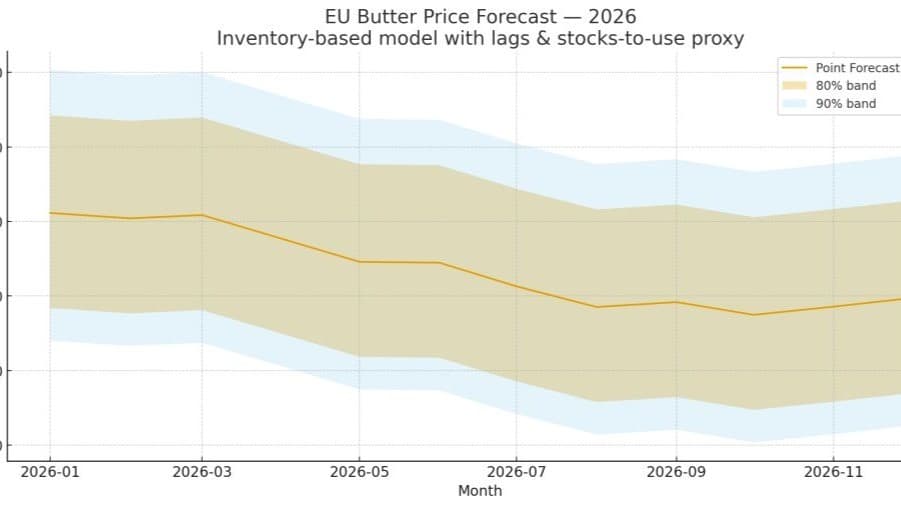
Summer Shopping or Summer Sale?
Last week was again a bit of a bearish week for the entire dairy industry. With cream prices under pressure and milk intake still strong, we keep seeing a market that has more supply than demand. Butter prices took another step lower, cheese prices cracked, and the powder market gave back a bit of its gains again.
Le rapport hebdomadaire
Recevez-le avant tout le monde
Chaque rapport de marché, dans votre boîte dès qu'il est écrit. Beurre, fromage, poudres, liquides — choisissez ce que vous négociez vraiment.
Environ hebdomadaire · Gratuit · Désinscription à tout moment