
Signs of Softness
Les rapports de marché ne paraissent qu'en anglais. Le reste du site est disponible dans votre langue.

In the first three days of this week, we’ve seen the market take a slightly more bearish turn—although calling it bearish may be overshooting. What we’re really observing is a shift in tone: more sellers are emerging, and buyers are easing off the gas. A weaker GDT auction is reinforcing the idea among sellers that we may have hit the ceiling on certain product prices, and locking in deals just below the top end might not be a bad strategy. Spot liquids haven’t shown the same weakness yet, but after weeks of firming, prices are now stabilising or even softening slightly.
🌏 GDT: Momentum Falters
Tuesday’s GDT auction provided the first hints of a shift. The headline result of -1.6% was primarily driven by a sharp -3.7% drop in WMP. Other product results were mixed: butter held flat (0%), SMP dipped by -1.1%, cheddar slumped -4.2%, and BMP dropped -6.1%. AMF showed strength with a +1.4% gain, remaining undervalued compared to other fat products, while Mozzarella rose 2.3%—although still falling short of where EEX futures had suggested it would land.
EU butter showed some mixed results. Solarec traded slightly higher at an average of €7450—up from the previous tender but still below last week’s top trades above €7500. Meanwhile, Kerry’s lactic butter dropped to around €7150, notably below what Irish producers expected to see outside the GDT framework.
Sure, the bullish camp will point out that prices remain historically high and that global demand for fat is strong. But with EU fat commanding the highest prices globally, the real question is whether there’s room left for EU prices to climb any further.
The GDT’s slightly bearish tone is now trickling into EU conversations. Again, bearish might not be the best word—prices aren’t collapsing—but sellers are showing up more frequently at the upper ends of the trading range. It’s as if the market has collectively decided that:
- Gouda above €4450
- Mozzarella above €4300
- SMP above €2450
- Butter above €7500
…may simply be a stretch too far. These levels have triggered enough farmer response to match current demand—so why go higher?
🥛 Spot Liquids: Stable but Vulnerable
Spot liquid prices remain in line with last week’s levels. Cream is trading between €8500 and €8800, with the lowest FCA offers from Eastern EU and the highest DAP offers into Central EU. Speaking with buyers late yesterday, we gathered that next week’s availability is still there, but most demand is already covered—hinting at a possible correction toward the end of this week.
Raw milk prices are flirting with the €0.50/kg mark, but most quotes from NL/BE/DE remain just under that. French milk prices edged up slightly, averaging around €0.45/kg—not exactly a bullish signal, but not weak either. Meanwhile, SMC remains steady, holding just above or just below €2000.
🧈 Butter: Market Pulls Back, Stock Builds
The butter market has taken a small step back. Last week, we closed some H2 sales in NL/DE/BE at €7500. Earlier this week, volumes moved at €7460, and current offers are now trending lower. Bids above €7325 are hard to come by.
Irish butter mirrors this pattern. After offers at €7450 last week, we’re now seeing numbers roughly €100/MT lower, with bids just above €7200. Polish butter, which peaked above €7400, has since seen trades closer to €7200 or lower. Ukrainian butter is offered between €6700 and €7000.
There’s no product flood—yet—but sellers are clearly building stock. Until late April, prompt product was hard to come by. Now, buyers in need for this week loading are finding fresh and frozen offers, readily available. Trading houses seem well-covered, having secured in May and June volumes to hedge H2 shorts. Producers, still on a month-by-month sales rhythm, may soon need to warehouse May–July production themselves to serve Q4 demand.
Our take? The market may turn bearish quicker than expected. The product in the last weeks has not been short on product—it was short on sellers. And now that shift has arrived. If sellers grow more aggressive in the coming weeks without buyers stepping up for Q3, prices for nearby positions could correct sharply. A discount of €300 versus Q4 might be needed to incentivize carryover of June–July into Q4.
Expected Offers:
- 9 trucks NL/DE/BE Q3 @ €7425
- 6 trucks NL/DE/BE June @ €7380
- 9 trucks Irish lactic Q3 @ €7350
- 4 trucks Polish lactic June @ €7300
- 2 trucks UK lactic @ €7250
- 5 trucks Irish Sweet Cream @ €7275
🧀 Cheese: Top Heavy
The cheese market is tracing butter’s pattern, albeit with more subdued buy-side activity. Sellers (both producers and traders) are actively looking to offload at the upper end of recent price ranges.
For Gouda, there’s ample selling interest around €4350, though lower bids would likely be considered. Mozzarella offers are back at €4300–€4350, but buyers have retreated to €4200–€4250. If cream and butter prices soften, cheese could follow—but likely at a slower pace.
Expected Sellers:
- 4 trucks Gouda June @ €4350
- 4 trucks Edam June @ €4325
- 3 trucks Mozzarella June @ €4325
🌫️ Powders: Hesitant Optimism
SMP sellers appear a touch more confident—buoyed by higher SMC prices and stable EU GDT performance. But weak demand and a soft USD are limiting any real upside. Despite higher US prices and NZ being out of season, EU sellers aren’t seeing the lift they’d hoped for. The window to break €2500 is closing. Trades remain stuck between €2300 and €2400, and offers above or bids below rarely meet.
For FCMP, the negative GDT outcome has made sellers more cautious. Offers are circulating more widely, but buyers without immediate needs are content to sit tight, waiting to see if prices dip further.
🧠 Final Thought: A Market at a Crossroads
We’re not seeing panic, but we are seeing posture changes—especially from the sell side. Prices aren’t collapsing, but they’re meeting firm ceilings. Producers for the first time in months are activlty calling buyers requesting bids. Demand hasn’t disappeared, but it’s now priced in. The coming weeks will be shaped not by product availability, but by timing and tone. If sellers keep testing the top while buyers stay patient, the balance may tip faster than most expect.
Keep your hedges flexible. Keep your Q4 eyes open. And maybe, just maybe, don't bet the barn on June prices holding firm.
Plus du desk
Our Long View Before Our Long Break 
Our Long View Before Our Long Break
Last week the market found a bit of stability. After lower trades on cheese, the cheese market traded slowly up, although a real rally remains absent. Butter prices did dip a bit further, although at the start of this week we see some strength on the back end of the curve. And on powder, our bullish feeling just doesn't go away — and now we can find some confirmation in the market as well.
Dairy Carry Has a Shelf Life 
Dairy Carry Has a Shelf Life
Last week was bearish across the board — every product we broker leaned the wrong way. Powders lost more momentum, cheese slipped well below €3,000 for some products, and butter continues to impress with just how much keeps showing up. Supply, supply, supply.
Summer Shopping or Summer Sale? 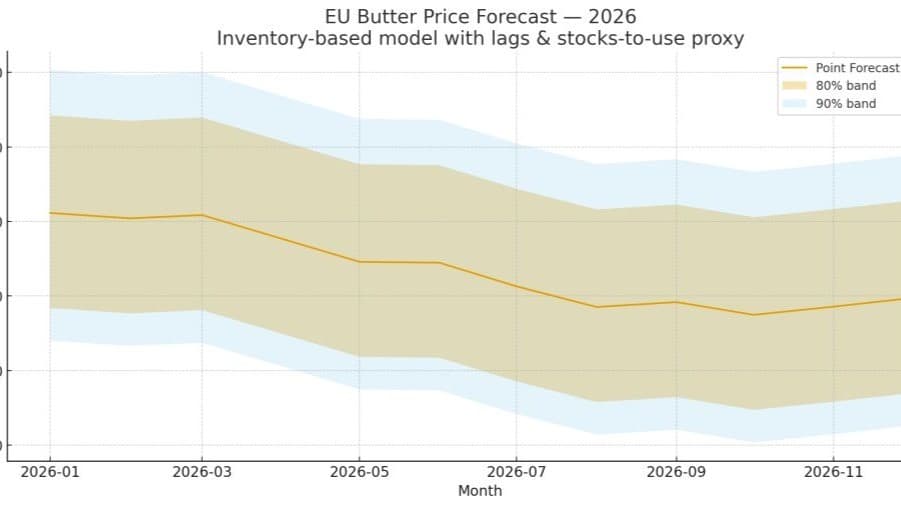
Summer Shopping or Summer Sale?
Last week was again a bit of a bearish week for the entire dairy industry. With cream prices under pressure and milk intake still strong, we keep seeing a market that has more supply than demand. Butter prices took another step lower, cheese prices cracked, and the powder market gave back a bit of its gains again.
Le rapport hebdomadaire
Recevez-le avant tout le monde
Chaque rapport de marché, dans votre boîte dès qu'il est écrit. Beurre, fromage, poudres, liquides — choisissez ce que vous négociez vraiment.
Environ hebdomadaire · Gratuit · Désinscription à tout moment