Market Analysis Week 33
Les rapports de marché ne paraissent qu'en anglais. Le reste du site est disponible dans votre langue.
The market last week felt a bit bumpy. Demand and supply both did not show any strong signals and all commodities we broker showed both strengths and weaknesses. The best thing is to try and zoom out and look at the fundamentals, but this also leaves a lot of room for debate. We decided to make again a bulls and bears analysis.
1. Milk Supply: Bullish for now / bearish for further out
We start with one of the most important factors, the milk supply. Looking at the European milk intake we hear, and have been reporting ourselves, many different numbers. Monthly figures over June and July seem to be showing a more increased trend, with milk numbers growing and the deficit with the year before decreasing. Belgium, Holland, Italy, Poland, and Ireland all seem to be reporting plusses, but Germany and France are showing more negative numbers still. But some argue that the milk intake is still at a higher number than the milk intake in 2019 and 2020, only the year 2021 is showing more milk. Looking at milk outside of the EU it seems that milk production is getting better. NZ season still needs to get fully active, but for now, the start looks promising. The US is also reporting a bit more milk YoY over the last months.
The milk figures from the previous weeks do show a bit more bearish signs. The hot weather is pushing down milk intake and the milk is reported thin with a lower fat and protein content. The biggest deficit in milk intake also hear is showing again for Germany and France, the two biggest suppliers. But looking at the weather outlook for Holland this week we see rainfall and lower temperatures again.
But the biggest question for supply is how will it develop over the next months. Speaking to farmers and sons of farmers they are happy with the current milk price. And at this milk price, it still pays off buying extra feed, even at a higher price. Moreover, we think we began the bigger downtrend last year in August, so we will compare milk intake numbers against the big minuses of last year. We think we might start to see bigger increases over the next months.
2. Demand: Slightly weaker for closeby / more bearish for further out
The demand side has always been the biggest blindspot for most participants in the market. Because you can predict the behaviour of cows better than the behaviour of humans. We have the tendency to copy our behaviour on the total consumer market, but so far it seems that not everyone thinks the same as us.
Prices of the commodities we brokered have increased around 80% compared to last year but prices in the supermarkets have "only" increased 10-30%. This means that suppliers and or retailers are losing a bit part of their margin. The price increase will have to follow slowly again to the consumers.
Up until now we also don't see a very big decline in consumption. We do hear some end users are selling 10-20% less compared to the year before but total consumption doesn't seem to be down yet. We hear frozen pizzas are more popular than ever as it is one of the cheapest meals you can buy in the supermarket.
But if we understand correctly supermarket will increase again their prices in September to keep their margins on track. Our expectation is still that if temperatures go down and gas usage goes up more and more people will have to rethink their spending. The careless summer period will have to make place for a winter of worries. We saw the following calculations for dutch consumers for an average household:
This is a spending increase of over € 9000,- per year, without adding the additional cost for clothing, Horeca, travels and luxury goods. We don't know if buying less dairy is a solution to close this gap, but we can't see any way that this is bullish for dairy demand. The longer these high prices are here, the more extreme we think the effect will be.
3. Alternatives: bearish
Dairy also knows a lot of alternatives. From Almond milk to vegetable cheese and soy drinks. Butter can be replaced by different types of vegetable oil and milk powders like whole milk has strong competition from different kinds of fat-filled and other blends The shortage of vegetable oils worldwide made production harder and much more expensive, but these prices have come down and availability is getting better again. We hear that butter spreads are demanded more again to keep the price a bit down.
And then we have the alternatives for on bread for example. Peanut butter, Jelly, chicken slices, or salami are coming down in price again and supermarkets can keep their sales price at the same level, but they will have to increase their price for all dairy products. We might see a shift in consumption due to better alternatives for demand.
4. Cost price: bullish!
The biggest bullish factor we see is the cost price factor. Looking at the cost for farmers we think it is mainly covered by the milk price of 60ct. But factories that take the milk and produce it into commodities are faced with higher costs in almost every factor in their business. They are faced with higher transport costs, higher labour costs, higher gas and energy prices, higher costs for packaging material, and higher financing costs. Making cheese, butter or SMP just isn't viable at lower prices as we are seeing in today's market.
And the costs are not likely to go down anytime soon. This is the main reason that sellers see no reason to lower the price further out as they expect to be faced with even higher costs! And we agree that we expect that these higher costs are here to stay for a long time!
The only argument against this reasoning remains that the market price of a commodity is never determined by the cost price of the commodity, but by the balance in supply and demand. If the supply exceeds demand prices will have to go down, no matter the cost price a factory has to produce the product. And the biggest button they can turn is that of the pay-out price for the milk.
My wife always tells me the same. You can spend 20 hours and € 500,- on paint, brushes and a canvas, but nobody will pay € 750,- for a painting you have made, no matter what your cost was. Maybe it's a long stretch to compare my art with dairy commodities, but we hope you get the point.
5. Export / Import: bearish
Europe is a big exporter of dairy products. With over 7.000.000 mt of export volumes, the EU is the biggest exporter in the world. With the current weakening of the euro, the EU faces much more difficulty exporting products. We hear it from all our partners, export business from out of the EU is down! And all this extra milk needs to find a new consumer.
The second biggest exporter in the world is Oceania. With the NZ season starting strong and prices for some products trading more than € 1500,- per mt lower we think Oceania will be taking more of the export volumes. We also hear that there is some non-EU product entering the EU market, and this is not only NZ product. We also hear more products from Ukrain entering the EU market. So with more expected import volume and less exported volumes, we expect the supply to grow quickly over the next 6 months.
If you want to listen to this update, please do so by listening to our podcast that we send out daily. Please find it via Spotify or Apple Podcast.
Plus du desk
Our Long View Before Our Long Break 
Our Long View Before Our Long Break
Last week the market found a bit of stability. After lower trades on cheese, the cheese market traded slowly up, although a real rally remains absent. Butter prices did dip a bit further, although at the start of this week we see some strength on the back end of the curve. And on powder, our bullish feeling just doesn't go away — and now we can find some confirmation in the market as well.
Dairy Carry Has a Shelf Life 
Dairy Carry Has a Shelf Life
Last week was bearish across the board — every product we broker leaned the wrong way. Powders lost more momentum, cheese slipped well below €3,000 for some products, and butter continues to impress with just how much keeps showing up. Supply, supply, supply.
Summer Shopping or Summer Sale? 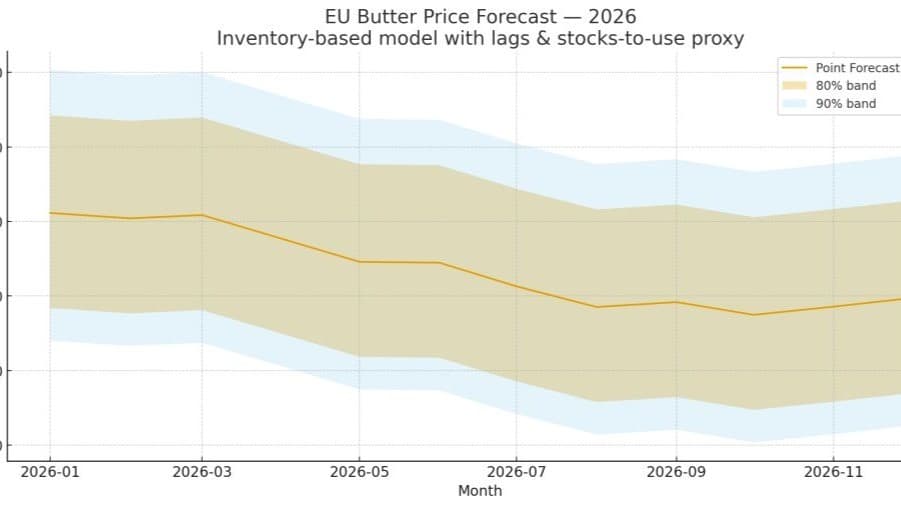
Summer Shopping or Summer Sale?
Last week was again a bit of a bearish week for the entire dairy industry. With cream prices under pressure and milk intake still strong, we keep seeing a market that has more supply than demand. Butter prices took another step lower, cheese prices cracked, and the powder market gave back a bit of its gains again.
Le rapport hebdomadaire
Recevez-le avant tout le monde
Chaque rapport de marché, dans votre boîte dès qu'il est écrit. Beurre, fromage, poudres, liquides — choisissez ce que vous négociez vraiment.
Environ hebdomadaire · Gratuit · Désinscription à tout moment