
Hoping for a Healthier Herd
Les rapports de marché ne paraissent qu'en anglais. Le reste du site est disponible dans votre langue.

Last week, our household was hit hard by the flu that’s been making its rounds in the Netherlands. Unlike FMD, this one doesn’t wasn't contained with a single case, as it quickly spread from our son to my wife, from my wife to me, and from me to our youngest daughter. The result? A week of lowered productivity across the board. My son voluntarily went to bed early (a first), the kitchen sink resembled an art installation of dirty dishes, and, unsurprisingly, brokering dairy commodities took a hit. While we’re on the mend, the efficiency of our well-oiled family machine will take some time to restore fully (looking at the sink....).
Interestingly, this flu-induced slump in productivity parallels what we’re observing in the EU dairy market. Milk yields in areas affected by bluetongue over the past months—Northern France, Belgium, the Netherlands, and Northwest Germany—continue to lag behind last year’s levels. The big question looming is whether bluetongue will resurface as temperatures rise and cows return to pasture, or if herds will recover and output will rebound in the coming months. Either way, this uncertainty looms large over the market, fueling the indecisiveness we’re seeing.
As for last week’s market movements, there wasn’t much to report in terms of dramatic shifts. Butter prices for February/March stayed steady around €7,350, with Q2 prices ticking up slightly. Gouda cheese remains accessible around €4,300, though the market feels firmer than expected, while Mozzarella offers hover around €4,000 or lower. Powder prices for SMP inched upward, but this seemed more a result of higher offers than genuine demand, with the market sitting between €2,450 and €2,500. Liquids, on the other hand, showed some weakness—raw milk prices outside of France are well below 50 cents, and cream ended the week between €8,250 and €8,450. These softer liquid prices hint at growing availability and reduced demand from processors turning them into hard commodities.
Milk supply dynamics?
Here’s what we gleaned from last week, despite our “man flu” haze. Conversations with producers across Europe painted a clear picture: their bullish stance isn’t just wishful thinking for higher prices but stems from real challenges with milk production. In Belgium, some report a 4% shortfall against forecasts, while in Northern France, figures are down nearly 10%. Interestingly, the milk that is being produced seems richer—likely a result of favorable prices incentivizing farmers to optimize quality.
Germany’s production story aligns with these trends. Most partners attribute reduced yields—about 2% lower on average—to last year’s bluetongue outbreaks, compounded by smaller herds and underperforming cows. A breakdown of where Germany’s milk is heading in 2025’s first weeks reveals notable shifts: butter production is up 7%, SMP is up 15%, while cheese is down 4%. These adjustments reflect supply challenges and hint at why the cheese market feels firmer, whereas butter appears more balanced—plenty of supply, just fewer ready sellers.
Meanwhile, Irish co-ops are firmly in “wait and see” mode. After Friday’s storm, it’s not hard to imagine why milk collection and logistics might have been challenging. While we’ve heard no major market disruptions yet, we wouldn’t rule out an “Eowyn effect” in the coming weeks. When it comes to forward selling, Irish co-ops seem content to sit tight, only offering prices comparable to last year’s levels.
Producers in the Netherlands, ever pragmatic, are less bullish than their neighbours. As one put it, “We’re realistic.” Their primary concerns aren’t with milk supply forecasts but with securing offtake contracts. Fats remain uncompetitive for export, and even cheese could face headwinds. Moreover, the rapid growth in EU cheese consumption that drove recent price hikes appears to be slowing. Add to that the lingering effects of the FMD outbreak in Germany—however well-contained—and export logistics become trickier. As one Dutch producer remarked, “We know Brandenburg is a six-hour drive from here, but try explaining that to someone in Malaysia.”
Bringing it all together, the flat market makes sense. There’s little to suggest a strong upward price movement, despite low stocks of butter and cheese hinting at some upside potential. If it were summer, we’d likely be bullish on both. But given the season and the expectation that milk volumes will rebuild inventories over the coming months, such optimism seems premature. If Germany’s approach to milk utilization is indicative of broader EU trends, we could see significantly more milk diverted to butter and SMP production, leaving cheese somewhat sidelined. We’ll continue to keep a close eye on developments. Let's hope our family's recovery is an inspiration for the blue tongue-affected cows and we will start to see some milk flowing in the next months.
This week, we’ll be attending Eucolait in Brussels with Linda. We’re eager to share insights with as many of you as possible. Forgive us if we keep a bit of distance—we aim to spread knowledge and commodities, not this persistent flu.
Butter: Waiting on cheaper cream
The butter market, as it stands, isn’t exactly buzzing with activity. And that’s not just our take—it’s the consensus across the board, from producers to end-users and traders. It seems we’re all watching and waiting for the same elusive catalyst: cheaper cream. End-users appear to have their immediate needs covered, with most signaling they’ll only return to the table if prices dip below €7,000. Traders, burned a little too often by speculative strategies in 2024, are now exercising caution, waiting for better offers from producers. And as for the producers? They’re also playing the waiting game, eyeing more affordable cream. One producer summed it up rather aptly: “Give me 20 containers of cheaper cream, and I’ll give you 10 containers of cheaper butter.” Without cheaper cream, producers see little incentive to entertain speculative price reductions.
That said, the cream market provided plenty of drama last week. Between Monday and Wednesday, cheaper cream was practically a ghost, with prices surging to nearly €9,000 DAP. But by Thursday morning, the tide turned—more cream offers surfaced just as buyers seemed to have satisfied their needs. This shift saw prices retreat to as low as €8,250, though the bulk of trades hovered around €8,450. If this trend persists, we anticipate producers will adjust block butter prices downward accordingly.
In Poland, we could see butter prices dipping close to €7,000, while Germany, Belgium, and the Netherlands might stabilize around €7,250 to €7,300, where demand seems solid. As for the Irish, don’t hold your breath—they’re unlikely to follow suit in the coming week, as they currently have no pressing incentive to enter the market.
Our market opens with buyers for...
- 6 loads of NL/DE/BE for February at € 7300
- 6 loads of NL/DE/BE for Q2 at € 7150
- 1 trucks of Lumiko Lactic for February at € 7000
Cheese: Will less production drive prices up?
We firmly believe that the long-term price of a commodity is ultimately dictated by the delicate dance between supply and demand. Right now, that balance is showing divergent trends: butter supply is increasing, while cheese supply is shrinking. A quick analysis suggests an upward trajectory for cheese prices. The lingering question is, why are producers channeling less milk into cheese? Is demand softening in tandem with production? While we lack precise data, what we observe hints at a slowdown or plateau in growth. A full-blown decline? That seems overly pessimistic at this stage.
This shift in cheese production dynamics should soon make itself known in the pricing landscape. Speaking to traders, many report younger cheese coming to market—some of it too young for their partners to even process. Meanwhile, demand for cheddar remains robust, so a slightly more bullish cheese market wouldn’t come as a surprise.
The main bearish note we heard last week revolves around export volume challenges. Some destinations for EU cheese have raised concerns over German milk in cheese products. Although export restrictions have been lifted in some eareas, not everyone is eager to book new volumes just yet. Given the significant role of the EU’s export business (and the German share of it) in the cheese market, any sustained slowdown here could counteract the bullish effects of lower production. This is certainly something to keep a close eye on.
We expect to start with the following offers...
- an offer for 2 trucks Gouda for February at € 4325
- an offer for 1 truck of Mozzarella for prompt at € 4050
- an offer for 3 trucks of Mozzarela for Q2 at € 4180
- an offer for 3 trucks of Gouda for Q2 at € 4450
Powders: Can we get liftoff?
The powder market has become a master of the “fake-out breakout” over the past two years. The recurring nature of these false starts suggests one thing: the majority of market participants are inherently bullish. Before the FMD outbreak, the market once again carried a bullish undertone, only to be dragged down swiftly by mounting concerns over export challenges. With SMC coming under pressure unusually early this year, we even heard of German SMP trading at prices around €2,300. However, the market, ever resilient, appears to be adapting to this new reality, and last week brought a noticeable shift—let’s call it a move from “bearish” to “ready for another fake-out.”
The EU’s export potential was buoyed last week by a weaker euro, with more deals reportedly booked, reinforcing that budding bullish sentiment. But, as is often the case, reality came knocking at the end of the week with some less-than-encouraging news. Algeria is expected to announce in its next tender a block on powders from the Netherlands, Germany, Belgium, and France—a move that could certainly shake up market dynamics. Meanwhile, Malaysia continues its block on German products, adding another layer of complexity to exports from the region.
As for the currency market, the dollar’s strength appears to be waning, much like it did during Trump’s first presidency. While the initial surge in the dollar under Trump created ripples, it seems the tide is receding once more, subtly affecting market sentiment.
We expect to start the day with the following offers
- 200mt of Solarec SMP (max 6 months) for Feb at € 2600
- 200mt of German SMP (max 3 months old) for Feb at € 2550
- 100mt of Spanish SMP (max 6 months old) for feb at € 1050 FCA NL
Plus du desk
Our Long View Before Our Long Break 
Our Long View Before Our Long Break
Last week the market found a bit of stability. After lower trades on cheese, the cheese market traded slowly up, although a real rally remains absent. Butter prices did dip a bit further, although at the start of this week we see some strength on the back end of the curve. And on powder, our bullish feeling just doesn't go away — and now we can find some confirmation in the market as well.
Dairy Carry Has a Shelf Life 
Dairy Carry Has a Shelf Life
Last week was bearish across the board — every product we broker leaned the wrong way. Powders lost more momentum, cheese slipped well below €3,000 for some products, and butter continues to impress with just how much keeps showing up. Supply, supply, supply.
Summer Shopping or Summer Sale? 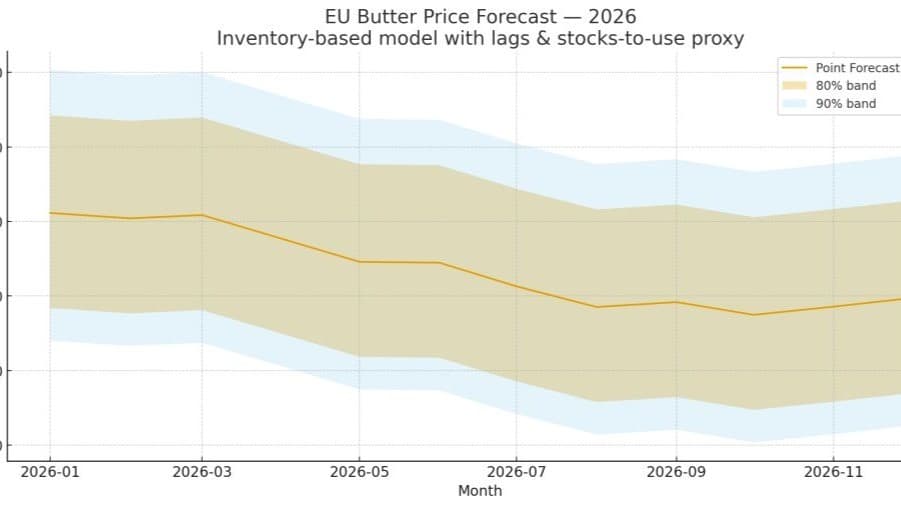
Summer Shopping or Summer Sale?
Last week was again a bit of a bearish week for the entire dairy industry. With cream prices under pressure and milk intake still strong, we keep seeing a market that has more supply than demand. Butter prices took another step lower, cheese prices cracked, and the powder market gave back a bit of its gains again.
Le rapport hebdomadaire
Recevez-le avant tout le monde
Chaque rapport de marché, dans votre boîte dès qu'il est écrit. Beurre, fromage, poudres, liquides — choisissez ce que vous négociez vraiment.
Environ hebdomadaire · Gratuit · Désinscription à tout moment