Firm Commodities & Weaker Liquids
Les rapports de marché ne paraissent qu'en anglais. Le reste du site est disponible dans votre langue.

The last two trading days have been relatively quiet. The commodity market seems to be at a standstill, with both buyers and sellers either unable, unwilling, or simply too uncertain about where the right price level should be. Stocks for core products like cheese, butter, and SMP remain relatively low, and the fear of runaway prices still lingers. As a result, market sentiment remains nervous—leaning slightly bullish—but we see little fundamental data to confirm that stance. In fact, there’s little support for current price levels to hold in the long term.
Those closest to the liquid market are already seeing signs that more milk will have to be processed. Cream, raw milk, and SCM in Ireland and the UK are under immense pressure. Prices below €1,000 for SCM in Ireland, cream trading under €7,700, and raw milk dipping below 10 cents today were no exception. And with the seasonal milk peak still ahead, we’re looking at another 5–8 weeks of significant pressure on the liquid segment. The problem with having excess liquid on an island is getting it to the continent. It’s not easy—and definitely not cheap. Transport costs can run upwards of €3,000–€4,000 per load, making even the cheapest product relatively expensive by the time it arrives on the mainland.
But it’s not just Irish milk volumes rising quickly. While France had been trailing behind last year’s pace, the latest data suggests milk intake is now on par with both 2023 and 2024. And with the peak still ahead, a strong post-peak milk tail—encouraged by higher farmgate prices—could keep flows elevated well into late spring. Spot milk in France dropped well below €0.40 this week. Combine this with strong UK and Irish volumes and France’s recovery, and it's no surprise that continental liquid markets are under renewed pressure. Cream prices today were reported between €8,200 FCA Western EU and €8,550 DAP Eastern EU.
The official EU-27 milk intake numbers for January and February are in: volumes are up around 0.6% compared to last year. And all signs from March suggest that Ireland, the Netherlands, France, and Germany have continued that upward trend. Barring any major disruptions from Bluetongue or FMD, the EU is set for a strong milk season.
What’s more, farmers are getting some of the highest milk prices they’ve ever seen—without the high input costs that previously accompanied such prices. Unlike during the last price peak, energy, fertilizer, and feed costs have not surged at the same pace. In short, margins look a lot healthier this time around.
Import + Exports
Looking beyond milk intake, we turn to import and export figures to understand broader EU supply-demand dynamics. Unfortunately, we don’t have access to weekly updates, but the latest available data indicates that imports of butter and cheese are up year-on-year, while exports have declined.
Butter Imports & Exports
In 2024, EU butter exports had already declined by 2.6% year-on-year, according to Vesper data. However, the first figures for January 2025 indicate an even sharper slowdown, with volumes down over 10% compared to January 2024. On the import side, the longer-term trend has shown a significant decline over the past three years. Yet, the January data suggests a notable shift: butter imports rose by approximately 38%, marking a clear break from previous years. This uptick is particularly evident in volumes from third countries, including shipments brokered through our own network. Based on these early figures, EU butter imports are poised to significantly outperform last year's levels.
Cheese Imports & Exports
EU cheese exports grew by around 1% in 2024, reinforcing the EU's strong global position in cheese trade. However, the January 2025 data shows a reversal in this trend, with exports falling by more than 8% compared to the same month last year. It’s worth noting that this drop may be largely attributed to the FMD outbreak in Germany during January, which led to the suspension of nearly all cheese exports. We’ll be closely monitoring the data in the coming months to assess whether this is a temporary disruption or the beginning of a broader trend. On the import side, cheese volumes have remained stable, tracking closely with the previous year.
SMP Imports & Exports
EU skimmed milk powder (SMP) exports experienced a sharp decline last year, with volumes down nearly 9% compared to the previous year. This suggests lower production, although weak exports did not translate into significant price increases. Early figures from January 2025 indicate that SMP exports are currently running at similar levels to January 2024. Meanwhile, SMP imports rose by 15% over the course of last year, with the bulk of volumes coming from the UK and Ukraine. This growing reliance on external supply will be an area to watch going forward.
With global dynamics shifting rapidly and the euro strengthening against the weakening dollar, we’ve already concluded that exporting EU dairy at historically high price levels will remain a challenge. US milk production is increasing, and Oceania is also seeing growth—both competitors are positioned to reclaim market share, pushing EU exports further into decline.
This leaves internal EU demand as the critical balancing factor. Unfortunately, as we’ve discussed many times, demand data only becomes available when it’s too late to act on. So we rely on anecdotal evidence. Some reports suggest slowing demand due to high prices, while others indicate that customer interest remains stable compared to last year. In the absence of firm data, we’ll settle on the safest conclusion: internal demand is stable.
So where does that leave us?
With the supply and demand curve shifting, we should expect price adjustments. But so far, the market hasn’t responded in the way many anticipated. One partner even questioned whether our analysis might be off. We doubted ourselves for a split second—then moved on quickly to avoid answering such an uncomfortable question. Because the market has behaved far more resiliently than fundamentals alone would justify. Our view hasn’t changed: this market isn’t short on product, it’s short on sellers. And buyers aren’t necessarily consuming more—they’re just trying to secure volume earlier.
From a seller’s point of view, the reluctance to sell forward is understandable. The price curve is backwardated, the political climate for dairy is far from friendly, and health threats like Bluetongue and FMD add uncertainty. There’s little incentive to commit forward, and month-to-month selling strategies have so far delivered excellent returns.
From a buyer’s perspective, we also understand the urge to secure volume early. The same production uncertainty is pushing them to lock in supply—even if the price stretches their comfort zone. Last year’s month-to-month strategy was a losing game, and this year’s hopes for lower prices haven’t played out either. Buying forward is a logical and safe strategy.
Traders caught in between—the ones bridging hesitant sellers and eager buyers—are now exposed on forward contracts without strong phycial commitments from producers. Paper contracts may hedge their price risk, but not their physical risk. As a result, traders are cautious about selling forward physical volume without the ability to derisk themselves forward.
This combination of nervous sellers, early-buying buyers, and exposed traders has created a firm market for commodities like cheese and butter. It’s a situation that could continue for days, weeks, or even months. But logic suggests this pattern isn’t sustainable. Buyers who took a head start in covering their months forward will finish covering their needs before producers finish selling. And if that coincides with strong milk flows, weak exports, and increased competition from non-EU origins, the winning month-to-month sales strategy could quickly unravel.
In such a scenario, traders may be forced to unwind paper hedges in order to purchase physical product—resulting in a double impact on prices. Because the big question there is, who will be there to catch those offered futures? So when Futures will fall, physical prices will have to follow, otherwise the trader can't unwind their hedge. A perfect mirror image of the current market, where eager buyers are driving both physical and futures prices higher than the fundamentals support.
And with that final bit of market theory, we’ll sign off—for now.
With Easter approaching and a short family break ahead, we’re stepping away from the dairy market for a few days. Our colleague Linda will be available to assist from April 22nd, and we’ll be back in full swing on April 29th to help our partners secure the best prices on butter, cheese, and SMP.
Wishing you all a happy and peaceful Easter.
Plus du desk
Our Long View Before Our Long Break 
Our Long View Before Our Long Break
Last week the market found a bit of stability. After lower trades on cheese, the cheese market traded slowly up, although a real rally remains absent. Butter prices did dip a bit further, although at the start of this week we see some strength on the back end of the curve. And on powder, our bullish feeling just doesn't go away — and now we can find some confirmation in the market as well.
Dairy Carry Has a Shelf Life 
Dairy Carry Has a Shelf Life
Last week was bearish across the board — every product we broker leaned the wrong way. Powders lost more momentum, cheese slipped well below €3,000 for some products, and butter continues to impress with just how much keeps showing up. Supply, supply, supply.
Summer Shopping or Summer Sale? 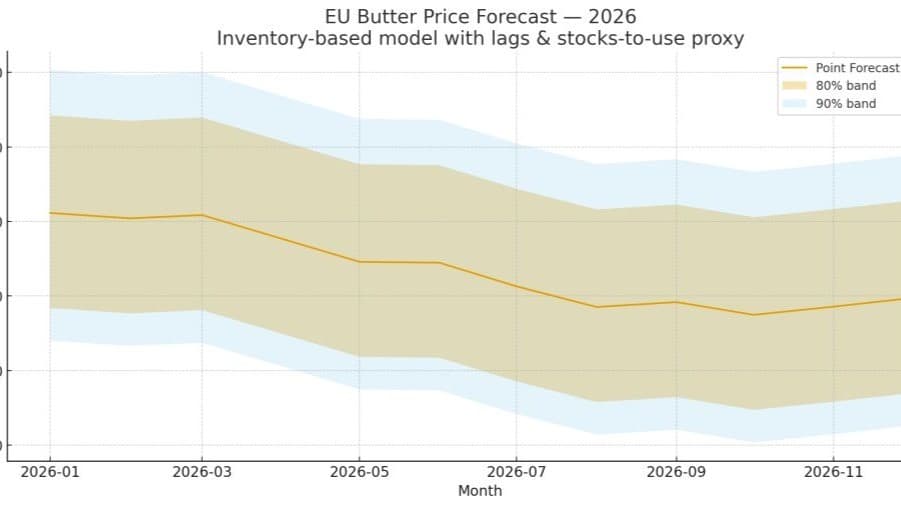
Summer Shopping or Summer Sale?
Last week was again a bit of a bearish week for the entire dairy industry. With cream prices under pressure and milk intake still strong, we keep seeing a market that has more supply than demand. Butter prices took another step lower, cheese prices cracked, and the powder market gave back a bit of its gains again.
Le rapport hebdomadaire
Recevez-le avant tout le monde
Chaque rapport de marché, dans votre boîte dès qu'il est écrit. Beurre, fromage, poudres, liquides — choisissez ce que vous négociez vraiment.
Environ hebdomadaire · Gratuit · Désinscription à tout moment