End-User Rally
Les rapports de marché ne paraissent qu'en anglais. Le reste du site est disponible dans votre langue.

Yesterday the market continued its strong run. And where in the first days of this market lift up it has been mainly driven by traders covering shorts and building positions, now it seems the end users are pulling the price rally further up. It seems end users realize that waiting for the market to come down might take longer than they expected, and with 2022 still fresh in their memories (we went from € 5500 in February to € 7500 in April for butter) they all seem to jump on the train and cover their needs.
We have had several discussions about the market again, mainly about the market "fundamentals". And this seems to be the conclusion that might explain the current market conditions.
Supply: How strong is it?
We talk about a strong and steady milk supply, but against what do we need to compare it? Looking at the Dutch milk supply it's on the highest intake it has ever been, confirming the opinion about strong milk intake. But looking at Germany we see that the curve might be elevated over 2022 production figures, but it's relatively flat compared to 2021. And France is reporting a minus of 2%, but this is even compared to a very weak 2022. Compared to the previous 5 years it's at its lowest. In general, it seems the milk supply is up compared to last year, but how much EU milk production is up against 2021 (the last best year) we can't get those numbers clear yet. But it seems that it isn't close to the 3-5% increase we see in the Netherlands and Germany.
Demand: How weak is it?
Another much hear conclusion is that demand is weak! Retail numbers are down but reported differences variate between 6% and 20%. It's not that strange, because last year around this time, the world was only now just coming out of its COVID period. And with the war in Ukraine, the market last year also got a demand boost (people panic buying) so those numbers will continue to look weaker. Food service demand seems to be rather stable. There are big economic headwinds, but the question remains how much do they impact food service demand? It seems that families who are impacted most were already in a situation where they couldn't spend their money without thinking. The people that were buying "expensive" dairy products and ordering food in the restaurant and pizzerias all got an increase on their paycheck and keep spending as they did.
We do hear that export demand remains very low as some countries in Africa and the middle east struggle with inflation and low demand in their countries as well. We do understand that most of these countries have "eaten" through their stocks in the last 9 months of high prices, so once prices drop again to attractive levels, most countries will have to rebuild their stocks again, giving a boost to demand at lower levels.
Stocks: How big are they?
If we have to believe the stock reports from our partners around the world, it seems the world is sitting on a hell lot of dairy products. And we have got confirmed that warehouses are full, China is sitting on a big bump of milk powders, and especially for milk powder there is a lot of old product around in the market.
But it seems that stocks at retailers and end users have been rather small. At record-high prices, it was not attractive or financially possible to keep big stocks. We see some end users still work with a rather small working stock. Demand from these customers seems to focus on next week/week after deliveries. Retailers who are nearing the end of some contracts are keeping their warehouses empty only to replenish them once the new lower contracts are closed. We saw the strong effect of this two weeks ago once the retail contracts in Germany were closed around € 5100 after trading at € 7500 the months before.
It's never as bad or as good as it seems
The conclusion seems to be at the end of most conversations that the market dynamics might be in the favour of supply and a lower market price is fair to expect. The question that needs answering is what a lower market price is. Historically cheese at € 3000,- is fair market value, butter at € 3800 seems decent and powders around € 2400 seem ok to live with. But we have to factor in the inflation of the last 5-10 years. Regulations have made farming much more expensive, labour costs are up, feed and fertilizer are more expensive and energy might be back from all-time highs, but they are still up 100-200% compared to previous years. Maybe if we add 15-20% to the long-term fair value prices we will find a price level where supply and demand find a balance.
Last year when the market shot up to record-high levels we concluded at the end that supply and demand were still relatively well balanced and the fear to get short on supply was never needed. And now that the market took a dive to the lows their seemed to be the fear that demand would disappear and nobody would eat a sandwich with butter and cheese ever again. But just like myself, it seems demand might shift a bit, but it didn't collapse.
Plus du desk
Our Long View Before Our Long Break 
Our Long View Before Our Long Break
Last week the market found a bit of stability. After lower trades on cheese, the cheese market traded slowly up, although a real rally remains absent. Butter prices did dip a bit further, although at the start of this week we see some strength on the back end of the curve. And on powder, our bullish feeling just doesn't go away — and now we can find some confirmation in the market as well.
Dairy Carry Has a Shelf Life 
Dairy Carry Has a Shelf Life
Last week was bearish across the board — every product we broker leaned the wrong way. Powders lost more momentum, cheese slipped well below €3,000 for some products, and butter continues to impress with just how much keeps showing up. Supply, supply, supply.
Summer Shopping or Summer Sale? 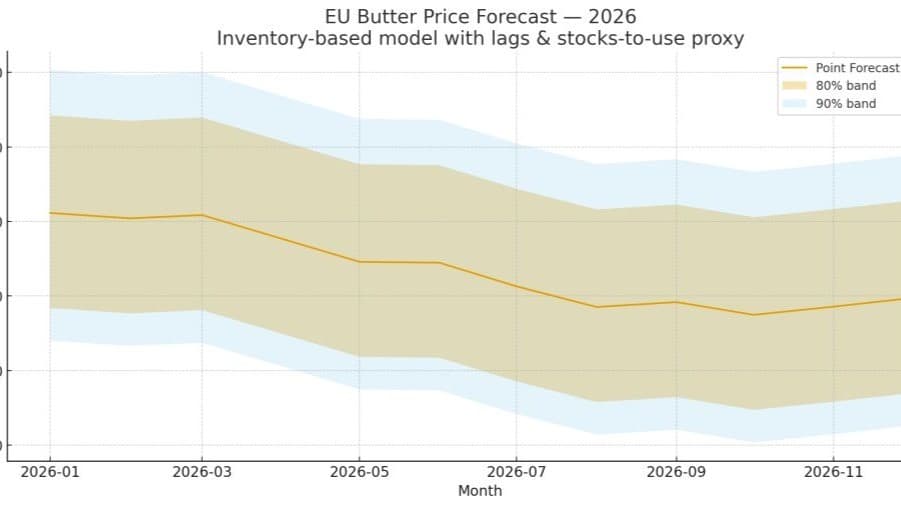
Summer Shopping or Summer Sale?
Last week was again a bit of a bearish week for the entire dairy industry. With cream prices under pressure and milk intake still strong, we keep seeing a market that has more supply than demand. Butter prices took another step lower, cheese prices cracked, and the powder market gave back a bit of its gains again.
Le rapport hebdomadaire
Recevez-le avant tout le monde
Chaque rapport de marché, dans votre boîte dès qu'il est écrit. Beurre, fromage, poudres, liquides — choisissez ce que vous négociez vraiment.
Environ hebdomadaire · Gratuit · Désinscription à tout moment