Balanced Market with Bias Confirmation
Les rapports de marché ne paraissent qu'en anglais. Le reste du site est disponible dans votre langue.

Last week, we spent our time mingling and debating with trading partners in Denmark. The city of Copenhagen treated us well — with good weather, even better company, and tasteful food and drinks. Interestingly, no one seemed to arrive with a strong opinion on the market direction for any commodity — and just as few left with one. The presentations we attended offered both bullish and bearish perspectives, and the general takeaway seemed to be the same across the board: the market is currently balanced, and as such, prices are likely to move sideways for now. If we had to summarise the sentiment at Eucolait, it would be this: uncertain, but calm — and perhaps that’s the most honest read on today’s dairy market. One partner put it like this, and with his permission, we share his thought below:
"The dairy market has a bright future, and the long-term trend in prices appears steadily upward. In the short term, however, prices will continue to bounce due to volatility in production, trade restrictions, inflation, weather conditions, and shifting consumption patterns. These swings—both upward and downward—are becoming more dramatic, reinforcing the growing need for robust risk management. The days of earning money purely through market vision seem to be behind us. Today, it’s the capacity to stay agile, adapt quickly, and manage exposure that separates the survivors from the standouts."
GFD Exchange Update:
A big thank you to everyone who showed genuine interest in the renewed GFD Exchange, launching this September. Your enthusiasm confirms what we’ve felt for a while: a good part of the dairy commodity market is more than ready for its next evolution. In the coming weeks, we’ll open up pre-registration for early adopters — and start sharing more about the updated way we work. If last week taught us anything, it's this: the demand for a smarter, more tailored digital approach to trading is stronger than ever.
Your feedback will directly shape how we move forward and we welcome to keep getting your feedback. In the near futures we will be shifting away from minute-to-minute price broadcasting and moving toward a model that prioritises:
🎯 Access to specific, relevant counterparties
Precision over volume — connect only with those who truly match your trade profile.
📈 Focus on the broader price trend, not just the noise
Zoom out, trade smarter. Let the market guide you without drowning in hourly swings.
⚡ Quick and intuitive trade execution
Click, confirm, done. Speed matters — especially when the market moves faster than your inbox.
🔒 Structured privacy with strategic transparency
Your offers, bids and trades are protected. Only share what serves your deal — not what exposes your position.
🔄 Support for flexible deal types (swaps, index linked contracts and more)
Modern markets need modern mechanics. GFD Exchange enables the trades of today and tomorrow.
We believe the next phase of digital trading isn’t about more data — it’s about better direction. “It’s not about seeing everything. It’s about seeing what matters, and more over, what matters to you — and acting faster when it does.”
Butter Market Outlook: Balanced Market with Bias Confirmation
It’s been one of those weeks. The kind where the butter market didn’t scream in either direction — but still managed to spark lively debates. On paper, the fundamentals didn’t shift much. Prices hovered in familiar territory, demand signals were mixed, and supply concerns stayed manageable. But that didn’t stop the interpretations from flowing.
Bulls saw strength in stable pricing, solid retail pull, and decent production. The IFCN presentation, in particular, was music to the ears of the bulls — especially the graph projecting a potential growth path toward $10,000 butter prices. Of course, the team from IFCN will point out that this is only one of several scenarios, and in the meantime, prices are likely to bounce around heavily around a trendline that may gradually rise in that direction. Still, we tend to agree with their broader view: global demand for butter is growing, and the real question is whether production will be able to keep up. Especially with a weak outlook for SMP, butter might have to carry the weight when it comes to valorisation, competing with other products to drive market value.
Bears, on the other hand, pointed to lacklustre export momentum, rising stocks, increasing imports, and softening demand from industrial users like bakeries and the chocolate industry. Monica Wohlfarths presentation from ZMB struck a chord with the butter bears. Her expectation that butter stocks could end the year above last year’s levels seemed to ease some of the anxiety among our partners who feared another tight supply situation by year-end.
So, those who came to Copenhagen bullish on butter likely left just as bullish — but the bears didn’t lose confidence either. By Friday, we were looking at a butter market made up of sellers convinced prices would rise, and buyers just as convinced they would fall — making our job of bringing the two together, well… nearly impossible.
Cheese: Peak Milk Production Hits Market
The cheese market has been even more rangebound than butter over the past few months. And if you ask our partners most active in cheese, there's not much excitement to report. Even some producers have voiced their frustration — not about low prices, but about the sheer lack of movement.
Retail demand has been relatively stable — in some cases even slightly stronger than last year — thanks to aggressive discounting on the shelves. These heavy discounts are now eating into the margin of retailers. The question is how long they will continue to stimulate cheese sales at the cost of their own margins. However, steady production has kept stock levels balanced, preventing any real tightening. Among the various cheese types, cheddar feels more oversupplied than Gouda, Edam, or Mozzarella.
One of the more telling charts from last week showed turnover in the food service sector. After years of steady growth, it’s now plateauing — roughly flat compared to the same period last year. But with inflation running high, flat turnover means fewer kilos are being sold at higher prices. That loss in volume is expected to become more visible in the coming months. Export demand also seems to be losing a bit of steam.
In the current spot market, we’re seeing more availability for nearby deliveries. Prices for Mozzarella, Gouda, and Edam are under slight pressure, as more volume is entering (or about to enter) the market in June — just as demand softens. Some suggest this is a temporary issue tied to peak milk flush production. If so, volumes should taper off soon, and any near-term price weakness might be short-lived.
At the moment, we continue to see selling pressure for Gouda, Edam, and Mozzarella — with Gouda and Edam trading just below €4300, and Mozzarella slightly above €4200.
Powders: Our Bullish Pick
But if you really wanted to meet bored traders, buyers, or producers last week, you should’ve talked to the powder crowd in Copenhagen. For the second year in a row, they’re reporting sideways price action — especially on skimmed milk powder — and after more than 24 months of rangebound movement, few are feeling optimistic about the near-term outlook.
That’s where we diverge from the consensus.
Yes, the powder market has been stuck in a tight range, which has kept buyers away from forward contracts at any sort of premium. But at the same time, we’re not seeing producers or traders offering flat forward sales either. No one seems eager to take a long position — and yet, older stocks are becoming increasingly scarce, and fresh SMC production remains inconsistent and, in some cases, almost unusable.
Frankly, if a general commodity trader without dairy-specific knowledge looked at this setup, they’d probably call it bullish.
In addition, several market participants pointed out that the price gap between whey and skimmed milk proteins has grown too wide. There are early signs that buyers are starting to shift away from SWC toward SMP. If that trend gains momentum, it could give a much-needed lift to the SMP market.
That said, the outlook for WMP/FCMP is less bullish. The EU remains expensive, and more NZ product is making its way into the bloc. At current spreads, buyers appear increasingly open to non-EU origins — and if the protein shift toward SMP continues, whey prices could come under additional pressure in the months ahead.
As for the current market? We’re honestly wondering why powder traders are so bored. At GFD, we continue to see growing activity across our books. Special shoutout to Linda, who was prepped, sharp, and ready to mingle in Copenhagen — until her ankle had other plans. Not the market but her ankle twisted, leaving her injured at the sidelines of the Eucolait. While one foot stayed elevated in her hotel room, the other stayed firmly planted in the market — and she still managed to broker over 1,500 MT of product. For those who missed her, don’t worry — we’ll be at the StoneX event in Dublin, ready to talk powders, prices, and possibly orthopaedic footwear.
From Noise to Navigation
In a market where everyone is waiting for someone else to make the first move, it's tempting to mistake silence for stagnation. But underneath the sideways charts and cautious conversations lies a quiet shift: away from chasing daily direction and toward building smarter systems, better access, and stronger positioning. At GFD, we believe that in a balanced market, it’s not about having the loudest view — it’s about having the clearest one. Let's stay connected. If we are able to help you with your need to buy or sell dairy commodities, feel free to reach out. And if you have any questions about the GFD Exchange? Stay connected and we will tune in again soon with more concrete news and actions.
Plus du desk
Our Long View Before Our Long Break 
Our Long View Before Our Long Break
Last week the market found a bit of stability. After lower trades on cheese, the cheese market traded slowly up, although a real rally remains absent. Butter prices did dip a bit further, although at the start of this week we see some strength on the back end of the curve. And on powder, our bullish feeling just doesn't go away — and now we can find some confirmation in the market as well.
Dairy Carry Has a Shelf Life 
Dairy Carry Has a Shelf Life
Last week was bearish across the board — every product we broker leaned the wrong way. Powders lost more momentum, cheese slipped well below €3,000 for some products, and butter continues to impress with just how much keeps showing up. Supply, supply, supply.
Summer Shopping or Summer Sale? 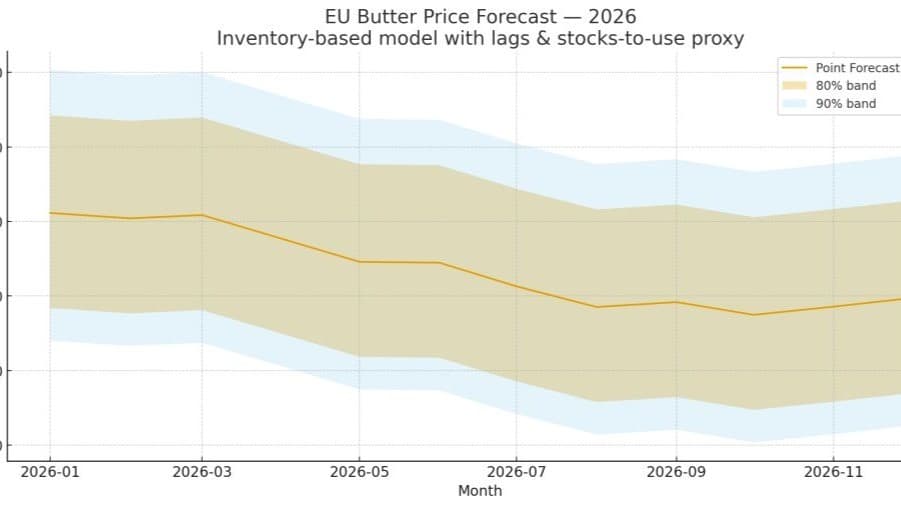
Summer Shopping or Summer Sale?
Last week was again a bit of a bearish week for the entire dairy industry. With cream prices under pressure and milk intake still strong, we keep seeing a market that has more supply than demand. Butter prices took another step lower, cheese prices cracked, and the powder market gave back a bit of its gains again.
Le rapport hebdomadaire
Recevez-le avant tout le monde
Chaque rapport de marché, dans votre boîte dès qu'il est écrit. Beurre, fromage, poudres, liquides — choisissez ce que vous négociez vraiment.
Environ hebdomadaire · Gratuit · Désinscription à tout moment