Weekly Update: Price Elasticity v.s. Price Emotions
Raporty rynkowe ukazują się wyłącznie po angielsku. Pozostała część serwisu jest dostępna w Twoim języku.

The dairy commodity markets are facing enormous pressure when we look at the prices. Last week butter prices lost almost € 400,- in a week, cheese lost about € 200,- and SMP prices also showed a correction of about € 150,-. The most asked question we got last week is if we think we are near the bottom of the price correction yet, or if there is more room to go down? We think the answer can be found in the past.
Commodity prices are determined by the balance between supply and demand. Usually, high prices lead to low demand. low demand leads to lower prices, low prices to higher demand etc. etc. etc. But in markets where you can not easily control the amount of supply, volatility grows. The most extreme example we saw last year. Milk supply in Europe fell down by about 1%, but market prices rose by about 80%! Fed by fear of not having sufficient product buyers aggressively bought as much product as they could against any given price. Suppliers increased their sales price after every sale causing the longest bull run we have seen in dairy. And because increasing milk production takes time, the supply side did not grow as quickly as prices went up. But we remember we haven’t heard of any of the end-users we work with shutting down their business due to a lack of commodities or raw materials. In our opinion, the balance between supply and demand didn’t justify the price move, but the sentiment did. It seems there was no price elasticity formula that could explain the move the market made.
The start of the war in Ukraine earlier this year added more uncertainty and emotions to the market. We did not see the war have a big impact on the supply side. Of course, higher energy prices made the cost of production higher, but it did little for milk production in the EU and it did not affect consumer demand either. But the increased uncertainty increased dairy prices by another 10-15%
The market from September 2021 until August 2022 felt undersupplied keeping prices firm at the maximum acceptable price levels. At certain levels, producers weren't able to increase the price anymore as end users were not able to finance their purchases and would rather step out of their existing contracts. So butter at € 7500. Gouda at € 5400 and SMP at € 4400,- levels, were the levels where the pain became too big. End users up until those levels kept accepting the prices as they felt that supply and demand were at best in balance and they had little power to negotiate lower prices.
But since the start of September, the sentiment has changed. More and more countries are starting to report a higher milk intake (compared to the year before) and retail demand is reported down. Anyone with a statistics background will tell you that demand due to Coved has shifted between food service and retail that it is too soon to draw any conclusion. And looking at the milk intake the volumes are still below the 3-year average in most countries. In other words, the fundament might be a little bit more bearish, but the market price correction we have seen over the last month seems to be an overreaction as we have seen last year. Commodity prices do not seem to be set by the factual change in the demand and supply balance, but by the emotions felt by all stakeholders. Because now buyers are back in control they use the same strategy as producers did last year. After every purchase the next purchase needs to be a bit cheaper, causing the markets to fall in quick decline. Products that are less affected by imports and export (like butter) are affected the quickest as producers have little different outlets. SMP did correct earlier, but are likely to correct less severe as the world market can act as a buffer.
So, do we think that prices should not go down this low is a much-heard question. Our answer is simple, we think that prices did not have to go up as high as they did in the first place. Commodity prices did need to go up to compensate the farmers for their higher production costs. But the current milk price of 62ct does far more than that, incentivizing farmers to overproduce in the months to come.
Will we see lower prices over the next few months? Yes, we think so. Will prices fall down in a straight line? If history repeats itself, yes! Maybe we will see a few days of stabilization but the falling trend will continue until we reach levels that will give too much resistance (and we are still far from where we think these painful levels are). But as long as we still see more supply than demand, that resistance level will take some time. Because the lower commodity prices we are seeing currently don’t solve the supply side, and don’t solve the demand side. Think about it, lower commodity prices will only affect retail prices in 3 to 6 months from now. If retail prices go down we might see demand come back. And the best way to influence the supply side is to lower the milk price and discourage farmers from milking more. But asking around, it seems likely that payout prices will stay firm until next year and they will only go down gradient.
As long as most external factors from outside the dairy market go unchanged we think lower markets are unavoidable. We would hope the markets find a floor of around € 5000,- for butter, € 2800 for powders and € 4000,- for Gouda cheese. This would mean that co-ops can still pay farmers a milk price that should be sufficient to continue farming. If commodity prices will fall below these levels we will be writing a report 12 months from now that the milk production is down again, and commodity prices are shooting back up due to returning demand and a slowdown in milk production. Let’s hope the market can find a balanced price for a while.
Więcej z parkietu
Our Long View Before Our Long Break 
Our Long View Before Our Long Break
Last week the market found a bit of stability. After lower trades on cheese, the cheese market traded slowly up, although a real rally remains absent. Butter prices did dip a bit further, although at the start of this week we see some strength on the back end of the curve. And on powder, our bullish feeling just doesn't go away — and now we can find some confirmation in the market as well.
Dairy Carry Has a Shelf Life 
Dairy Carry Has a Shelf Life
Last week was bearish across the board — every product we broker leaned the wrong way. Powders lost more momentum, cheese slipped well below €3,000 for some products, and butter continues to impress with just how much keeps showing up. Supply, supply, supply.
Summer Shopping or Summer Sale? 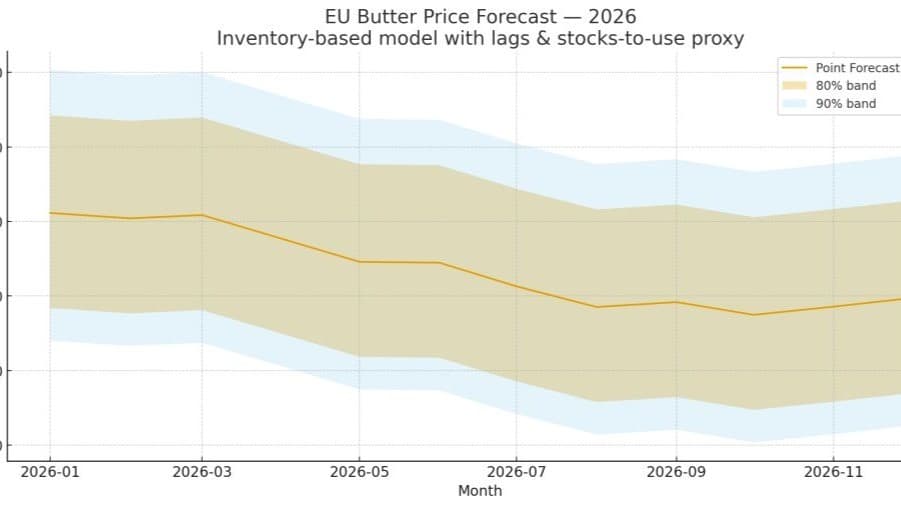
Summer Shopping or Summer Sale?
Last week was again a bit of a bearish week for the entire dairy industry. With cream prices under pressure and milk intake still strong, we keep seeing a market that has more supply than demand. Butter prices took another step lower, cheese prices cracked, and the powder market gave back a bit of its gains again.
Raport tygodniowy
Miej go, zanim trafi gdziekolwiek indziej
Każdy raport rynkowy prosto na Twoją skrzynkę, gdy tylko powstanie. Masło, ser, proszki, produkty płynne — wybierz to, czym naprawdę handlujesz.
Mniej więcej co tydzień · Bezpłatnie · Rezygnacja w każdej chwili