Volatility Rules in a Thin Market
Raporty rynkowe ukazują się wyłącznie po angielsku. Pozostała część serwisu jest dostępna w Twoim języku.

The market for almost all dairy commodities remains very volatile. Yesterday butter prices traded significantly higher on the fear of lower milk production and high demand for cream. At the same time, the lower milk production doesn't really seem to impact prices for SMP. With a negative GDT Pulse, the worldwide sentiment for powders remains bearish. For cheese, we keep seeing the spread between Cheddar curd and Gouda/Edam grow with more pressure on cheddar and less availability for Gouda and Edam. We see very few active partners in the current market, and a few bids or offers can move the market up or down quite easily. Thin markets are a guaranteed success for volatile trades.
Higher Butter Market
Our market started with more buyers for butter. Where yesterday the buyers were hard to find, suddenly the buyers appeared, ready to accept higher offers than the days before. The market is now trading roughly € 250 higher compared to Friday. Lower milk collections, lower cream availability, and some sput buyers pushed up the market. And after finally finding some sellers again at the end of last week, and the beginning of this week, most sellers decided to take a step back again. The butter market once again proves that a thin market with only a few buyers and sellers is the key to volatility.
The strange thing we do hear is that most warehouses in the Netherlands are still full and stories about high butter stocks keep returning. One theory is that the buyers for Q1 and Q2 keep covering/ closing their purchases and the only available product is stock to hedge the risk. This should also explain the steep forward curve as storage and financing costs are going higher and higher.
Mixed Cheese Markets
The cheese market keeps giving mixed signals, and speaking to our partners they seem to think the current rally is over. We see offers for Gouda for November/December and Q1 between € 4050 and € 4100 but sellers have disappeared as fast as they appeared last week. Cheddar offers are now coming in lower at € 3750,- and some even indicate lower than that, most pressure seems to come from the UK. Demand for Mozzarella, Emmantal and Maasdam also remains low.
One of our partners pointed to the fact that the export market kept accepting higher offers up to € 3750,- although they doubt that prices well above € 4000,- will be accepted as well. But as long as cheese exports are steady, a relief on EU prices is very unlikely for Gouda and Edam.
Poor Pulse result
So where butter is firm, and cheese is mixed, we see a clearly weaker powder market. With a poor GDT Pulse result the market seems to confirm that worldwide demand is struggling. The EU is far from being competitive and we see bigger offers coming to the market at lower prices. But where lower prices should attract buyers, at the moment most seem to be scared away. Demand is harder to find and bids from our export partners are close to $ 2500 CFR Asia, so not attractive at all for EU products.
Looking at the market it seems the poor supply in Q4 is of real concern to most of our EU-focused partners. Only the more export-driven powder market seems to be affected by the lower export demand. It seems very unlikely that we will see a reversal of the current trends in the near future, but there is only a handful of traders/partners that want to act on expectations for what might happen in Q1. Most partners seem to be on the sideline, waiting for the market to get into calmer waters.
Więcej z parkietu
Our Long View Before Our Long Break 
Our Long View Before Our Long Break
Last week the market found a bit of stability. After lower trades on cheese, the cheese market traded slowly up, although a real rally remains absent. Butter prices did dip a bit further, although at the start of this week we see some strength on the back end of the curve. And on powder, our bullish feeling just doesn't go away — and now we can find some confirmation in the market as well.
Dairy Carry Has a Shelf Life 
Dairy Carry Has a Shelf Life
Last week was bearish across the board — every product we broker leaned the wrong way. Powders lost more momentum, cheese slipped well below €3,000 for some products, and butter continues to impress with just how much keeps showing up. Supply, supply, supply.
Summer Shopping or Summer Sale? 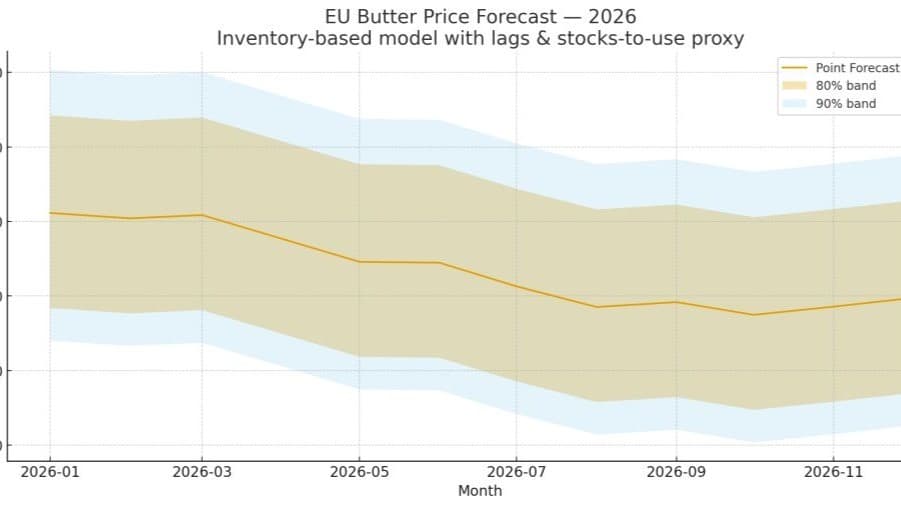
Summer Shopping or Summer Sale?
Last week was again a bit of a bearish week for the entire dairy industry. With cream prices under pressure and milk intake still strong, we keep seeing a market that has more supply than demand. Butter prices took another step lower, cheese prices cracked, and the powder market gave back a bit of its gains again.
Raport tygodniowy
Miej go, zanim trafi gdziekolwiek indziej
Każdy raport rynkowy prosto na Twoją skrzynkę, gdy tylko powstanie. Masło, ser, proszki, produkty płynne — wybierz to, czym naprawdę handlujesz.
Mniej więcej co tydzień · Bezpłatnie · Rezygnacja w każdej chwili