Increased Liquids Weigh on Market Balance
Raporty rynkowe ukazują się wyłącznie po angielsku. Pozostała część serwisu jest dostępna w Twoim języku.

We are back from a short family break and found the market largely where we left it. Following developments from the sidelines, we observed slightly increased availability of liquids, driven by seasonal and year-on-year (YoY) rises in milk intake. However, prices across most commodities have continued to trade relatively sideways, suggesting the market remains well-balanced after being slightly undersupplied in previous months. The key question today: Will the currently balanced market tip into oversupply, or will prices strengthen once the seasonal milk peak passes?
Liquids: Under Pressure
Liquid prices are facing headwinds. Spot milk prices in Germany have dropped to approximately €0.45/kg FCA, and sweet cream market (SCM) prices have fallen to between €1,550 and €1,700 FCA. Cream prices are inching lower, with reported trades around €7,900 FCA. Our best offer yesterday stood at €8,000 FCA Netherlands, while sales between €8,100 and €8,200 DAP Germany/Italy were still reported. Nevertheless, these figures translate to commodity prices significantly below current market valuations.
A note of caution: we are nearing the seasonal peak and navigating a series of bank holidays (Easter, Labour Day) which often artificially depress prices. That said, underlying milk intake data indicates growing pressure, with suppliers reporting substantial increases not just in milk volume but also in milk solids. As one of our partners quipped, "you should place an asterisk next to the asterisk."
Futures: Weakness Visible, but Solid Margins Prevail
The current weakness is also mirrored on the futures market. EEX butter futures (Q3) corrected downward by roughly €200, with minor adjustments observed in cheese futures. However, it would be premature to call the market "weak"—butter and cheese returns, when converted to farmgate milk prices, remain solid. This continues to support a positive outlook for EU milk production over the coming months.
Farmers, currently receiving between €0.52–€0.56/kg, are enjoying margins of €0.15–€0.18/kg—levels unseen in previous years—providing strong incentives to maximize production. Favourable weather and lower feed costs are contributing to optimal conditions for milk solids output.
Production data supports this view: French milk intake, previously down 3% YoY, has now exceeded 2023 and 2024 levels. The UK is posting >7.5% YoY growth, with Ireland and Poland also reporting strong gains, although Polish April figures are more expected to be a bit more cautious.
Risks to Production Growth: Bluetongue and FMD
Bluetongue has not yet surfaced largely this season, but concerns remain. Similarly, Foot-and-Mouth Disease (FMD) has disappeared from headlines but not from reality, with Hungary and Slovakia losing significant cattle numbers. While the EU may have dodged a bullet regarding exports, local production challenges persist.
Outlook: Optimists vs Pessimists
Forecasts hinge on perspective. Optimists—often buyers—see solid margins, favourable conditions, and an upward trend in milk production. Pessimists—often sellers—see risk and tread cautiously. In a market where psychology often outweighs economics, the risk of undersupply is keeping buyers active and sellers cautious. If milk intake plateaus, most will be pleased with risk-averse strategies; but if intake continues to grow, those betting on a weaker market may find themselves rewarded with sharper price corrections.
Butter: Stepping Down
The butter market corrected from last week's highs. Last week, butter traded between €7,350–€7,400 for NL/DE/BE origin; futures were aligned. Today, German butter prices tumbled to €7,150–€7,200, with Irish butter adjusting to €7,150 after bids fell to €7,050 late in the day. Polish butter traded at €7,125, although some producers' sales occurred at even lower prices. Prices from Northern Ireland and the UK dipped below €7,000 according to some of our sources.
Stock data on butter in the EU lags behind, but February figures show a narrowing stock deficit: from a 42,000 MT deficit in December to 20,000 MT in February compared to 2024. The EU is ramping up production, suggesting stock levels could normalize soon—potentially softening market tension.
Buyer focus has shifted to Q3, with less urgency for immediate forward buying. Current cream prices (€8,000–€8,200 FCA) imply that fresh butter production could be offered between €7,000–€7,100 FCA (based on standard cream-to-butter conversion).
Offers:
- 4 loads Polish Sweet Cream Butter, May, €7,125
- 6 loads Irish Butter, May–June, €7,150
- 6 loads NL/DE/BE Butter, Q3, €7,250
- 4 loads NL/DE/BE Butter, May, €7,200
Bids:
- 3 loads NL/DE/BE Butter, Q3, €7,150
- 4 loads Northern Irish Butter, May, €7,050
- 6 loads Polish Sweet Cream Butter, Q3, €7,000
Cheese: Weaker
Cheese continues to follow the fat market. With more butter availability, sellers for cheese are also more willing to negotiate. Gouda offers for May–June sit around €4,250, from German producers, but buying interest is limited. Mozzarella offers are around €4,100, with some trades reported at €4,050. The cheddar curd market also feels softer, although concrete bid/offer structures remain unclear.
Demand appears to be slowing. Several sources cite weaker export sales, particularly for mozzarella and cheddar, facing growing competition from New Zealand and the U.S. Domestic demand is also softening, with Just Eat Takeaway (owner of EU delivery services) reporting fewer orders—a trend partners have flagged for weeks.
Given strong whey prices, cheese production remains attractive, but the risk of price softening looms. As long as butter prices hold above €7,000, significant corrections are unlikely; if butter breaks lower, cheese is expected to follow.
Offers:
- 4 loads Mozzarella, May–June, €4,125 (German/Danish origin)
- 6 loads Gouda, May–June, €4,325 (NL/DE origin)
Powders: Weak, Limited Downside
Our powder desk is quieter with Linda away on leave, but feedback from partners indicates continued price pressure due to low SMC values. Nevertheless, availability remains relatively tight. Sellers remain firm at €2,400+ FCA for preferred brands despite limited buyer enthusiasm.
ONIL’s market presence provides some support, often pushing sentiment and EEX prices up temporarily. However, based on historical patterns, we expect a correction once ONIL awards are finalised. EU producers seem keen to lock in volumes, some suggest they expect producers to sell even below recent GDT levels.
Market Activity:
- Buyer for 100 MT Limelco SMP, June loading, €2,300
- Buyer for 50 MT DMK Zeven SMP, €2,330
Więcej z parkietu
Our Long View Before Our Long Break 
Our Long View Before Our Long Break
Last week the market found a bit of stability. After lower trades on cheese, the cheese market traded slowly up, although a real rally remains absent. Butter prices did dip a bit further, although at the start of this week we see some strength on the back end of the curve. And on powder, our bullish feeling just doesn't go away — and now we can find some confirmation in the market as well.
Dairy Carry Has a Shelf Life 
Dairy Carry Has a Shelf Life
Last week was bearish across the board — every product we broker leaned the wrong way. Powders lost more momentum, cheese slipped well below €3,000 for some products, and butter continues to impress with just how much keeps showing up. Supply, supply, supply.
Summer Shopping or Summer Sale? 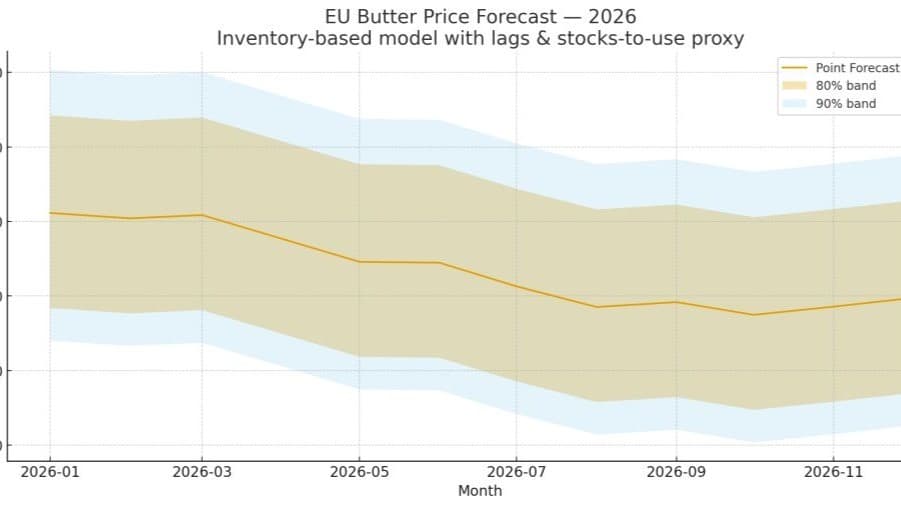
Summer Shopping or Summer Sale?
Last week was again a bit of a bearish week for the entire dairy industry. With cream prices under pressure and milk intake still strong, we keep seeing a market that has more supply than demand. Butter prices took another step lower, cheese prices cracked, and the powder market gave back a bit of its gains again.
Raport tygodniowy
Miej go, zanim trafi gdziekolwiek indziej
Każdy raport rynkowy prosto na Twoją skrzynkę, gdy tylko powstanie. Masło, ser, proszki, produkty płynne — wybierz to, czym naprawdę handlujesz.
Mniej więcej co tydzień · Bezpłatnie · Rezygnacja w każdej chwili