Global Dairy Disappointment
Raporty rynkowe ukazują się wyłącznie po angielsku. Pozostała część serwisu jest dostępna w Twoim języku.

The first day of the second half of 2025 did not start on a bullish note. In the EU, pressure continues to mount on SMP and cheese prices, butter is once again being pushed lower, and the first GDT auction of July delivered its steepest decline of the year. All major commodities trended down, with only BMP and Lactose managing a gain. Liquid prices held steady, but even EEX futures came off. Producers will need to digest these disappointing signals, and in the coming days, we’ll see whether global sentiment starts to weigh on EU prices, or if producers continue to resist lower trades.
Starting with the GDT results.
As mentioned in our previous update, our outlook was already bearish, so the results come as no surprise. The past weeks have indicated weakening demand, not just in the EU, but also from international partners. Still, the overall result of -4.1% is a tough one to swallow. The biggest hit came from the fat complex: Butter dropped 4.3% and AMF fell 4.2%. NZ butter bore the brunt, especially with Q4 prices looking increasingly soft. On the EU side, Solarec butter underperformed expectations, trading across all contracts (Aug–Oct) below €7300, averaging €7270. Kerry, in contrast, exceeded our expectations slightly, with September trading at €7210.
In cheese, cheddar prices declined by 2.5%, while mozzarella was down just 0.4%. However, a closer look at the mozzarella numbers reveals a slightly distorted picture. Prices are reported in USD, but all product was sold in euros. From an EU perspective, mozzarella looks notably weaker: Arla traded between €4060 (September) and €4100 (October), down around 2%. Solarec landed at €4160 for September, down 2 cents (0.5%) from the last tender.
WMP took the biggest hit this round, dropping 5.1%. A sharp correction, to say the least. EU-origin product held its ground relatively well, but NZ powder bore the heaviest blow—particularly in the forward months during peak milk season, which appear to be trading at significant discounts.
SMP showed a more modest decline, down 1.7% versus the previous event. Again, EU product remained relatively flat, but NZ-origin skim saw the bulk of the correction. Still, calling this result “positive” for EU producers would be a stretch. Forward price expectations appear flat, with October prices—even for premium origins—hovering between €2275 and €2350.
So, how do we interpret the GDT outcome?
It’s clearly not a bullish signal for the global market. We do want to add a friendly reminder from some partners: last year’s first July event also started with a steep decline (over 10% for butter), after which EU butter prices began their climb. True—but we countered that last year’s GDT slump came as EU butter was significantly undervalued compared to NZ, triggering a surge in EU exports and squeezing NZ sales. This year, the decline isn’t the result of buyers switching from NZ to EU products. Instead, global butter supply looks healthier, while demand appears shakier. With relatively cheap butter coming from both North and South America, and lower forward prices on NZ butter, we don’t expect a firming EU market in the coming months.
Looking back at our data:
In June 2024, EU butter prices climbed from €6500 to €7500 by the end of summer. On the back of soft production numbers, declining milk volumes mainly caused by bluetongue, and boosted exports (US exports grew by 50% and more exports to Asia) the EU market got tighter than ever. This year we should see healthier milk volumes (no blue tongue just yet), lower exports (we are simply too expensive) and better production data. Who knows, that € 6500 to € 7500 trend climb might see a nice mirror in 2025.
EU Spot Liquids: Fat Stable, Protein Rising
So far, the much-discussed EU heatwave hasn’t translated into a noticeable market impact. In fact, we’re hearing more cream offers, and reported sales are flat or even slightly down compared to last week. Prices continue to hover just above or below €8800, with less sign of tightness.
SMC, on the other hand, is firming up fast. Trades well above €2000 are being concluded, with no competitively priced alternatives in sight. These elevated SMC values could soften the cream market somewhat, as protein—not fat—is currently driving value.
Butter: Another Step Down
Butter prices have taken yet another hit over the past two days. July contracts are now trading as low as €7100 for NL/DE/BE origins, and August/September deals are landing around €7160. That puts Q3 butter pricing down another €75/mt, now trading at nearly €400 below official quotations. We remain curious how Dutch, French, and German quotations will manage to stay aloft despite falling GDT results and softer GFD market trades—but if history has taught us anything, they will.
In Ireland, the week opened with decent sales around €7175 for July, but buyer appetite at those levels has faded. The best bid for July now stands at €7050, and August has slipped to €7100. Similar bid levels are being seen for Arla DK/SE origin butter. From our Polish contacts, we’re hearing producers are offering fresh butter around €7150, while buyers have stepped back to €7000.
Indicative Markets for Today:
-
4 trucks NL/DE/BE (Jul/Aug):
Offer: €7200 | Bid: €7100 -
4 trucks Irish Butter (Jul):
Offer: €7150 | Bid: €7050 -
4 trucks NL/DE/BE (Oct/Nov):
Offer: €7250 | Bid: €7200 -
12 trucks NL/DE/BE (H1 2026):
Offer: €7000 | Bid: €6925
Cheese: Show me a bid, I will show you an offer
It’s not a lack of sellers that defines today’s cheese market—it’s a lack of buyers. But we’ve said that before. What’s notably absent, however, is panic. We’re not seeing aggressive sellers chasing the market down with lower offers and scaring off the few buyers still in the game. Instead, sellers remain composed and reactive: “Show me a bid, and I’ll show you an offer.”
And bids—we do have. Just not the kind that sellers are eager to respond to. At least, not yet.
Yesterday’s weaker GDT has made the landscape slightly more workable. If it confirmed anything, it’s that it’s not just our buyers holding back from paying a forward premium. The broader market appears aligned in its expectations: stable or sideways pricing for the time being.
Indicative Markets for Today:
-
4 trucks Mozzarella (July):
Offer: €4100 | Bid: €4000 -
4 trucks Mozzarella (August / September):
Offer: €4150 | Bid: €4000 -
6 Trucks Gouda (Q4):
Offer: €4325 | Bid: €4200 -
2 trucks Mozzarella (October):
Offer: €4200 | Bid: €4050
Powders: Let's call it a year
Following today’s GDT, it felt like some of our partners were ready to throw in the towel. Once again, no fireworks on the SMP side. EU prices continue to drift sideways, perhaps slightly weaker—but not enough to trigger real concern. With solid SMC trades, firmer BMP deals, and relatively low stock levels, there’s still no reason to panic.
One trader summed up the mood perfectly:
“Can you find me a buyer at €2350 for a few thousand tonnes? I’ll sell it, disappear for six months, and come back to find the market exactly where I left it.”
Honestly? He might have a point.
The forward curve for EU SMP remains dead flat. We continue to see decent support at lower levels, which gives us confidence that the market won’t fall off a cliff. But with NZ, US, and EU prices all hovering in a tight range—and none of them showing signs of breaking out—we wouldn’t blame anyone for mentally closing the books on 2025 already.
Final Thought
The market sentiment was already subdued—but now, there’s another layer of uncertainty creeping in. With Lumpy Skin Disease (LSD) re-emerging in parts of Europe—including Sardinia, Lombardy, and the French Alps—producers face more than just market pressure. This disease doesn’t just cut into milk yields at the farm level; it also imposes strict movement and export restrictions, with quarantine zones extending up to 50 km around affected areas.
While the full impact is hard to predict, any outbreak of this scale could further reduce milk output—especially in regions already struggling with heat and price fatigue. At the same time, export opportunities may shrink, not due to lack of demand, but due to tightened regulations and disrupted logistics.
In short: one more unpredictable variable in a market already juggling weak prices, hesitant buyers, and fading producer confidence.
Więcej z parkietu
Our Long View Before Our Long Break 
Our Long View Before Our Long Break
Last week the market found a bit of stability. After lower trades on cheese, the cheese market traded slowly up, although a real rally remains absent. Butter prices did dip a bit further, although at the start of this week we see some strength on the back end of the curve. And on powder, our bullish feeling just doesn't go away — and now we can find some confirmation in the market as well.
Dairy Carry Has a Shelf Life 
Dairy Carry Has a Shelf Life
Last week was bearish across the board — every product we broker leaned the wrong way. Powders lost more momentum, cheese slipped well below €3,000 for some products, and butter continues to impress with just how much keeps showing up. Supply, supply, supply.
Summer Shopping or Summer Sale? 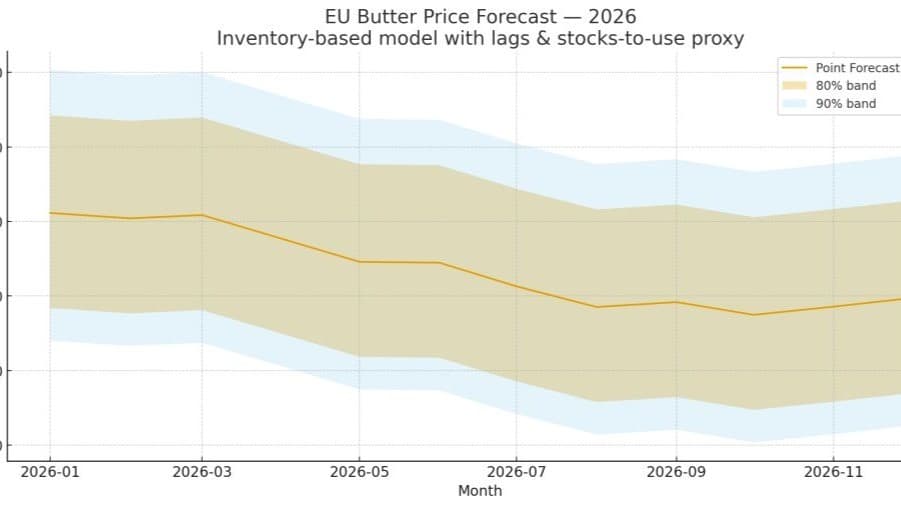
Summer Shopping or Summer Sale?
Last week was again a bit of a bearish week for the entire dairy industry. With cream prices under pressure and milk intake still strong, we keep seeing a market that has more supply than demand. Butter prices took another step lower, cheese prices cracked, and the powder market gave back a bit of its gains again.
Raport tygodniowy
Miej go, zanim trafi gdziekolwiek indziej
Każdy raport rynkowy prosto na Twoją skrzynkę, gdy tylko powstanie. Masło, ser, proszki, produkty płynne — wybierz to, czym naprawdę handlujesz.
Mniej więcej co tydzień · Bezpłatnie · Rezygnacja w każdej chwili