A Dull December Departure
Raporty rynkowe ukazują się wyłącznie po angielsku. Pozostała część serwisu jest dostępna w Twoim języku.

December, so far, has not been a very active month yet. Ok, we are only three days in, but the activity we see seems to be much lower than the previous months of December. "We Wait!" seems to be the only two words most of our partners know how to pronounce. "We wait for the ONIL tender results" or "We wait for the GDT result." or "We wait for retail to close contracts" or "We wait for cream prices to get more clear" or "We wait for our budget meeting." and let’s not forget "We wait until our partners are done waiting." This vicious circle needs to be broken, but until then...
All jokes aside, we really see a market where 90% of our customers seem to be waiting for some form of confirmation that the chosen strategy is right, or a signal on what strategy they should choose. Speaking to our partners, the majority seem to expect a bearish few months, but still, we don’t see many partners acting on what they think will happen. Lessons from the past keep traders from overexposing themselves, buyers from overbuying, and sellers from overselling.
"The appetite to expose ourselves to risk gets smaller as the reward we get for taking risk gets smaller as well."
This quote sums up the market for us best. Last year producers oversold based on the expectations of milk growth. Once that growth did not come, many ended up postponing deliveries, therefore unable to profit from the quick rise in commodity prices. Buyers who overbought the last time prices were high still have that bad taste in their mouths. And after overpaying in Q4, they are happy to wait and hold off any purchase they don’t absolutely need. And the traders have burned their fingers a few times too many last year, leading them to reduce their market exposure.
We expect the market to gradually trade lower. We think producers do see the need to lower their prices a bit as sales slow down, stocks start to build, and GDT data shows a bit of weakness. Buyers will buy a bit hand-to-mouth over the next weeks, acknowledging the risk the market can trade higher. French milk is showing a bit of a setback, and with low stock, they realize that these lower prices are not expected to last very long. And the traders, already exposed to a minor short, will be happy to lock in profit once the market falls back a bit. But with relatively small short positions we would argue most won't engage in closing their positions unless in profit.
The market conditions are not set for buyers to drive up prices, traders to suddenly switch positions, and producers to suddenly find a few thousand mt of stock. The conditions are set to gradually follow the trend the supply and demand balance dictates, and that is slightly bearish.
GDT: Bullish Headline, Bearish Details
Those only looking at the GDT result headline might think yesterday’s GDT was bullish. But looking closer, it seems only the WMP price kept prices up. With a plus of 4.2%, WMP lived up to the expectations we had. All the other commodities traded down, just as we expected they would. AMF prices can be seen as relatively stable, but butter prices traded down 5.2% with EU butter trading roughly at €6,850 for the Q1 average. Cheese prices also came down with EU mozzarella prices at €3,900. Last but not least, SMP prices also showed a correction, down 1% with EU prices back down below €2,600 average on Q1.
Liquids: A Bit More and a Bit Lower
Looking at the market for liquids, it seems that there is a bit more available at a bit lower prices. Speaking to traders, a clear signal that we are in a bearish trend is the lack of buyers on Tuesday. In previous weeks buyers were lining up on Tuesday morning, ready to scoop up the first volumes; that seems to have changed a bit. Spot prices for raw milk are reported to us as low as 45ct, and SMC prices are down to €2,100 in Germany but below €1,900 in the UK. Cream prices are shown at or just below €10,000 for next week, but the week after, prices dropped further down to €8,600 levels. Sellers seem eager to sell, buyers not as eager to buy. Still, these prices don’t justify butter below €7,000.
Looking ahead for cream for Q1, we see buyers are ready to buy at levels around €7,500, sellers try to hold prices above €8,000.
Butter: A Lot of Bearish Buyers
The butter market shows itself from its most opportunistic side again. Butter buyers pointing eagerly to lower GDT trades, lower prices for cream, and declining cheese prices, only to continue with bids that are well below the just argued data suggests. After a €450 drop in prices, buyers seem to be willing to push prices further down. And even though we sympathize with the buyers, and agree with their long-term view, we do believe that prices well below €6,900 for NL/DE/BE butter in Q1 might need to ease down a bit more gradually.
In December, we see that there is still some volume available, but sellers still target prices over €7,000 for NL/DE/BE and Danish butter. Only Irish butter seems to be changing hands easily below €7,000, with prices as low as €6,650 for winter grade and €6,750 for summer grade.
Cheese: A Lot of Bearish Sellers
The cheese market is bearish as well, but here we find more sellers than buyers. The lower prices on GDT did not help boost the sentiment, and we see sellers, mainly for Gouda and Mozzarella. With sellers for Mozzarella at €3,950 in December and similar prices for Q1, it’s the first time in months we have seen Mozzarella offers below €4,000 again. Gouda prices are still offered at €4,400 for December but are already down to €4,250 in Q1. The hardest thing to find in the cheese market today... is a buyer.
Powders: Back to the Boring Bandwidth
A bit as predicted, the powder market is back in its boring bandwidth. With offers around €2,600 (as seen on GDT) and bids in the low €2,500 or even below for older product. Although it seems that on current levels the EU is most competitive on the world market, we might see the US come back to play the game. With a significant drop on the CME, we would not be surprised to see them back battling for business with the EU starting by the end of Q1. Up until then, the EU seems the cheapest on the world stage, but with demand fading and SMC prices dropping, we don’t see a huge upward potential on SMP.
Więcej z parkietu
Our Long View Before Our Long Break 
Our Long View Before Our Long Break
Last week the market found a bit of stability. After lower trades on cheese, the cheese market traded slowly up, although a real rally remains absent. Butter prices did dip a bit further, although at the start of this week we see some strength on the back end of the curve. And on powder, our bullish feeling just doesn't go away — and now we can find some confirmation in the market as well.
Dairy Carry Has a Shelf Life 
Dairy Carry Has a Shelf Life
Last week was bearish across the board — every product we broker leaned the wrong way. Powders lost more momentum, cheese slipped well below €3,000 for some products, and butter continues to impress with just how much keeps showing up. Supply, supply, supply.
Summer Shopping or Summer Sale? 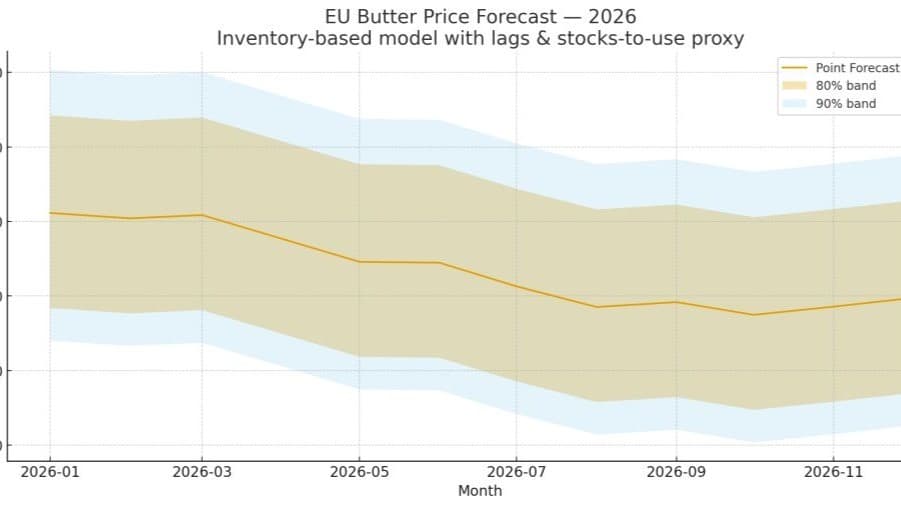
Summer Shopping or Summer Sale?
Last week was again a bit of a bearish week for the entire dairy industry. With cream prices under pressure and milk intake still strong, we keep seeing a market that has more supply than demand. Butter prices took another step lower, cheese prices cracked, and the powder market gave back a bit of its gains again.
Raport tygodniowy
Miej go, zanim trafi gdziekolwiek indziej
Każdy raport rynkowy prosto na Twoją skrzynkę, gdy tylko powstanie. Masło, ser, proszki, produkty płynne — wybierz to, czym naprawdę handlujesz.
Mniej więcej co tydzień · Bezpłatnie · Rezygnacja w każdej chwili