A Bearish Market With Bullish Concerns
Raporty rynkowe ukazują się wyłącznie po angielsku. Pozostała część serwisu jest dostępna w Twoim języku.

Our last update is from November 26th and we promised only to be back if there is something significant to report. Most of you will have noticed the market is in full bearish mode. Prices for powders, cheese and butter are sharply correcting following the trend of 2022, the pace this year only seems to be even more dramatic. The trends seemingly is fuelled by the seasonal lower demand for liquids and the end of the Christmas demand in combination with the seasonal increase of milk collections in the EU. The biggest question we hear from our partners is, will we see a quick renounce in Q1 (as seen last year) or will we continue to trade bearish? Below is a quick review of all we have seen and heard in the previous weeks:
We noticed that there are still two visions of how the world will trade in 2024. We have partners who focus on the lower milk intake and those who focus on the lower demand and upcoming recession. Let's focus on both!
Low Demand: A real concern!
The thing that is striking us the most is the very weak demand. Since the start of Q4 we have been writing about that, and it seems to remain the story that buyers/end users keep repeating. Especially demand in France seems down a lot, whereas Eastern Europe seems to be affected least by the declining demand. The lower consumption seems to be confirmed by data from retail. At least in the Netherlands, it seems consumers are buying fewer quantities. The turnover of the retail seems to be still growing, but only in Euro's, not in volume. We hear similar effects in the surrounding countries. We still hear buyers postponing collections, renegotiation delivery schemes and stocks with end users seem bigger than usual.
Demand from the export markets is low, and in addition, the EU has been (and still is) the most expensive region in the world for powders and cheese. Chinese demand might not be as bad as it seems, but it isn't good. And we hear little signals that they will be back with strong volumes anytime soon. Demand from the rest of the regions seems to be slowing down a bit as well. Some partners even indicated they see products from China reappearing in the SE Asia markets.
Another bearish indication of demand is the quickly declining oil price. The long-term trend between Oil prices and worldwide dairy prices has been proven many times. With oil nearing $ 70,- per barrel again there isn't much optimism to be found there as well. Those who would only speak to end users/buyers would become very bearish! And that is risky! Because the bearish signals might be strong, but they don't paint the entire picture!
Milk Intake: Is it a bigger concern?
The dairy industry has normally been a supply-driven market. More milk always leads to lower prices, less milk leads to higher prices. And those following the milk intake in the EU can see a declining trend. And if old patterns will repeat the lower milk intake will lead to higher commodity prices. France has been declining for more than a year now, and German milk intake is a few months in a row in the negative territory as well. Ireland finished their (already mediocre) season very weak and producers aren't convinced next year will be much better and in the Netherlands growth is very unlikely.
With the current milk prices paid by the biggest EU coops, we should see farmers incentivized to maximize milk output from their existing herd. There are also some concerns here. We hear from more and more farmers and partners who work closely with them, that most farmers kept their oldest cows last year a bit longer as the milk price was extremely good. This year the heard might be a good bit smaller. So even optimizing milk output might still leave the milk intake lower than last year.
And if commodity prices decline as fast as they are doing this week and follow last year's trend, the milk price will be below 40ct before the western EU enters the flush, probably flattening the curve. Overall the outlook for EU milk production isn't that great, which should be bullish for commodity prices. It seems the question isn't if commodity prices in 2024 will rise, the question seems to be when.
Short-term outlook: Bearish
Ok, so will we see the market bounce back up quickly again in 2024? We do not think so. The short-term outlook remains bearish in our view for a few reasons.
Last year the buyers in the market only had the chance to buy products for Q1 and Q2 at very high prices. Up until the end of November cheese prices were trading well above € 5000,- powder prices were trading well above € 3000 and butter prices well above € 7000,-. Most buyers decided to buy as little as possible forward and therefore we saw a very active spot market in Q1 and Q2. In addition, traders shorted the market at the end of the year, adding themselves to the list of buyers. Producers locked in as much sales also possible once prices started to fall, leaving them oversold during the first months of the year. This kept prices from falling further down and most prices bounced back up rapidly.
This year most buyers have been able to cover forward at historically good prices. Butter prices during the summer for the first half of 2024 were offered between € 4400 and € 4800 for a long time, bringing a lot of buyers to the table early. It seems most buyers have locked in much more of their needs compared to last year. People are saying this is a bullish argument as it means producers or traders sold short. But if we listen closely most sales for Q1+2 seemed to be covered with 2023 stock. Producers in the meantime sold a lot less forward as it didn't give a proper price in return. Traders also didn't manage to sell a lot forward as most agreed that selling short below € 5000,- was a dangerous game. We therefore expect to see a lot fewer buyers in the first 3-4 months of the year, and a lot more sellers. And with seasonal milk volumes growing, this should lead to pressured sellers to lower their prices.
Looking at the powder market we see something similar. For a long time, Q1+2 prices for SMP traded between € 2400 and € 2700,- a long-term attractive price for the EU buyers who seemed to have covered well forward. We see a lot of products being moved around between warehouses, some still produced in 2022 and a lot of products produced in Q2. We know some people doubt the stock levels in the EU, but we think they are still quite large. And with exports expected to be dull in the next months and worldwide competition from the EU and NZ strong, EU prices have little room up, and still some potential down.
Cheese prices have been carrying the market for the last few months, but with butter and SMP simply being a problem (in our view) we expect cheese prices to lose a bit of their support. We don't see cheese prices collapsing much below € 3500,- but the support of around € 4000,- broke easily in the last week and we expect to see more downside with producers coming to the market and buyers stepping back.
Long term: 2024 average higher prices compared to 2023
But although we might begin bearish (in our view) we don't think 2024 will be that bad for dairy prices. The long-term trend in the EU remains that lower milk intake will dominate the sentiment. And this lower milk intake will lead to higher prices. If commodity prices will fall back as low as they did in Q1 2023 we expect the milk intake for 2024 to be causing H2 prices to rally again. In the end, we believe that prices for cheese and butter in 2024 should be higher than the average prices for these products in 2023. Protein prices are of a bit bigger concern for us. With worldwide demand fading but milk production in China increasing fast, we think the lack of the biggest customer in the world might be hitting the markets hard.
Więcej z parkietu
Our Long View Before Our Long Break 
Our Long View Before Our Long Break
Last week the market found a bit of stability. After lower trades on cheese, the cheese market traded slowly up, although a real rally remains absent. Butter prices did dip a bit further, although at the start of this week we see some strength on the back end of the curve. And on powder, our bullish feeling just doesn't go away — and now we can find some confirmation in the market as well.
Dairy Carry Has a Shelf Life 
Dairy Carry Has a Shelf Life
Last week was bearish across the board — every product we broker leaned the wrong way. Powders lost more momentum, cheese slipped well below €3,000 for some products, and butter continues to impress with just how much keeps showing up. Supply, supply, supply.
Summer Shopping or Summer Sale? 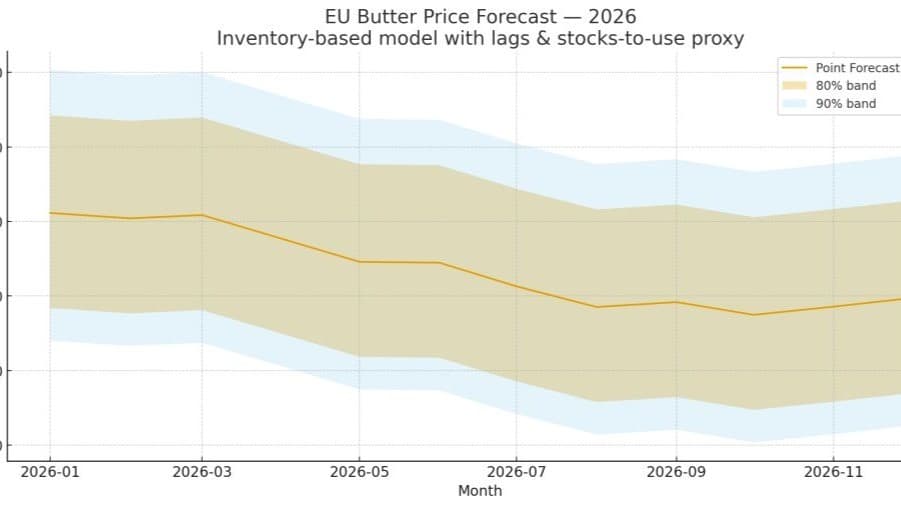
Summer Shopping or Summer Sale?
Last week was again a bit of a bearish week for the entire dairy industry. With cream prices under pressure and milk intake still strong, we keep seeing a market that has more supply than demand. Butter prices took another step lower, cheese prices cracked, and the powder market gave back a bit of its gains again.
Raport tygodniowy
Miej go, zanim trafi gdziekolwiek indziej
Każdy raport rynkowy prosto na Twoją skrzynkę, gdy tylko powstanie. Masło, ser, proszki, produkty płynne — wybierz to, czym naprawdę handlujesz.
Mniej więcej co tydzień · Bezpłatnie · Rezygnacja w każdej chwili