
Lack of Product? Or lack of sellers?
Marktrapporten verschijnen alleen in het Engels. De rest van de site is wel in uw taal beschikbaar.

We start the week with a quiet Monday. We have been speaking to a lot of partners, but none with a conviction of where the market price for any commodity should be. But speaking to these partners, we do start to recognize a pattern. The problem in the market doesn't seem to be a lack of products available, but a lack of sellers.
With the risk of getting some angry feedback, we do want to share with you our analysis of why we think the market is trading on too high levels. Because reading the reports out there about stock levels (up) and milk production (up) and consumption (down) we come to a stable or even to a bearish conclusion. But looking at the market trend we need to be bullish as all commodities continue to trade higher.
But the lack of available/willing sellers seems to be the cause of higher trades, not the lack of product. And this is seen most clearly when we look at the different products we broker and speak about. It seems that the shorter the shelf life, the quicker the sales pressure mounts. The longer the shelf life, the better easier it is to keep the product off the market.
The weakest valorization for commodities seems to come from liquids. Sellers of raw milk, SMC and cream need to sell their volumes on a weakly basis. And they need to sell (or use) all the raw materials they have, there is no way to store them. Buyers on the other hand will only buy what they need or buy some additional product if they can process it into a profitable product. Raw milk, SMC and cream seem to be all under pressure, a clear sign of no additional demand.
The second lowest valorization after the liquids we see for fresh yellow cheeses, seem to give the lowest valorization. We have seen a firm rally in the last weeks, but the prices of Gouda, Edam and Mozzarella aren't giving the same valorization as butter as smp. Mozzarella can be kept in a warehouse for a couple of weeks but needs to find an end user quickly before losing value quickly. Gouda and Edam might have a few extra weeks but do also need to move to a processor before losing sliceable quality. Sellers for these cheeses might be able to close their shops for 3-4 weeks, but will need to come back to the market quickly again. Cheese that are better to keep like cheddar, Emmental and Maasdam also still seem to be keeping firm, they did not drop as far down as Gouda, Edam and Mozzarella.
Sellers for Butter and Powders can play a different game. Frozen butter hardly loses value, and SMP (and other powders) are cheaper and easier to store. If sellers have a firm belief that prices for their commodities need to move up higher they could close their sales book for a bit longer period. However, we do think that that's unlikely to happen in the mid of the flush as financial pressure will put sales departments with their backs against the wall to sell.
As said, we don't think there is a lack of commodities/supply that is pushing up the market up or an increased demand. It is the lack of sellers (compared to the buyers) that has pushed the market up. That said we could see a reversal once sellers do decide to come back to the market, we do think that that could take some time, as we hear some sellers are convinced about a firmer market price. We have seen the same in October/November last year. Even though the market was seeing strong supply since September, the lack of sellers kept the price up. But once sellers stepped in, a lot of the demand was filled and the balance between sellers and buyers changed dramatically, pushing down prices by more than 40% in 3 months.
We don't expect a similar market. But seeing a drop like that in Q4 (where demand usually outpaces production) we would hope for the sellers to not wait as long as they did back then. Because as soon as buyers are done securing their needs (and demand for March / Q2 is drying up a bit we hear) they might stay absent for a longer time during the flush.
Meer van de desk
Our Long View Before Our Long Break 
Our Long View Before Our Long Break
Last week the market found a bit of stability. After lower trades on cheese, the cheese market traded slowly up, although a real rally remains absent. Butter prices did dip a bit further, although at the start of this week we see some strength on the back end of the curve. And on powder, our bullish feeling just doesn't go away — and now we can find some confirmation in the market as well.
Dairy Carry Has a Shelf Life 
Dairy Carry Has a Shelf Life
Last week was bearish across the board — every product we broker leaned the wrong way. Powders lost more momentum, cheese slipped well below €3,000 for some products, and butter continues to impress with just how much keeps showing up. Supply, supply, supply.
Summer Shopping or Summer Sale? 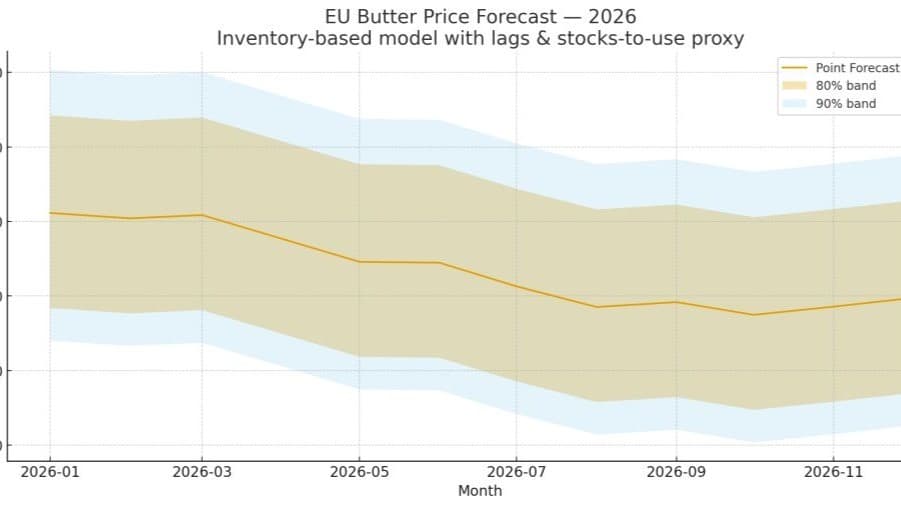
Summer Shopping or Summer Sale?
Last week was again a bit of a bearish week for the entire dairy industry. With cream prices under pressure and milk intake still strong, we keep seeing a market that has more supply than demand. Butter prices took another step lower, cheese prices cracked, and the powder market gave back a bit of its gains again.
Het wekelijkse rapport
Krijg het voordat het ergens anders staat
Elk marktrapport, rechtstreeks in uw inbox zodra het geschreven is. Boter, kaas, poeder, vloeibaar — kies wat u daadwerkelijk handelt.
Ongeveer wekelijks · Gratis · Altijd opzegbaar