Fakeout or Breakout?
Marktrapporten verschijnen alleen in het Engels. De rest van de site is wel in uw taal beschikbaar.

February has been an exciting month so far, and with two more days to go, the market might be in for another few days of high volatility. Last week the Gulfood was the main event where most of our partners were exhibiting or visiting and for us, it was hard to follow the market with so many people moving and harder to reach than usual. This is why we were caught by surprise by the sudden activity in the second half of the week. Because after the market seemed to stabilize during the first two days of the Gulfood, the market broke its sideways/downward trend again, to trade higher for all commodities. But are we witnessing a final breakout? or is this another fakeout to throw market participants on the wrong foot?
Last Friday we were looking at a puzzle that is hard to lay out. We should have most of the pieces to make a complete picture, but it seems the pieces don't fit together. It is as if somebody took two puzzles and mixed the pieces of both of them. Because we can't explain why liquids across all products are stable or even down in the weeks before, and at the same time the commodity prices are up!
1. Liquids
Looking at the market for liquids and speaking to our partners, it doesn't seem that demand for raw materials is great. We hear it is hard to find an outlet for raw milk for these weeks as most processing plants are fully operational or don't want to produce extra commodities. Raw milk prices are reported between 32ct and 35ct last week. It is higher than in the first weeks of January, but lower compared to the beginning of February.
The price of cream last week traded stable to slightly lower. The highest reported prices for cream have gone up as high as € 5600,- but at the end of the week there were still trades possible around € 5300-5350,-. Admittedly it's still up a lot compared to early January, but still a long way from where we see butter equivalent prices. Cream at € 5300 produces butte rat € 4600 and not at € 5050,-.
SMC also looks to be trading in a lower range although the feedback from the market gives a widespread. We hear prices as low as € 1650 and as high as € 1900,-. But it's still a long way from the prices of € 2750,- we see for SMP futures.
Looking at the milk collection Ireland does seem to have a very slow start. Some coops report a minus of 10% compared to last year. But it's a minus against a very low intake number. Most coops admitted that they expect milk to be at the expected production levels in about 2-3 weeks. It does keep the pressure on this market a bit longer. German/Dutch/Belgium milk intake remains strong, and with high protein levels, it's "full" milk. The French are down about 2% still (give or take).
Looking at milk production out side of Europe it seems the most important regions are up in milk production. The US is showing very strong numbers and the EU and the US might be in strong competition in the months that will follow now for export demand. Both rely on export to offset the internal supply/demand balance.
Looking at the liquids we can't find the explanation for the quick increase in dairy commodity prices, although sentiment about lower milk intake in Ireland is a bit of a concern for some.
2. The effects of International Demand
When at the Gudlfood we did have the feeling it has been more crowded compared to the previous years. It seems a lot of people are looking for new sources of commodities. It might not be important at the moment, but last year showed it was quite convenient to have multiple sourcing channels. Speaking to the European traders and producers it felt as if Asia and Africa were actively looking for new supply routes. It fed the expectation that demand might have been up.
The biggest demand we hear is for cheese and smp. Butter demand from export markets wasn't showing a lot of interest. Looking at Tuesday's GDT we did see the strongest increase in butter. We think this fed a bit of speculation for the EU butter prices and triggered again some big buyers to become active in the EU market. With the market now between € 5050 and € 5400 for 2023 it might be that we are trading € 1500,- above the dip of 4 weeks ago, we are still trading € 2000,- below the top of 6 months ago. We hear big industrial buyers don't want to take the gamble and wait for lower prices on butter, because even at € 5000/€ 5400 they are still buying within budget.
For Powders, the ONIL tender seems to be the reason for some good support. We hear SMP prices were booked at $ 3000,- CFR, which calculates back to prices of € 2750 FCA, explaining the firmer EEX futures. For cheese, we hear Japan, Korea and Taiwan were showing a stronger interest in Q2/Q3 shipment, mainly for Gouda and Mozzarella. This triggered a bit of a rally at the end of last week causing prices to trade € 200,- higher. For cheese, some big industrial buyers seem to follow the same logic as buyers for butter follow. We might be trading roughly € 500,- above the low prices of January but we are still € 2000,- below the prices of 6 months ago. The risk/reward ratio with postponing purchases a bit or buying right now seems to be in favour of buying right now.
Looking at International developments outside of the EU it seems there could be some reason for more bullish prices. Although there is a difference between a buyer showing interest and a buyer confirming an offer.
3. Inactive producers
But with every producer, we know present in Dubai and all with the same strategy (don't sell anything) it seems that their absence from the market is causing a very imbalanced market with much more buyers looking for offers compared to sellers willing to provide. We wrote about it in our previous reports. It seems most traders have lost their appetite for risky trading (they also see relatively low downward potential, and high upward potential) so the usual sellers (producers and traders) weren't putting any additional volume in the market while buyers were taking off a lot.
If producers will keep this up for another 2-3 weeks we think that for some products (mainly butter and cheese) they might be able to push the market up another 10-20%. Because we think the level where buying resistance becomes too big isn't found at the current market prices.
Does the big question remain how long producers can stay inactive? As reported in the first remark, the pressure on liquids is strong, and if the gap between raw materials and commodities becomes too great, these raw materials will find a way trough different channels to the commodity markets. Another big issue we hear for some smaller coops is how to finance the sales stop and the effects the higher commodity prices might have on the milk price they pay during the peak of the milk during the flush. Not every producer we spoke to is happy to be paying at 50ct + milk price to the farmers in may. It will cause liquidity issues.
Looking at the producer's side we think there is cause for a continuation in bullish sentiment, but there are some big question mark on how long they can keep away from the market and who breaks first.
4. Expectations for this week
We start this weak with a neutral vision of this market. We think there are a lot of reasons to believe that prices will remain firm. Even if pressure on liquids and producers will increase we think the market has a strong floor 10% below today's market prices. Only a sudden overproduction or a collapse in demand will cause the market to dip lower. But asking around, both are not to be expected.
But we do think that the pressure from the supply side is strong enough to keep commodity prices in this 10% range as well as the upside. Even our most bullish producers indicated to expect that with such a high milk price, commodity prices have a limit to where they could rise.
So are we seeing a breakout or a fakeout? We think a breakout won't occur until we have the milk flush behind us, and we also think that these big price swings are overreactions to uncertain sentiment. But calling it a fakeout would be to strong, cause it would suggest that the price increase in artificial and fake, and we think there is some well-based sentiment among a greater group of buyers that is causing these swings to occur.
We do still believe that this market is more a reflection of an imbalance of buyers v.s. seller than a imbalance between supply and demand. We still believe that fundamentally the market will face a correction over time because supply is outperforming demand. But this imbalance can last for another few weeks, so the short term trend is expected to be more bullish than our long term outlook.
Meer van de desk
Our Long View Before Our Long Break 
Our Long View Before Our Long Break
Last week the market found a bit of stability. After lower trades on cheese, the cheese market traded slowly up, although a real rally remains absent. Butter prices did dip a bit further, although at the start of this week we see some strength on the back end of the curve. And on powder, our bullish feeling just doesn't go away — and now we can find some confirmation in the market as well.
Dairy Carry Has a Shelf Life 
Dairy Carry Has a Shelf Life
Last week was bearish across the board — every product we broker leaned the wrong way. Powders lost more momentum, cheese slipped well below €3,000 for some products, and butter continues to impress with just how much keeps showing up. Supply, supply, supply.
Summer Shopping or Summer Sale? 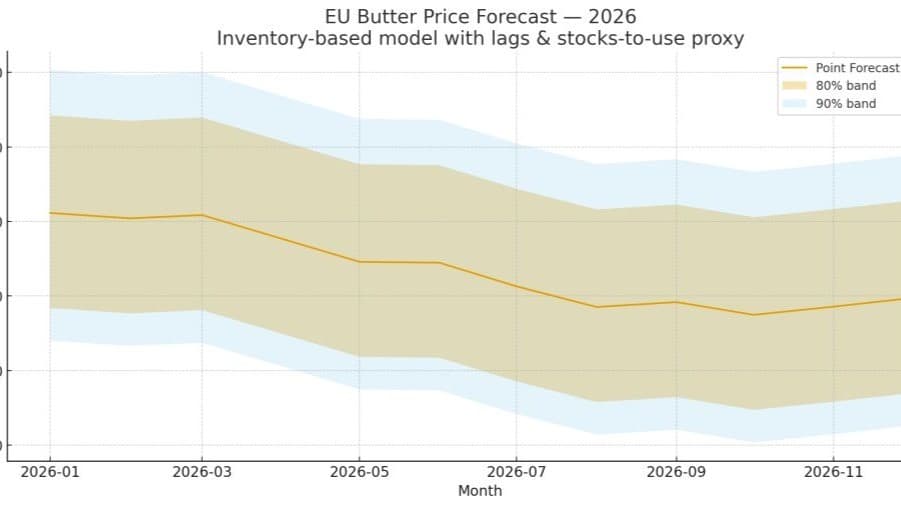
Summer Shopping or Summer Sale?
Last week was again a bit of a bearish week for the entire dairy industry. With cream prices under pressure and milk intake still strong, we keep seeing a market that has more supply than demand. Butter prices took another step lower, cheese prices cracked, and the powder market gave back a bit of its gains again.
Het wekelijkse rapport
Krijg het voordat het ergens anders staat
Elk marktrapport, rechtstreeks in uw inbox zodra het geschreven is. Boter, kaas, poeder, vloeibaar — kies wat u daadwerkelijk handelt.
Ongeveer wekelijks · Gratis · Altijd opzegbaar