Will Retail Stabalize the Market?
Marktrapporten verschijnen alleen in het Engels. De rest van de site is wel in uw taal beschikbaar.

January has never been known for its strong demand for dairy products, and this year is not any different. But this year the demand seems to come down a bit harder than normal. We spoke to partners who are a bit closer to the retail industry and who had some different insights into the market dynamics that we do want to share with you. Because all fundamental data will point to lower prices in the near term, we should not exclude the sentimental data that can turn quickly in the favor of the sellers they say.
Healthy Habits never last long
Unfortunately, something we can confirm from a personal point of view. Most people start the year with the ambition to change their diet, eating patterns and sport regime. But most new year's resolutions fail in the third week of January. So demand for butter, fat cheese, full yoghurts and chocolate drop in the first weeks of the year, but gets picked up again quickly and is back to normal in February. Some (ok, we should state we...) even overcompensate a bit because they have been missing the sweet taste of full-fat food so much. Restocking the refrigerators might lead to a bit better demand in the next weeks. We do think that the financial side of cutting these products from your daily diet might be a good incentive for some to keep these products out of their shopping basket for a bit longer.
Empty Retail Warehouses
Retailers are, as we speak, under negotiations for the price of some products for February onwards. It is safe to say that their new contract prices for the February call of volumes will be much lower than the prices of January. Therefore some expect that the stocks in retail are extremely low as new contract prices are about € 2000,- lower than the old prices. The start of February might be hectic if all retailers start to replenish their stock and fill up their warehouses again.
Dairy to attract the customer
Retailers have had a good year in 2022, and they want to keep their sales up, and their customers in the store. But with consumers being more aware of prices due to the high inflation retailers will have to make themselves as attractive as possible. Dairy products are often used to attract customers to supermarkets. And the retailers will have some room to give firm discounts in February. If dairy prices drop by 30% again in the next week in the supermarket, demand might get an extra boost as well. Butter in Eastern Europe has always been an often-used product, and we have seen butter sales spike if the prices drop low enough.
Production capacity issues
And another different insight we got from a producer. They say it is not the demand for a product that is too low, it's the capacity to rework the liquids on the spot market that seems to be the issue at the moment. If it is true we find it hard to check, but that would mean we are producing commodities at the maximum we can in Europe. For us it would be a worrisome fact. Because normally milk production grows in the first months of the year to a peak in April / May. So if we are already seeing problems to allocate all the milk now, we will face more troubles in the months ahead. Cheese production is supposed to be running at full capacity, this is highly unusual for January. The expectation of some is that the spread between liquids and commodities will only grow wider. Our personal opinion is that it's unlikely that such a gap will last for longer than a few weeks and if liquid supply is going to continue to grow the commodity prices will have to correct down.
Bullish Conclusion
So for those who look for reasons to be bullish, there are some. We might see retail demand stabilize a bit (or even go up). We might see a short squeeze from retailers pushing for more production in February, and we might have reached to max of production capacity for commodities in western Europe. If it is enough to stabilize the market of even push it back up, we are sceptical.
Bearish Conclusion
Those who are bearish will point out that the drop in retail demand is much harder than in normal years. We hear lower sales for dairy products in Germany between 8 and 15% compared to a normal year. The financial situation of low-income households is capping demand for expensive dairy products. And with more milk expected in the months to come more commodities will have to be produced. If true the milk intake in Holland is up by 5% in January, we will now have more milk in January than we had in the peak months of the 2022 season with higher fat and protein content reported. If the spread between liquids and commodities will shrink again, the commodity prices will drop another 20% just as the spot prices for cream and raw milk are doing.
Meer van de desk
Our Long View Before Our Long Break 
Our Long View Before Our Long Break
Last week the market found a bit of stability. After lower trades on cheese, the cheese market traded slowly up, although a real rally remains absent. Butter prices did dip a bit further, although at the start of this week we see some strength on the back end of the curve. And on powder, our bullish feeling just doesn't go away — and now we can find some confirmation in the market as well.
Dairy Carry Has a Shelf Life 
Dairy Carry Has a Shelf Life
Last week was bearish across the board — every product we broker leaned the wrong way. Powders lost more momentum, cheese slipped well below €3,000 for some products, and butter continues to impress with just how much keeps showing up. Supply, supply, supply.
Summer Shopping or Summer Sale? 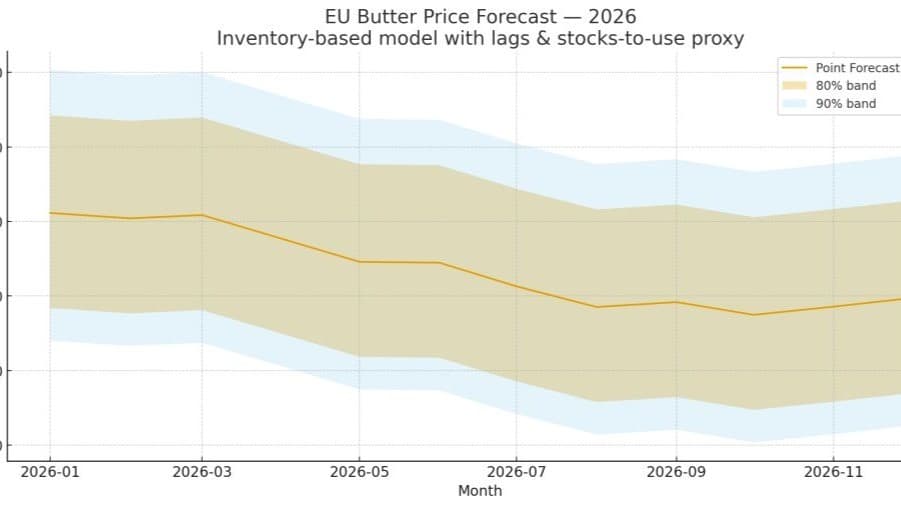
Summer Shopping or Summer Sale?
Last week was again a bit of a bearish week for the entire dairy industry. With cream prices under pressure and milk intake still strong, we keep seeing a market that has more supply than demand. Butter prices took another step lower, cheese prices cracked, and the powder market gave back a bit of its gains again.
Het wekelijkse rapport
Krijg het voordat het ergens anders staat
Elk marktrapport, rechtstreeks in uw inbox zodra het geschreven is. Boter, kaas, poeder, vloeibaar — kies wat u daadwerkelijk handelt.
Ongeveer wekelijks · Gratis · Altijd opzegbaar