Weaker Signals During a Mexican Standoff!
Marktrapporten verschijnen alleen in het Engels. De rest van de site is wel in uw taal beschikbaar.

The Dairy Market remains in a Mexican standoff between buyers and sellers, both convinced that their market view will be the dominating trend in the weeks and months that will follow. Both sides try to act relaxed and keep their nerves. It feels like whatever part of the market will move first will determine the course of the following weeks. This Mexican standoff will take a casualty in the end, but whether it's the buyer's side or the seller's side who will suffer... only time will tell. In the meantime, the market suffers from boring events, disappointing tenders and low trade activity.
Today GDT seems a fair reflection of the market. With a flat result of 0.0% the market again can pick its information to argue their view of the market. But we would read this result as bearish. Diving into the numbers we see that SMP prices have traded 3.8% lower where a + of more than 5% was expected by most market participants. The fat market underperformed as increases of about 8-10% were expected, but butter traded even lower than the previous event with a minus of 1.1%. And looking at the cheese we see cheddar has lost all it has gained in the previous event, closing 9.5% lower than the previous event.
Meanwhile, there are some concerns surrounding the Polish / Ukrainian border. Over 3000 trucks have stranded with goods with Ukraine as a destination, among these trucks we know there are quite some dairy exports that are stranded. And with no real solution in sight we see some pushback on the product that was destined to go to Ukraine, but now needing to find a buyer in Europe again. For butter, this means one of the driving buyers for butter prices has become a seller now.
This new conflict, the disappointing GDT results and the low buying activity for Q1 are in line with the disappointing ONIL tender and the disappointing demand from the export markets. It seems North Asia isn't buying much on the GDT and that would confirm the low demand we have been hearing for a while now. Most buying partners will use this disappointing result to bid the market lower. It seems worldwide demand just isn't as good as it was a year ago. The question is if sellers will become nervous our if they will keep their calm as they have done for the last 4 months!
Prices Last Year v.s. This Year
Speaking about a year ago there are some funny similarities when we take a look at the EU commodity market. On November 18th we send out our morning report reporting the following prices for Q1-2023. Butter prices for NL/DE/BE were offered at € 5750 fresh and € 5700 for fresh/frozen while polish butter was offered at € 5400. Cream prices that week were reported at € 7700,-. This falls very much in line with the prices we see today.
Looking at the cheese market last year offered prices for Gouda in Q1 were at € 4200 for Gouda and slightly lower for Edam almost identical to today's prices. Only SMP prices were trading roughly € 200-300 higher between € 2800 and € 2900 for Q1.
Of course, we are now in a different market. Milk prices for NL/DE/BE farmers are much lower than a year ago, but on-farm costs have decreased as well. France and Spain are paying much higher prices compared to a year ago so they might even be incentivized more than last year to produce more. And as we came down from much higher prices in Q4 2022 we expect end users to be much better covered compared to Q1 2023.
Can History repeat itself?
It's way too easy to state that because today's prices are the same as prices were a year ago prices for the end of December and in Q1 will follow the same trend as last year. We don't expect to see as much milk as we did in Q1 2023, although with the current milk price, the decline might not be as big as we are seeing today. The demand side does remains questionable as high commodity prices started to hit the retail in 2023 and demand started to fade. It seems a lot of retail contracts are yet to be closed so with similar commodity prices, retail prices might get closed at roughly the same levels again. And with inflation hitting the household spending power it seems unlikely demand in Q1 will get a boost. Just to give an interesting look back at how prices developed last year for Q1.
Gouda:
20th November € 4200 / 1th of January € 3650 / 20th of January € 2980
Butter:
Lactic West EU: 20th of November € 5750 / 1th of January € 5000 / 20th of January € 4300
Lactic Irish: 20th of November € 5500 / 1th of January € 4800 / 20th of January € 4250
Sweet Polish: 20th of November € 5400 / 1th of January € 4600 / 20th of January € 4150
SMP:
20th of November: € 2900 / 1th of January € 2600 / 2oth of January € 2550
Cream:
20th of November: € 7700 / 1th of January € 5400 / 2oth of January € 4300
Those who only want to take the bearish trend out of this. We want to note that prices by the end of Q1 had bounced again to butter prices around € 4500, Gouda price back above € 3200, and SMP prices did come off again to € 2150 levels.
Our Q1 outlook remains very unclear although when we put all the information together we keep landing on the more bearish side. It would fit in a normal dairy commodity cycle where Q4 prices are up and Q1 prices are down. It would be illogical for EU prices to keep rallying with world prices dropping. The big question remains where the new floor for Q1 lies. Because with inflation of over 10-15%, we don't expect to see the low prices mentioned above come back. Will it be as easy as adding 10-15% to last year's lows? As always, only time will tell!
Meer van de desk
Our Long View Before Our Long Break 
Our Long View Before Our Long Break
Last week the market found a bit of stability. After lower trades on cheese, the cheese market traded slowly up, although a real rally remains absent. Butter prices did dip a bit further, although at the start of this week we see some strength on the back end of the curve. And on powder, our bullish feeling just doesn't go away — and now we can find some confirmation in the market as well.
Dairy Carry Has a Shelf Life 
Dairy Carry Has a Shelf Life
Last week was bearish across the board — every product we broker leaned the wrong way. Powders lost more momentum, cheese slipped well below €3,000 for some products, and butter continues to impress with just how much keeps showing up. Supply, supply, supply.
Summer Shopping or Summer Sale? 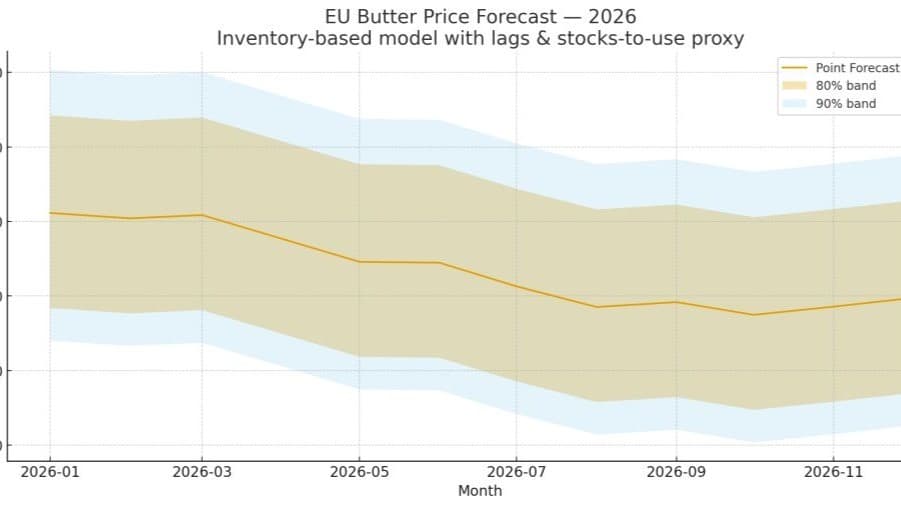
Summer Shopping or Summer Sale?
Last week was again a bit of a bearish week for the entire dairy industry. With cream prices under pressure and milk intake still strong, we keep seeing a market that has more supply than demand. Butter prices took another step lower, cheese prices cracked, and the powder market gave back a bit of its gains again.
Het wekelijkse rapport
Krijg het voordat het ergens anders staat
Elk marktrapport, rechtstreeks in uw inbox zodra het geschreven is. Boter, kaas, poeder, vloeibaar — kies wat u daadwerkelijk handelt.
Ongeveer wekelijks · Gratis · Altijd opzegbaar