Short-Term Strategies as Uncertainty Lingers
Marktrapporten verschijnen alleen in het Engels. De rest van de site is wel in uw taal beschikbaar.

Yesterday was another day where it felt as though the market was trading in a universe where time stands still. The FDM situation keeps everyone sitting nervously on the edge of their seat, yet from that edge, most are merely observing. So far, there isn’t much to report regarding the spread of the disease—and in this case, no news does indeed feel like good news. Meanwhile, we see partners attempting to reroute their logistic streams, and we can start to discern some early outlines of what the situation might look like in the near future. And how does that translate to dairy prices? So far, it seems the market is moving sideways or perhaps edging ever so slightly upwards.
In our conversations with partners, one thing is clear: until there is a green light from the German authorities, the FDM situation will dictate every decision. Producers we spoke with say it makes little sense to sell anything forward if they aren’t absolutely certain they can deliver, which nudges them toward a week-to-week sales strategy. Thanks to low stock levels, most producers appear comfortable keeping their sales to a minimum unless the prices “make sense.” This conservative approach is keeping the market snug and tidy, which in turn nudges prices a bit higher.
Speaking to end users, we notice a similarly cautious stance. Those with major exposure to export markets are reevaluating their strategies. If the FDM situation expands to other countries, exports might remain blocked for a longer period, and some of the raw materials purchased (for the time being, solely German) can’t be used for production intended for partners outside the EU. Combined with a tighter market, many partners seem worried and hesitant. Not buying leaves them vulnerable to potentially higher prices later this year, but making commitments that might end up being unusable also poses risks. Their strategy appears to focus on a “hand-to-mouth” approach.
Turning to traders, we observe they’re somewhat trapped between the other two strategies. There’s little buying activity, but there’s also no real pressure from producers. They could lock in higher-priced stock, but with customers possibly scaling back their needs, that risk feels a bit too heavy to carry. But selling forward to those buyers who are willing to engage at lower levels, feels to risky as well.
None of our partners have a compelling reason to take action right now. Without that spark, the focus slips back to back-to-back business and spot trading. We wouldn’t be surprised to see this style of trading persist until there’s more clarity on the FMD situation. For the moment, the negative effects we see remain:
- limited to non-export possibilities for German product for (probably) three months
- raw milk, cream, and SMC from Germany having fewer outlets outside Germany
- some export partners putting EU origin on “hold” as they want to be sure the disease doesn’t spread
- end users who utilize German commodities as an ingredient starting to block German product
These effects might appear negative, but if the outbreak remains confined to Germany, it seems the rest of the EU can operate like communicating vessels. Dutch cheese could substitute for German cheese, French powder for German powder, and Belgian butter for German butter in the export market. And with fewer of those alternative origins available for use within the EU, German product would likely step in to fill any gaps.
Overall, we can’t help noticing some damage to the EU’s export position. We believe that further along, there could be a dip in EU exports, which would result in more supply available within the EU. But if the situation doesn’t escalate, that impact can be contained and limited to hardly any price swings—especially as the EU dairy market was already feeling a bit too tight for many partners.
Liquids: More or the Same
Although we spoke to several partners who had some difficulty rerouting existing business, the overall liquids market showed no major disruptions. Cream prices even seemed to peak at certain moments, with Polish prices hitting as high as €8850, though they appeared to ease by the end of the day. In Germany, prices dipped to €8400 before firming back up to around €8600, roughly matching levels in NL/BE. German SMC had a tougher time, with some loads changing hands just over €2000, while most transactions were between €2100 and €2150. Raw milk prices in Germany came under a bit of pressure and dropped a few cents below 50ct, whereas NL/BE/FR milk prices increased to 50ct+ (reaching up to 55ct).
Butter: High Offers, Low Bids
The butter market remains directionless. Although it appears further-out prices keep inching up, Q1 prices continue to fluctuate between €7300 and €7400. On the high side, there are ample offers from producers and traders; below €7250, we see a comparable number of bids. Safe to say we’re in a tight range without a clear sign of prices climbing decisively higher or dropping much lower. Ironically, despite all the concerns about German butter, the highest price paid through us yesterday was €7400 for GERMAN lactic butter (frozen).
Most of our partners agree that if cheese exports take a hit (as some expect), producers could redirect more milk toward butter and SMP production. The market remains backwardated, with physical butter trading as low as €7125 for Q2, though at that level there seems to be growing buying interest. We expect to start the market with:
- an offer for 4 trucks of German fresh/frozen butter for January at €7400
- an offer for 4 loads of Polish butter (2023 production) at €7285 FCA PL
- an offer for 2 loads of Irish butter, FCA NL for January at €7350
- an offer for 4 trucks of German fresh butter for February at €7350
- an offer for 3 loads of Belgian butter for February at €7400
And we anticipate the following bids:
- a bid for two trucks of frozen German butter for January at €7350
- a bid for 1 truck of frozen Polish sweet cream at €7050
- a bid for 6 trucks of NL/DE/BE butter for Feb/March at €7250
- a bid for 6 trucks of NL/DE/BE butter for Q2 at €7100
Cheese: Export Swaps
In the cheese market, movement is equally scant. Most partners are preoccupied swapping out German cheese (currently barred from export) for other origins that are still export-eligible. Beyond that, we haven’t seen any noteworthy buying interest. Producers appear happy to sell at the higher prices indicated by the futures market, effectively capping any immediate price upswing.
Yet again, the same uncertainty keeps both buyers and sellers from making big moves. If cheese exports take a substantial hit due to the FMD outbreak, prices should correct back down to levels closer to those at the end of the year. But if the market finds a way to maintain high EU cheese exports, today’s prices might be justified. One buyer succinctly summed it up: with this logic, there’s no real incentive to purchase forward and plenty of reason to hold off.
We see the following markets:
- offer for 6 trucks of Gouda 48% NL/DE Q2 at €4500
- offer for 2 trucks of Gouda 48% NL/DE for January at €4375
- offer for 6 trucks of Mozzarella for Q2 at €4250
Bids:
- bid for 6 trucks of Mozzarella for Q2 at €4000
- bid for 6 trucks of Gouda for Q2 at €4250
Powders:
The powders market is also searching for direction. Cheese and powders (unlike butter) are significant export products, and SMP is a major player in that category. German SMP won’t be able to go on export for the next few months, although we’re hearing about efforts to clear product with additional statements and declarations. Even so, that may only work for certain export destinations—most German powder exports will face major hurdles.
We also sense hesitation among export partners regarding next steps. Locking in volumes for Feb/March shipments from non-German origins remains possible, but questions keep cropping up: What if FMD spreads elsewhere? What if more EU origins face export blocks? How will those contracts be fulfilled?
Within the EU market, business seems to be rolling along decently enough. We managed to secure some WMP and SMP deals, with WMP prices firmer and SMP slightly weaker.
We begin with:
- a bid for 100mt of Kerry SMP at €2440 FCA IE (including export docs)
- a bid for 100mt of SMP codex at €2375 FCA NL for February
- a bid for 100mt of Kerry HHHS at €2600 for March
We start with the following offers:
- offer for WMP Dairygold, June or fresher, at €4440 FCA NL
- offer for 100mt of EU codex SMP at €2450
- offer for 100mt of EU non-standardized SMP with 36% protein at €2550 DAP NL
And that’s where we stand for now. Let’s see what tomorrow brings—if the clock moves forward, that is.
Meer van de desk
Our Long View Before Our Long Break 
Our Long View Before Our Long Break
Last week the market found a bit of stability. After lower trades on cheese, the cheese market traded slowly up, although a real rally remains absent. Butter prices did dip a bit further, although at the start of this week we see some strength on the back end of the curve. And on powder, our bullish feeling just doesn't go away — and now we can find some confirmation in the market as well.
Dairy Carry Has a Shelf Life 
Dairy Carry Has a Shelf Life
Last week was bearish across the board — every product we broker leaned the wrong way. Powders lost more momentum, cheese slipped well below €3,000 for some products, and butter continues to impress with just how much keeps showing up. Supply, supply, supply.
Summer Shopping or Summer Sale? 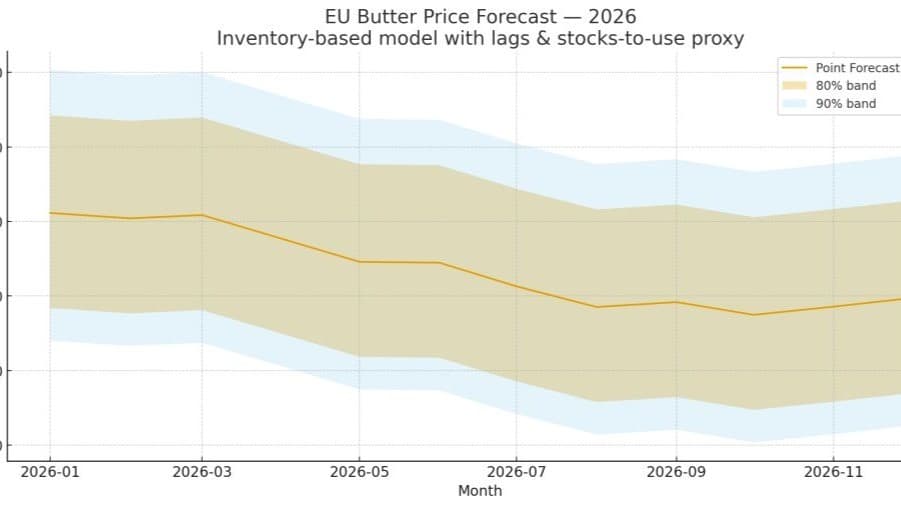
Summer Shopping or Summer Sale?
Last week was again a bit of a bearish week for the entire dairy industry. With cream prices under pressure and milk intake still strong, we keep seeing a market that has more supply than demand. Butter prices took another step lower, cheese prices cracked, and the powder market gave back a bit of its gains again.
Het wekelijkse rapport
Krijg het voordat het ergens anders staat
Elk marktrapport, rechtstreeks in uw inbox zodra het geschreven is. Boter, kaas, poeder, vloeibaar — kies wat u daadwerkelijk handelt.
Ongeveer wekelijks · Gratis · Altijd opzegbaar