Dairy Prices At A Crossroads!
Marktrapporten verschijnen alleen in het Engels. De rest van de site is wel in uw taal beschikbaar.

The Dairy market is nearing a crossroads we feel. With volatile market prices, low activity and more and more uncertainty, the dairy market seems to stand in front of a crossroads wondering what road to take. As dairy advisors, we would like to take our partners by the hand and show them the right road, but our compass has been failing for a few weeks already. We asked some experienced dairy market travellers what road they would take, but it seems experience is more a burden than a blessing in this market. The road ahead is influenced by more than only supply and demand, now financial instruments seem to dictate the market more and more. So what route will the dairy market take? The road to the top of the mountain?? Or the road to the deep valley?
The story above is just another metaphor for saying the market is still divided into two camps. Some call themselves realists and call others deniers, others see themselves as optimists and others as pessimists. It doesn't really matter what you call it, whether you are a bull or a bear (or a duck), what matters is that we see most of our partners looking at the same crossroads waiting for others to lead the way. And without a group leader taking the lead in the market direction, it might be that we will wander around this crossroad for a few more weeks.
The Road To The Top!
You could argue that in the last month(s) we have been on a hike and we are now halfway to the top of the mountain. Driven by lower milk volumes in France and Ireland and high cream prices, prices for butter have increased from € 4200 up to € 5800 this week a 35% increase in 10 weeks. With the high cream price, it is to be expected that butte production in September / October and November has been down a lot. Up until August, data we found via Vesper (www.vespertool.com), suggest this year butter production has been running higher than the previous year, but we expect the last three months to give up the headstart. A lower stock supply of butter, high cream prices and returning activity might put the butter market in overdrive to the top. Because de mid € 5000 butter range seems expensive, but it's cheap considering 14 months ago we had € 7500 prices.
For SMP we have seen an increase from prices at € 2100 in the summer up to € 2750 now, a more modest increase of about 30% although the correction of the last two weeks has brought the increase back between 20-25%. But looking at data for US NFDM / SMP production and also looking at the data for EU SMC production this year we see output volumes have been sharply down. Exported volumes out of the EU are still up so the S/D ratio should be very tight. It seems most stocks is in the hands of trade, but a few big buyers could take them quickly emptying the market quicker than some see possible. And last but not least, the positive GDT events show there is still demand in the export markets. And even though € 2600 prices feel a good way up from € 2100, they are still down roughly € 700,- from last year's pricing.
The road up for cheese has already taken a big leap. With prices around € 3350 during the summer the outlook for cheese prices looks a lot more positive. with prices up almost € 800,-. (25% up). Demand from retail is anecdotally increasing and strong demand from Eastern EU countries and exports to Korea, Japan and Ukraine has been driving the market higher and higher. The age of the cheese remains young and their is no sign of stocking or ageing product.
The Road to the Valley:
But the road to the valley can be seen as well. Although we have to admit that the road up is backed by facts, the road that leads to lower prices is based on a lot of assumptions. Looking at the butter market we see some worrying things that make a lot of our patterns believe that prices will have to come down again. We have seen a lot of buying done at earlier stages this year by the big industrial buyers. But Since the prices have gone over € 5000,- we have seen most activity come from traders. End user demand has been slow and most of our partners are claiming to have roughly 10-15% less sales. Looking at data found again on Vesper, we see for example German retail sales for butter is down 10% YoY. That is a massive number. And with butter prices increasing again at Aldi / Lidle, we can't see a quick increase in demand (apart from seasonal demand). The high cream price that is supporting the current high butter prices isn't expected to last longer. In the previous three years, cream prices started to drop between the second and the third week of November only to bottom out in the last week of January. We know that history never repeats itself exactly the same, but patterns usually do not change. The cream price in the last four years corrected three times to prices between € 3800 and € 4200, only in 2022 the prices stayed higher due to a severe lack of milk. The road down for butter is greasy and slippery, so once it starts going down, we might hit the bottom of the valley sooner than some might see reasonable.
On the SMP side, we see less doubt about what way prices should trade. Most partners agree that the bottom of the market lies somewhere around de € 2400 level. The biggest question is how fast prices can recover. With Asia not buying most demand is expected to come from the Middle East and Africa. But with Oil prices again under pressure, there are some doubts about how strong the worldwide demand might be. We still see plenty of aged stock that we can offer and with the cost of carry rising, we do not see many people stocking up. We might see some end-of-year selling before we see prices recover a bit again. But in general, we think the SMP crossroad is one where both ways lead to higher prices, one path is a slow easy walk that can take a long time, and the other is a sharp and steep climb!
The cheese path down is one led by the assumption that high valorization leads to higher production, which eventually leads to more supply and less demand (high prices kill demand) and eventually, this will lead to low prices. With low valorization for mozzarella, emmantal, natural ripened cheeses and cheddar we, and a lot of our partners, would think cheese markers will be putting as much milk in the cheese production as possible. Also, we looked up the data on Vesper and that suggests that demand for Yellow Cheese like Gouda in retail has been down roughly 9% YoY while production has been going up. Higher production and lower consumption usually don't lead to higher prices. We saw the Gouda / Edam market reverse last year in mid-November as well, some expect a similar move. We think the road down for cheese can be like a Swiss-type cheese. Once we fall into a hole, it might be a big one!
The Get Fair Dairy Compas:
It's always dangerous to make a prediction about the market direction, and we would say to anyone don't take this as any trading advice. But looking at all the data, and history and putting all the talks we have with partners in one overview we would be:
Bullish on butter for the next few weeks, but bearish for Q1. We think cream prices might drag prices down and we don't see many buyers who will jump on the market before we see prices coming back down well below € 5000. In addition, we think stocks might be bigger than last year while demand is a bit worse.
We would be stable on the short-term powder price, but bullish for Q1. We think the lower production of SMP and NFDM will at one point put pressure on buyers to start accumulating stock again. And more than with the buyers for butter, we have heard buyers postpone purchases rather than lock in cheap products.
On cheese we are undecided We think the current prices for November and December aren't right. Cheddar is undervalued, Gouda is overvalued and Mozzarella is exactly where we think the market should be. Looking at all other commodity expectations we think the market needs to normalize a bit in Q1. That means we expect Gouda prices to move back down, and cheddar and emmental prices to move back up. For November / December we see no reason for prices to change quickly. Short-term shortage of Gouda might even push the price higher, short-term oversupply of cheddar will maybe even put the market down.
So we stand at the crossroads with our partners, looking at our dairy compass finding the right direction. We dare to put our expectations out, but with all the "ifs" and "buts" that we can think of. As long s the market dynamics will not be influenced by war, international tensions, diseases or stuck ships in the panamacanals, we think our prediction above is the most likely for the dairy market.
Meer van de desk
Our Long View Before Our Long Break 
Our Long View Before Our Long Break
Last week the market found a bit of stability. After lower trades on cheese, the cheese market traded slowly up, although a real rally remains absent. Butter prices did dip a bit further, although at the start of this week we see some strength on the back end of the curve. And on powder, our bullish feeling just doesn't go away — and now we can find some confirmation in the market as well.
Dairy Carry Has a Shelf Life 
Dairy Carry Has a Shelf Life
Last week was bearish across the board — every product we broker leaned the wrong way. Powders lost more momentum, cheese slipped well below €3,000 for some products, and butter continues to impress with just how much keeps showing up. Supply, supply, supply.
Summer Shopping or Summer Sale? 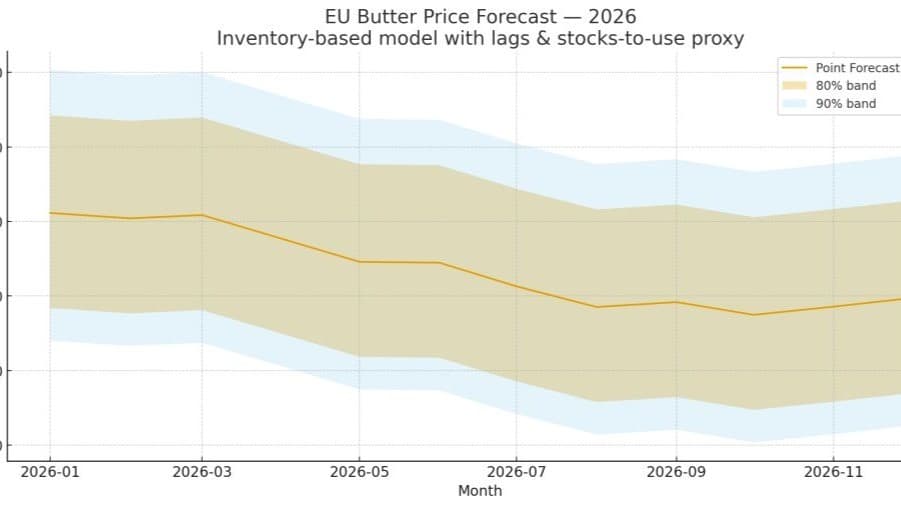
Summer Shopping or Summer Sale?
Last week was again a bit of a bearish week for the entire dairy industry. With cream prices under pressure and milk intake still strong, we keep seeing a market that has more supply than demand. Butter prices took another step lower, cheese prices cracked, and the powder market gave back a bit of its gains again.
Het wekelijkse rapport
Krijg het voordat het ergens anders staat
Elk marktrapport, rechtstreeks in uw inbox zodra het geschreven is. Boter, kaas, poeder, vloeibaar — kies wat u daadwerkelijk handelt.
Ongeveer wekelijks · Gratis · Altijd opzegbaar