Bulls And Bears Trade Hand in Hand
Marktrapporten verschijnen alleen in het Engels. De rest van de site is wel in uw taal beschikbaar.

Last week, the dairy market took an interesting turn. For the past 4-5 weeks, we’ve seen butter prices climb steadily, cheese move sideways, and powders stay, well... rather dull. But now, it looks like all the gears are shifting. The powder market is trending significantly higher, with a strong outlook for 2025. Cheese prices for next year are aligning with this year’s figures, and butter prices are showing some pretty dramatic spreads. While we're still bullish on butter for the next four weeks, what happens after Christmas is starting to look a bit foggy. We expect the dynamics to shift, making these last few trading weeks of 2024 far more exciting than we initially thought.
Kicking off this week, we anticipate a somewhat slow start, especially in the powders sector, as many players await the results of the Global Dairy Trade (GDT) auction. Given recent strong gains, a pause wouldn’t surprise us. The EU is scooping up some volumes thanks to its discount advantage, and remember, nothing rises in a straight line. A small correction might give everyone a chance to catch their breath. As for fats, we're dialing down our bullishness a bit. The same factors apply: with more competition from American exports, the butter market may see a minor correction. But don't expect anything too thrilling just yet. Overall, we predict a slightly bearish to flat GDT outcome.
Liquids: High Spot Prices, Lower Forward Prices
Last week saw record highs in the spot market for liquids. Cream prices in Western Europe shot up to €11,000, while spot milk prices in France even touched 80 cents. This confirms a tight market with solid spot demand but limited milk supply. Our partners are also noticing what we’ve been observing for weeks: milk output in key regions isn't bouncing back as fast as it used to, despite higher prices. Regions affected by bluetongue are taking longer than expected to recover, squeezing the market further. Many buyers were caught waiting for lower prices, adding pressure to an already imbalanced spot market.
However, after December 15th, we foresee a shift. Seasonal milk intake is growing while spot demand is waning, which tilts the supply-demand balance. Raw milk prices are expected to drop below 60 cents, and cream prices should hover around €9,000 post-Christmas. Those active in the trade for long-term liquid contracts see more willingness with producers to forward sell milk at lower prices. Its seems some are anticipating more milk over the next months. The UK is already seeing a milk intake surge, thanks to favorable weather and a bluetongue-free status. Continental Europe might follow suit once the disease's impact fades, though we're less optimistic about increased output in the Netherlands.
Butter: High Spot Prices, Steeply Backwardated Curve
Butter prices last week hit new highs in the first half of the week, mainly for contracts for deliveries in November and the first week of December. However, the second half of the week saw the market cooling down a bit. We see that prices in December show a strong difference between collection weeks. Butter collected before the 7th of December is, in some cases, priced a whopping €500 higher than butter for the second half of December. We also see a significant discrepancy between buyers who need fresh butter over the next three weeks (and are willing to pay a premium) versus those who are focused on Q1 needs.
The looser spot market for liquids is expected to ease the spot market for butter as well. More milk means more cream, which allows producers to ramp up butter production. The increased supply coincides with the traditionally weaker demand period in Q1, leading to a supply boost while demand decreases. In a typical year, we would expect a short correction in January, followed by a quick rebound. However, this year, the market faces challenges that could result in a steeper drop—and a potentially bigger bounce back. The big question is: "Who will stock and finance the overproduction from Q1 and Q2?"
If the market is in contango, producers will forward sell and keep the stock, or traders will use cash-and-carry strategies to move product from periods of overproduction to times of higher consumption. However, at the moment, the forward curve for butter is heavily backwardated, with a nearly €750 per metric ton difference between January and June prices. As long as the market remains so strongly backwardated, it will be challenging to find solid support for butter prices at current levels. Currently, high prices in November and early December are propping up Q1, but that window is shrinking. In the coming weeks, pressure from lower prices in Q2 will start to drag down Q1. How quickly the market finds support will depend entirely on buyers’ actions for the rest of the year. Their risk? If they don’t pay others to stock product for later, there’s a significant risk that no one will. And if that happens, the market for Q3 and Q4 of 2025 might become much tighter than it has been this year.
We Expect to have sellers for
| Product | Origin | Volume | Period | Price | Incoterm |
|---|---|---|---|---|---|
| Lactic Unsalted Fresh/Frozen | Irish | 88 | December | € 7775 | FCA IE |
| Sweet Cream Unsalted Frozen | Portugues | 44 | Nov-Dec | € 7975 | FCA PT |
| Sweet Cream Unsalted Frozen | Irish | 44 | Dec | € 8250 | FCA NL |
| Lactic Unsalted Fresh/Frozen | Arla DK | 88 | December | € 8000 | FCA NL |
| Lactic Unsalted Fresh/Frozen | NL/DE/BE | 66 | December | € 7925 | FCA NL |
| Lactic Unsalted Fresh/Frozen | NL/DE/BE | 132 | Q1 | € 7500 | DAP NL |
We Expect to have Buyers for
| Product | Origin | Volume | Period | Price | Incoterm |
|---|---|---|---|---|---|
| Lactic Unsalted Fresh/Frozen | Irish | 88 | December | € 7500 | FCA IE |
| Sweet Cream Unsalted Frozen | Portugues | 44 | Nov-Dec | € 7400 | FCA PT |
| Sweet Cream Unsalted Frozen | Irish | 44 | Dec | € 7800 | FCA NL |
| Lactic Unsalted Fresh/Frozen | Arla DK | 66 | Q1 | € 7250 | FCA NL |
| Lactic Unsalted Fresh/Frozen | NL/DE/BE | 66 | December | € 7500 | FCA NL |
| Lactic Unsalted Fresh/Frozen | NL/DE/BE | 132 | Q1 | € 7300 | DAP NL |
Cheese: Q4 softening, Q1 Strengthening (a bit)
The cheese market is showing a slightly different pattern than the butter market. While prices in Q4 have remained relatively firm over the last weeks, it was Q1 that showed no buying interest at all and price indication showed a huge backwardation. Even when butter prices were trading firmer and firmer, the cheese market did not move. Up until last week. It seems most partners have covered their needs for November and December and buyers have shifted their focus to the first quarter of next year. With one eye on the fat market and the other on the protein market buyers start to realize that finding free milk to produce sufficient cheese might get difficult. We already hear production of Gouda and Edam is expected to slow down a bit if November/December, fueling the need with buyers to cover.
With the demand for Q4 fading and the offers for Q1 drying up the markets that were once heavily backwardated started to form a more flatter curve. Still, it seems the market is pricing in a bit more milk due to higher payout prices, but the gap as shrunken significantly. Moreover, on these relatively low levels, and with a stronger dollar, the EU started to become more and more appealing for the export markets again. So overall the outlook for the cheese market is recovering a bit, although for us it remains one of the tougher markets to get a grip on.
We Expect to have sellers for
| Product | Origin | Volume | Period | Price | Incoterm |
|---|---|---|---|---|---|
| Gouda 48 Slicing | NL/DE | 88 | December | € 4550 | FCA NL/DE |
| Mozzarella 40% | NL/DE/BE/DK | 88 | Nov-Dec | € 4250 | FCA NL/DE/BE |
| Cheddar | UK | 44 | Dec | € 4850 | FCA UK |
| Gouda 48 Slicing | NL/DE | 132 | Q1 | € 4550 | FCA NL/DE |
| Mozzarella 40% | NL/DE/BE/DK | 66 | Q1 | € 4375 | FCA NL |
We Expect to have Buyers for
| Product | Origin | Volume | Period | Price | Incoterm |
|---|---|---|---|---|---|
| Gouda 48 Slicing | NL/DE | 88 | December | € 4400 | FCA NL/DE |
| Mozzarella 40% | NL/DE/BE/DK | 88 | Nov-Dec | € 4100 | FCA NL/DE/BE |
| Cheddar | UK | 44 | Dec | € 4600 | DAP NL |
| Gouda 48 Slicing | NL/DE | 132 | Q1 | € 4300 | FCA NL/DE |
| Mozzarella 40% | NL/DE/BE/DK | 66 | Q1 | € 4200 | FCA NL |
Powders: Poised for a Correction?
The powder market has enjoyed a nice upward run, fueled by a strong dollar and a weaker euro, driving export sales. However, unlike butter, this market doesn't just shoot up in a straight line. Last week, we saw more sellers entering the fray, eager to lock in profits at these elevated levels.
If the upcoming GDT auction signals a slowdown, a correction wouldn't surprise us. Many buyers seem content with their Q4 and early Q1 coverage and may be willing to wait it out. Additionally, there are reports that the Soummam tender volumes were secured outside the EU, mostly by Belarus at much more competitive prices. With the ONIL tender approaching, the EU may need to sharpen its prices to secure orders.
| Product | Origin | Volume | Period | Price | Incoterm |
|---|---|---|---|---|---|
| Skimmed Milk Powder, BB | FR | 100 | Nov | € 2500 | FCA FR |
| SWP | Spanish | 150 | Nov-Dec | € 975 | FCA SP |
| D40 | Spanish | 200 | Dec-March | € 1025 | FCA SP |
| Skimmed Milk Powder, Fresh | Solarec | 300 | Q1 | € 2800 | FCA BE |
| SWP Monki | Polish | 100 | November | € 1025 | FCA NL |
| Skimmed Milk Powder 36% | EU | 100 | November | € 2650 | DAP NL |
We would have the following bids
| Product | Origin | Volume | Period | Price | Incoterm |
|---|---|---|---|---|---|
| FCMP BigBags | EU | 96 | January | € 4220 | FCA NL |
| Skimmed Milk Powder n 36% | EU15 | 44 | November | € 2550 | DAP NL |
| SMP BC Spec | EU | 300 | Q1 | € 2650 | DAP BE |
| FCMP | IRL | 24 | December | € 4300 | FCA NL/BE |
Final Thoughts
In a nutshell, the dairy markets are in for a dynamic few weeks as we approach the end of the year. While butter remains the star for now, all eyes are on whether buyers will step up to support the forward market—or if the heavy backwardation will continue to weigh down prices. Keep an eye on those GDT results, and don’t be too surprised if we see a few twists before 2024 wraps up!
Meer van de desk
Our Long View Before Our Long Break 
Our Long View Before Our Long Break
Last week the market found a bit of stability. After lower trades on cheese, the cheese market traded slowly up, although a real rally remains absent. Butter prices did dip a bit further, although at the start of this week we see some strength on the back end of the curve. And on powder, our bullish feeling just doesn't go away — and now we can find some confirmation in the market as well.
Dairy Carry Has a Shelf Life 
Dairy Carry Has a Shelf Life
Last week was bearish across the board — every product we broker leaned the wrong way. Powders lost more momentum, cheese slipped well below €3,000 for some products, and butter continues to impress with just how much keeps showing up. Supply, supply, supply.
Summer Shopping or Summer Sale? 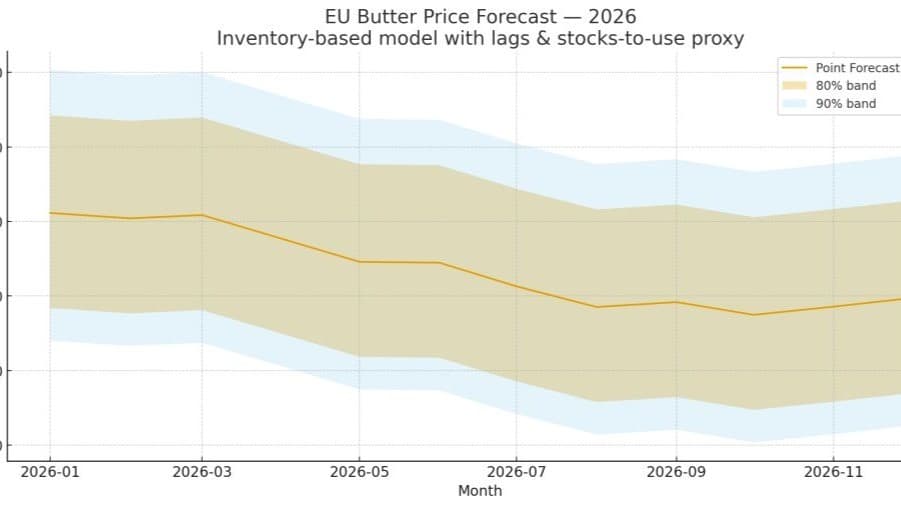
Summer Shopping or Summer Sale?
Last week was again a bit of a bearish week for the entire dairy industry. With cream prices under pressure and milk intake still strong, we keep seeing a market that has more supply than demand. Butter prices took another step lower, cheese prices cracked, and the powder market gave back a bit of its gains again.
Het wekelijkse rapport
Krijg het voordat het ergens anders staat
Elk marktrapport, rechtstreeks in uw inbox zodra het geschreven is. Boter, kaas, poeder, vloeibaar — kies wat u daadwerkelijk handelt.
Ongeveer wekelijks · Gratis · Altijd opzegbaar