Bullies and Bulls
Marktrapporten verschijnen alleen in het Engels. De rest van de site is wel in uw taal beschikbaar.

They say you should never mention politics while doing business, and for those who agree—feel free to skip the next few paragraphs. But as the world changes rapidly, we believe that everyone with a voice should speak out. While our reach may be limited, we think it’s important to use it.
Last Friday, we witnessed the so-called leader of the free world no longer leading by example or values but instead bullying his allies—flexing his muscles and throwing tantrums when not given the reverence he demands. Surrounded by extremists who want to exit NATO and the UN, who openly use the Nazi salute, and who believe minorities should conform to those with the loudest voices, the world is shifting at an alarming pace. Extreme right-wing groups in the EU are gaining ground, and even traditionally liberal media outlets are beginning to downplay or “put into perspective” the behavior of the U.S. Normalizing extremism is dangerous, and those with a voice in their community should speak up.
But it’s not just the U.S. stance on Ukraine that concerns us. Trump’s previous term already demonstrated his admiration for dictators (or, as he calls them, “strong leaders”), and that admiration seems to have only deepened over the past four years. He appears more interested in appeasing Putin than in supporting the allies who have stood by the U.S. for the past 75 years to maintain global peace. In fact, he’s withdrawing further and further from those allies, while his administration grows more radical in its approach. The return of 25% tariffs on Canada and Mexico is just the beginning; the EU will soon face the same. The reason? The EU’s unwillingness to embrace his twisted version of “freedom of speech" and the fact we don't buy enough of the cars the US is making With WTO treaties no longer setting global standards, expect trade wars to intensify, supply chains to be disrupted, and markets to experience increased volatility.
Trump is behaving like the schoolyard bully, demanding lunch money from the weaker kids. He’s already broken the resistance of the school nerds—now, they assist him in amplifying his message. With Bezos, Cook, and Zuckerberg bending their platforms to accommodate the president’s needs, pushing back against his narrative is becoming increasingly difficult. But, as with any school bully, appeasement never works. He will keep testing how far he can push us before meeting real resistance. Let’s hope EU leaders—and others around the world—decide not to hand over their lunch money but instead stand together. Because as strong as this bully might seem, he can’t take over the entire school by himself. If enough allies push back, perhaps rational Republican leaders in the U.S. will finally intervene and put an end to the tyranny of this failed reality-TV president.
We know this little rant won’t change the world. But if it inspires at least one person to challenge the normalization of this majoritarian steamroller—one that ignores and tramples minorities—then it’s worth it.
Now, back to the market.
Last week, the dairy market showed some strength again, with cream and butter prices jumping, and cheese becoming a bit more bullish as well. The question we’ve been asked repeatedly: what’s changed fundamentally? That remains difficult to pinpoint. Milk collection in Germany and France is still lagging behind last year’s levels, though it’s uncertain whether that’s the driving factor. Just a few weeks ago, with the same weaker milk collections, butter and cheese markets were leaning bearish. There’s plenty of data supporting a bearish outlook, yet an equally plausible case for further price increases.
A few key factors seemed to align last week, creating a perfect storm—one we don’t expect to calm down immediately.
Looking at butter, new retail prices for March were negotiated, dropping from €8,200 to €7,400–€7,600. This significant decline likely led buyers to deplete February stocks to the bare minimum, only to start restocking aggressively for this week. Reports from suppliers indicate that retail orders for this and next week are strong. Adding to this, Lidl announced a price reduction to stimulate sales, which could trigger a retail sales surge in packed butter.
The increased retail demand for butter boosted cream prices, which jumped from €7,900 in Western Europe to €8,450. In Eastern Europe, the price increase was even steeper. Just a week earlier, prices had dropped to €7,700, while last week saw producers paying up to €8,600. Combine this with a market still tight on stocks and buyers with fresh memories of butter prices above €7,000, and we witnessed a buying spree pushing butter prices up by €450 per metric ton.
Many traders found themselves caught short, expecting continued market weakness due to anticipated higher milk supplies and seemingly soft demand. Those who were short in a similar situation last year took heavy losses and, understandably, were not keen on repeating that experience. As their short positions turned underwater, they scrambled to exit, driving prices even higher.
On the supply side, butter production appears to be running smoothly—better than in 2025—and more non-EU butter is being offered and traded. However, producers are holding back some stock for later in the year. Winter butter production is currently strong, but it seems that little of what was produced between October and December was set aside. Meanwhile, Ireland’s production is ramping up, though much of it is being swiftly moved to the U.S. by Ornua to beat the April 1 tariff deadline. In Poland, production pressures were evident, but with soaring cream prices, producers opted to sell cream rather than churn more butter. Whatever was produced found buyers at higher prices within the internal market. Additionally, Polish exports faced challenges as the strengthening Zloty made trade more expensive.
Adding up all these factors—new retail pricing, Lidl’s butter promotions, traders caught short, low stock levels, tight supplies, and weak milk intake—we have a textbook short squeeze. We’d be surprised if the market’s momentum fades this week. Retail demand remains strong, end users are joining the buying frenzy, and producers are comfortably holding their positions with minimal pressure. While we still struggle to justify prices above €7,500 fundamentally, sentiment alone could drive them higher.
We may be stubborn, but our bearish outlook on butter persists. We anticipate that Irish producers will feel the impact of Trump’s tariffs. The U.S. is likely to become a bigger player in export markets across all commodities, particularly as it appears willing to weaken the dollar’s strength. Additionally, we still expect that high milk prices—especially if commodity prices continue to rise—will lead to increased milk production. From an EU perspective, the looming threat of trade wars presents a serious risk to our exports.
Cheese: Following Butter
The recent slight weakness in cheese prices seemed primarily driven by softer fat prices. Now, with fat prices on the rise, cheese prices appear firmer. After mozzarella dipped below €4,000 following the GDT auction two weeks ago, demand has rebounded, with Q2 prices now exceeding €4,120. Sellers, who might have been happy to offer at those levels before, have quickly lost interest as the fat market takes off.
For Gouda, we’re seeing a similar trend. Buyers looking for short-term deals found offers just below €4,300 but quickly realized prices were closer to €4,400. Interest for Q2 has shifted from selling to buying, though we haven’t seen aggressive bidding yet.
Powders: The Odd One Out
The powder market remains the weak link. Codex prices have dropped to €2,400, even for fresh product—scraping the lower bound of the year-long range. However, with fat prices climbing, producers seem unbothered by lower SMP prices as long as butter compensates. Butter prices are up €400, making a €100 SMP drop largely irrelevant. The real oddity is the relatively firm SMC price, with levels up to €2,300. At these prices, turning a profit on powder production remains a challenge.
This week’s GDT auction might shed some light on the international powder market’s direction. As EU prices soften, global prices are also looking shaky. With the EU needing to export, a further drop below the €2,400–€2,600 range could hit the market hard.
Week Off
We’ll be traveling this week with very limited access to email and phone. Urgent matters will be followed up, but for all brokering business, we direct you to our trusted partner Linda den Ruyter (linda@getfairdairy.nl or +31 6 20059342). We’ll be back next week to assist you with all your dairy needs.
Meer van de desk
Our Long View Before Our Long Break 
Our Long View Before Our Long Break
Last week the market found a bit of stability. After lower trades on cheese, the cheese market traded slowly up, although a real rally remains absent. Butter prices did dip a bit further, although at the start of this week we see some strength on the back end of the curve. And on powder, our bullish feeling just doesn't go away — and now we can find some confirmation in the market as well.
Dairy Carry Has a Shelf Life 
Dairy Carry Has a Shelf Life
Last week was bearish across the board — every product we broker leaned the wrong way. Powders lost more momentum, cheese slipped well below €3,000 for some products, and butter continues to impress with just how much keeps showing up. Supply, supply, supply.
Summer Shopping or Summer Sale? 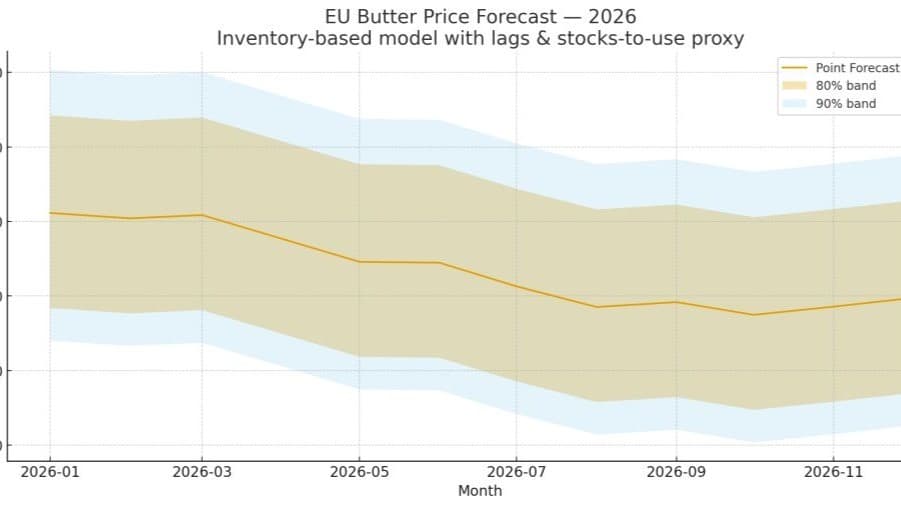
Summer Shopping or Summer Sale?
Last week was again a bit of a bearish week for the entire dairy industry. With cream prices under pressure and milk intake still strong, we keep seeing a market that has more supply than demand. Butter prices took another step lower, cheese prices cracked, and the powder market gave back a bit of its gains again.
Het wekelijkse rapport
Krijg het voordat het ergens anders staat
Elk marktrapport, rechtstreeks in uw inbox zodra het geschreven is. Boter, kaas, poeder, vloeibaar — kies wat u daadwerkelijk handelt.
Ongeveer wekelijks · Gratis · Altijd opzegbaar