Bearish Smokescreen? Or Start of a Sell-off.
Marktrapporten verschijnen alleen in het Engels. De rest van de site is wel in uw taal beschikbaar.

The market remains unusually active. The week before the Anuga usually is very quiet and normally doesn't really move much. But we see a lot of activity in both the butter and the powder market. The cheese market might be a bit less active, but we do see more than enough partners prepared to sell a bit of product. The amount of sales pressure from our partners right before the Anuga strikes us as strange, as the market sentiment was more than bullish and the expectations of a lot of partners was that the Anuga might have put oil on an already hot market. But does this pre-Anuga sales pressure put out the fire and did we start an early sell-off? or does it only create a bearish smokescreen that will disappear by the end of next week?
Of course, we like an active market where we can help and connect our partners to find buyers and sellers for their needs. But we also like to advise our partners about the expected long-term market direction. But with the current volatility and so much uncertainty surrounding supply and demand, giving the right advice and market outlook seems impossible. The biggest questions we have concern the situation surrounding stocks, demand from the industry and supply.
Stocks: How Much is There?
Those who would only speak to the suppliers would be easily under the impression that the stock situation is fully under control. We have spoken to several producers who claim to be carrying the lowest amount of stock in their recent history. And as it is not only one supplier telling us this story it seems most have followed the same strategy. But those who solely speak to end users would be under the impression that there has never been as much stock around. Some claim to be covered until the end of Q4 and we have even spoken to end users who have covered all of their needs up until Q2. The traders also seem to be carrying around a bit of stock. This is proven by the strong availability of aged products. We brokered today butter, SMP and BMP from 2022. Thinking back to the pricing in that production period we don't want to think about the cost price of these batches.
So no stock at the producers, a lot of stock with end users and traders also carrying a lot of products. What does that mean in our view? At least it tells us that producers would like to carry as little stock as possible, possibly because they don't see that much demand forward and would like to carry as little stock as possible towards the end of the year. Because selling expensive stock at low prices doesn't show up positively in the year-end results. At the same time, end users have been buying more than they needed as the low market prices for SMP and butter are no thread for their positions. Therefore most of them carry more product than they actually need, but they are happy to be carrying more stock as they remember the year 2021 when they were fighting for every kilo of product. And the trade? The trade has facilitated forward buying from end users at low levels. By selling forward in Q1 and Q2 and hedging those sales with physical products, they are the buffer between the producer and the end user.
Demand: Buying activity masks drop in demand
We think the buying activity over the last few months has masked a bit of the drop in demand we hear from our end users. Every time the prices for SMP and Butter dropped below a certain point (SMP below € 2200 and butter below € 4500) we have seen buying demand come back. As explained above, at these prices most end users feel very comfortable taking stock as in the previous years they have been paying much higher prices. Most end users are still able to sell at (or a bit below) their sales prices of a year ago, keeping their profit margins up. Buying SMP between € 2200 and € 2600 is no issue for most, and Butter between € 4500 and € 5000 seems a no-brainer for most buyers. But the question remains how long they will keep buying forward? During a period of low production and high consumption (Q3+Q4) this seems an easy choice as the stock goes out quickly. But the question remains if these buyers will keep buying during a period of low demand and high production (Q1+Q2). Because adding more products to an already full warehouse isn't as easy.
We truly believe that during the last months of relatively good forward buying (and traders therefore buying up stock for closeby) and lower production, we have been a bit misled by the activity. But listening well to those who were buying, we do hear that almost all of them have bought more products than they need. Starting November the production of commodities will climb and demand from December onward will start to fade. We might see an opposite market where sellers have fewer outlets as buyers would like to stock up further for Q3 and Q4 of 2024, and not Q1+Q2 in that year. And due to the high interest rates we see that more and more traders are carrying the maximum of stock they can afford. So our worry for demand is not so much in Q4 (we think supply wont push prices down a lot more) due to low demand, but in Q1 of next year.
Supply: High Forward Prices to Support Supply
The supply of milk has been strong in the first 6 months of the year. Apart from France, all major producers have shown strong milk numbers. Since August the picture has turned a bit darker. We did have a warm August and September, so it might be that these warm temperatures are creating a worse picture than we are actually seeing. Because speaking to producers it seems that on the current commodity prices, we don't have to fear even less milk. France will remain a problem, but at a price well above 42ct most EU farmers will continue to milk as much as possible. And looking at the valorization of cheese at the moment or SMP and butter on the EEX future prices, we expect farmers to start locking in their milk price and with that securing volume.
The Supply side of the market is, for us, the most difficult to read as we think logic doesn't always apply. Its weather-driven and farmers are facing a lot of headwinds in some of the countries and the friends from the "green deals". Therefore we would put the supply side in our analysis on the more tight side. A massive growth in milk supply in the EU for the years to come seems out of the question. Long term this should support EU commodity prices.
All things combined we think that we are seeing the effects of the (expected) supply pressure and the lack of buying activity. It seems there are more partners who have come to the same conclusion and wish to come to the Anuga carrying as little stock as needed. This has caused prices for some commodities to drop back a bit, but the real effects we will probably see the week after Anuga. We hope to see most of our friends and readers at the Anuga. We will be attending on Monday and Tuesday and hope to see as many people as possible. Do you want to meet? Look for a long tall broker looking for clues! See you in Cologne!
Meer van de desk
Our Long View Before Our Long Break 
Our Long View Before Our Long Break
Last week the market found a bit of stability. After lower trades on cheese, the cheese market traded slowly up, although a real rally remains absent. Butter prices did dip a bit further, although at the start of this week we see some strength on the back end of the curve. And on powder, our bullish feeling just doesn't go away — and now we can find some confirmation in the market as well.
Dairy Carry Has a Shelf Life 
Dairy Carry Has a Shelf Life
Last week was bearish across the board — every product we broker leaned the wrong way. Powders lost more momentum, cheese slipped well below €3,000 for some products, and butter continues to impress with just how much keeps showing up. Supply, supply, supply.
Summer Shopping or Summer Sale? 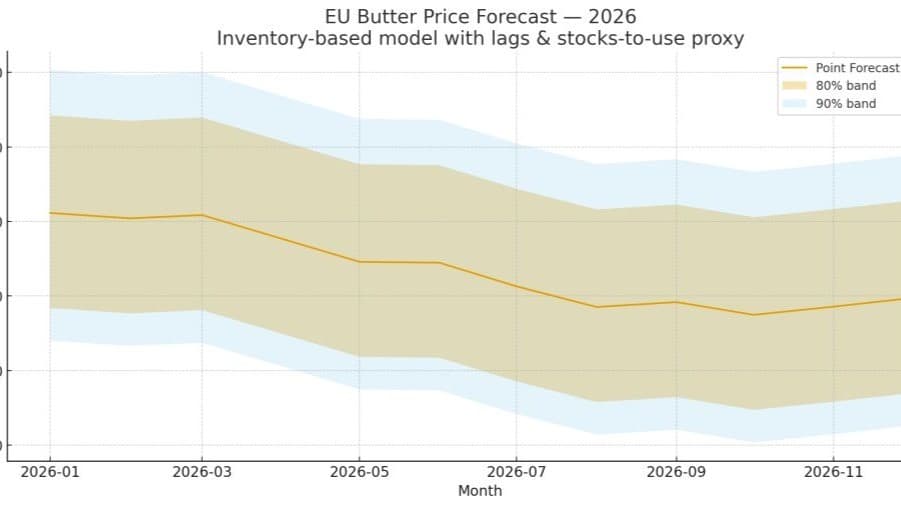
Summer Shopping or Summer Sale?
Last week was again a bit of a bearish week for the entire dairy industry. With cream prices under pressure and milk intake still strong, we keep seeing a market that has more supply than demand. Butter prices took another step lower, cheese prices cracked, and the powder market gave back a bit of its gains again.
Het wekelijkse rapport
Krijg het voordat het ergens anders staat
Elk marktrapport, rechtstreeks in uw inbox zodra het geschreven is. Boter, kaas, poeder, vloeibaar — kies wat u daadwerkelijk handelt.
Ongeveer wekelijks · Gratis · Altijd opzegbaar