Weekly Update: Dark Clouds and Rays of Sunshine

We are entering the second whole week of March and markets seem to have cooled and slowed down a bit. After an extremely bearish January and a bullish February, March seems to be trading more sideways (or within a relatively tight range). It seems sellers used January to take the pressure off their books, and buyers did the same in February, most of our partners have positioned themselves as "neutral". The saying, "Only time will tell" applies here, because in time either the buyers or the seller need to act again, as time adds stocks to the supply side, but eats it on the demand side. Who will come back first?
1. How is supply developing?
The supply side so far seems to be strong still. Looking at the Netherlands we see 4.1% more milk over February with more fat content in the milk pushing fat production even up 5.9%. In the Netherlands is the highest milk intake in February ever recorded. February 2020, was a higher milk intake, but that year February had 29 days, making the milk intake per day greater. In Ireland, January started 2.5% behind last year, and it seems February isn't going to be much better. However, reports of recent days suggest milk is starting to flow on the forecasted volumes. Germany, Poland, Belgium, Denmark, but also the UK and the US are showing strong numbers, all pushed up by the higher milk price. France is the only major producer that is still about 2% down v.s. last year.
2. How is the milk price developing?
The milk price (that is the main driver behind strong milk production) is starting to come down quickly now. Most producers are now paying roughly around € 0.50 per litre, which is between € 0.12 and € 0.15 lower than in December. We expect prices for April to drop with most major producers below € 0.50 although we think it won't impact milk supply. Most farmers' cost for additional production has come down together with the milk price, it's their overhead cost that has increased the most. So with a lower milk price, they would need to produce more milk to earn back their overhead. Unlike most of our partners, we don't think milk production will be impacted by lower milk prices until far in 2023 when the cost per litre might increase again.
3. How is demand developing?
Checking out the demand side we see a very mixed picture. Those who supply the food service claim to be working 24/7 to fulfil the demand of their customers, and higher prices are easily accepted. Most buyers need products for quick delivery, which indicates that buyers aren't keeping much stock. We did hear two different explanations for this. One partner thinks this means buyers haven't bought anything ahead as they were hoping for lower prices and now they have caught short. But another looked at it from a risk point of view. It seems most food service businesses are fearing a drop in demand as inflation keeps surging. In retail, inflation (in combination with the end of covid) is hitting the demand side quite hard. Some fear consumers might get more pessimistic and start to pay attention to their spending and those purchasing managers at these food service companies don't want to be facing high stocks once that happens. Last but not least we have to look at the demand in the export markets. In recent weeks we have seen more demand for export and we hear the same from our partners. Cheese and butter are easier to export in levels are low, although competition from both the US and NZ might get brutal.
4. How is inflation developing?
Inflation seems to be topping off, although some countries are showing increased inflation again. But looking closely at these inflation numbers we see a worrying development. Food inflation is going up extremely quickly. Where last year most of the inflation was contributed by energy, now food inflation is leading the way. Food inflation differs a lot per country. In the Netherlands, we have about 15.1% food inflation and in Belgium and France the last report was about 15.1 and 14.7%, But see-saw that Poland is having about 20% food inflation, Germany is experiencing 21% food inflation and Bulgaria even 70% inflation on food. Prices for food are increasing fast across Europe and unlike the energy price increase we don't think the governments are going to compensate consumers as they did in some countries with the energy bills. Some countries are trying to impose price increases, but it doesn't seem to have much effect.
5. How are economies developing?
Last week might have been a quiet week in dairy, its sure wasn't quiet on the stock markets. In the US the biggest bank since the 2008 banking crisis went down. The Silicon Valley Bank (SVB) is going to test the thrust of the financial world in our banking system. Due to the quickly increasing interest rates, it seems likely more institutes might get in trouble. This won't hit consumption or milk production directly, but it will have an impact on the consumer's mindset, but also on the willingness of creditors to put their money in commodities with a highly volatile profile and an exploration date.
Looking at the market we still see the short-term potential for prices to trade either up or down. The demand side in some sectors remains strong and the willingness from sellers remains small. The bigger picture in the mid-long term for us is starting to look more bearish by the week. Dark clouds are not only forming within the dairy market but in the entire market in general. Only a major supply disruption in our view might change the course of where prices in the dairy market are going too. Looking ahead toward 2024 and further, there are too many variables to say anything that makes sense, although we do think that longterm demand continues to grow, and supply will be restrained (in EU and US).
More from the desk
The Bull, The Bear & The Black Swan 
The Bull, The Bear & The Black Swan
Last week was an intense one. When conflict erupted in the Middle East, the market's first instinct was to buy. Partners moved quickly on available offers, and by Tuesday the GDT had rallied alongside a broad bullish swing across agricultural commodity markets world wide. For a moment, it felt like the market had made up its mind. The second half of the week told a different story.
The Bull, The Bear and the Fairy Dust 
The Bull, The Bear and the Fairy Dust
After another active week of trading and yet another slide in prices, we started preparing this week’s report. But beyond concluding that the market remains bearish, there are countless ways to tell the same story: more milk, more stock, slower demand, lower prices. You know the drill. So this week, we’ll skip the usual summary. Those who know us well know we have two children — Lina and Ollie.
The Five Phases of a Buyers Grief 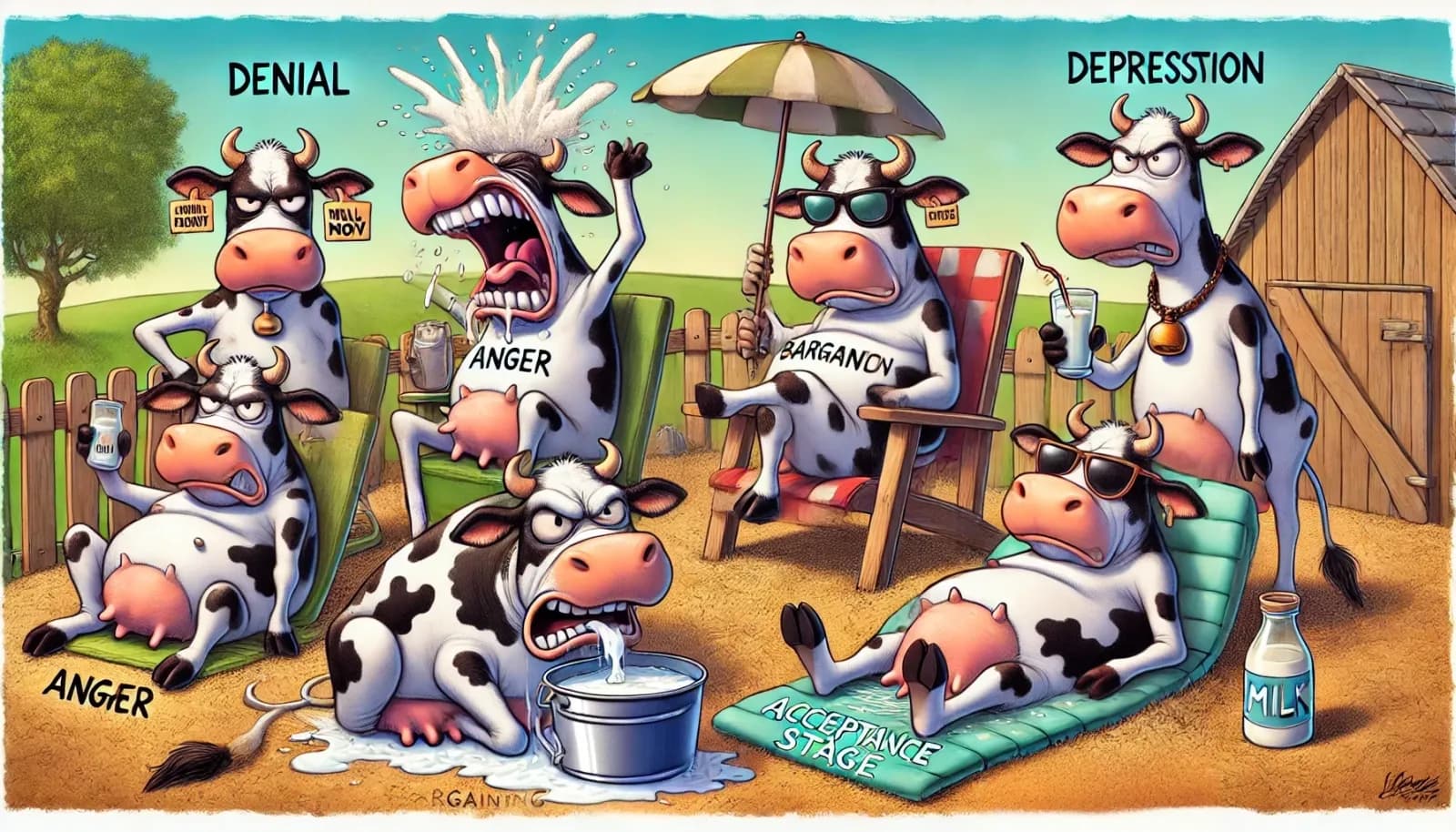
The Five Phases of a Buyers Grief
Yesterday, the market continued its bullish trajectory, driven primarily by surging spot prices for liquid products. With raw milk prices averaging €0.65, SMC prices reaching €2,550, and cream prices breaking records at €10,000 to €10,250, it’s evident that processors are fiercely competing for raw materials. This has left minimal supply available for commodity production.
The weekly report
Get it before it is anywhere else
Every market report, straight to your inbox the moment it is written. Butter, cheese, powder, liquids — pick what you actually trade.
Roughly weekly · Free · Unsubscribe any time