Ceteris Paribus (Sed Aliter)

Ceteris paribus is a Latin phrase meaning "all other things being equal" or "holding other factors constant." It’s used in economics and market analysis to isolate the effect of one variable by assuming that everything else remains unchanged. This simplification helps us understand cause and effect without interference from other moving parts. Let’s apply it to our world — physical dairy commodity trading.
Suppose we say:
"If milk intake increases, commodity prices should fall, ceteris paribus."
This assumes that; Demand remains unchanged, export conditions stay the same, Currency doesn't fluctuate, No diseases or regulatory changes occur. Of course, reality doesn’t work like that — but ceteris paribus allows us to test logical relationships before layering in complexity.
Over the past few months, we've been actively debating the market with our partners. As always, the focus tends to shift between current prices and anticipated ones. Together with our colleagues and clients, we strive to make sense of market logic and predict future movements. And while Latin rarely enters our vocabulary, we often find ourselves concluding discussions with a familiar phrase: 'as long as other market conditions remain unchanged.
…mutatis ceteris, pretium manet — all else has changed, but the price remains.
And that, paradoxically, is where we find ourselves today. While currencies swing, export logistics shift, consumption patterns evolve, economic sentiment wobbles, and milk production surges or stalls with the weather — prices for key dairy commodities remain eerily still. Butter, powder, and cheese sit in tight ranges, as if immune to the chaos surrounding them. It's as if the market has found a quiet spot in the eye of the storm and refuses to budge. Volatility hides in plain sight, but the price doesn't flinch. In a world where every variable screams “movement,” the price’s stubborn stillness becomes the real anomaly. So yes, we’ve left the safe thought experiment of ceteris paribus behind. In the current market, mutatis ceteris, pretium manet feels more accurate than ever.
Today’s landscape reflects a market that is anything but quiet beneath the surface. Milk collections are climbing across Europe — Ireland is showing notable growth, France is running ahead of last year, the UK is seeing a surge, and even Germany, after a slow start, is quickly closing the gap. The spot market for liquids tells the real story: raw milk, cream, and SMC are trading heavily, with prices under pressure across the board. And yet, the commodities produced from these inputs — butter, SMP, and cheese — remain remarkably stable. Butter in particular flirts with volatility midweek, reacting to sharp offers or thinner demand, only to bounce right back to familiar territory by Friday. It creates an illusion of movement, but little structural change. Only prices for May and June show some softness, though volumes traded are too low to call it a firm trend. The market breathes, stretches, reacts — but doesn’t actually move.
Before any meaningful market analysis can take shape, we’d need the broader conditions to settle — but let’s not hold our breath. Just as milk flows find their rhythm in spring, we’d hope the market would, too. Yet with Trump back in the White House and global trade tensions simmering like a vat of cream on full heat, expecting international calm might be more wishful than rational. If ceteris paribus is the peaceful pasture economists dream of, then today’s market is a muddy feedlot of shifting variables. In that light, maybe the current price stability isn’t a sign of stagnation, but the anchor we cling to while the rest of the boat rocks. Until currencies, politics, trade terms, and weather stop pulling in different directions, the market price may ironically be the only thing behaving the way textbooks said it would — by not moving.
Butter: Moving Sideways
Butter prices for May and June are starting to show signs of fatigue — and as long as cream prices remain below €8000, ceteris paribus, that pressure is unlikely to lift. Stocks are quietly building, and more producers are testing the waters for short-term buyers. In Germany, offers are slipping to around €7050–€7100 FCA ex-works, while in Poland we're consistently hearing levels between €6900–€6950. The only outlier remains Ireland, where producers appear glued to higher price ideas. Ceteris paribus? More like ceteris ignoratis — they may end up eating their own stocks, but judging by sentiment, they seem hungry enough to manage.
For now, outright buyers and sellers are scarce. Most partners are circling each other with swap intentions. If you're holding something tradable and want to explore a creative structure — give us a call. It's a good time to trade flexibility, not just volume.
We expect to have offers as follows
- 4 trucks fresh German butter for June at € 7125
- 6 trucks Irish butter for Q3 at € 7125
- 6 trucks NL/DE/BE for Q3 at € 7350
- 4 trucks Polish Sweet cream May at € 7050
Cheese: Moving Sideways
While butter is showing signs of softening, cheese appears to be holding firmer ground — at least for now. We continue to see more buyers than sellers, hinting at potential upward pressure. Mozzarella buyers are circling around €4050, with Gouda interest coming in around €4200. On the other side, sellers remain disciplined: Mozzarella offers are steady at €4200, and Gouda/Edam around €4350 FCA. The imbalance could suggest a price lift — but with other commodities trading mostly sideways, a genuine surge seems just as unlikely. The weakening USD may give EU cheese a small push, making exports slightly more attractive after months of battling aggressive third-country competition. Still, with the logistical and pricing gap between EU-origin cheese and global alternatives, any export-driven momentum is likely to be modest at best.
We expect to start with bids for
- 4 trucks of Mozzarella for June / July at € 4075
Powders: The Quiet One Starts to Stir
After months of near-hibernation, the powder market is finally showing signs of life. Prices have ticked up in recent days, with the recent tariff détente between the U.S. and China — easing duties to 30% and 10% respectively — giving the USD a tailwind and SMP some much-needed lift. EEX futures are edging higher, and we’ve seen stronger bidding on physical, with German-origin volumes trading for Q3 around €2400. Demand at these levels is notably more active. Ironically, the commodity we expected to trade sideways for the longest — and that did, without blinking — might now be the first to break formation. Our earlier assumption of flat pricing was, of course, ceteris paribus. But with geopolitics shaking the FX desk and global buyers waking from their slumber, powder might just be the first to reintroduce real volatility to this market. The dullest guest at the dairy table may yet become the one to watch.
We expect to have offers for
- 200mt UK Non Standerdized 37% FCA NL at € 2480
- 300mt Arla DE Q3 at € 2435
- 100mt SMP Solarec for June at € 2450
Conclusion
In a market clouded by shifting fundamentals, erratic geopolitics, and seasonal supply shifts, price behavior across commodities has diverged — or rather, decoupled from logic at times. Butter softens while cream sinks. Cheese resists gravity despite quiet exports. Powder, long dormant, is suddenly awake. What’s clear is that forecasting under current conditions demands more than charts — it requires context, flexibility, and a bit of humility.
So, as we search for structure in this scattered market, remember:
In mercatu ut in vita — nihil perpetuum est.
In markets, as in life — nothing is permanent.
More from the desk
Our Long View Before Our Long Break 
Our Long View Before Our Long Break
Last week the market found a bit of stability. After lower trades on cheese, the cheese market traded slowly up, although a real rally remains absent. Butter prices did dip a bit further, although at the start of this week we see some strength on the back end of the curve. And on powder, our bullish feeling just doesn't go away — and now we can find some confirmation in the market as well.
Dairy Carry Has a Shelf Life 
Dairy Carry Has a Shelf Life
Last week was bearish across the board — every product we broker leaned the wrong way. Powders lost more momentum, cheese slipped well below €3,000 for some products, and butter continues to impress with just how much keeps showing up. Supply, supply, supply.
Summer Shopping or Summer Sale? 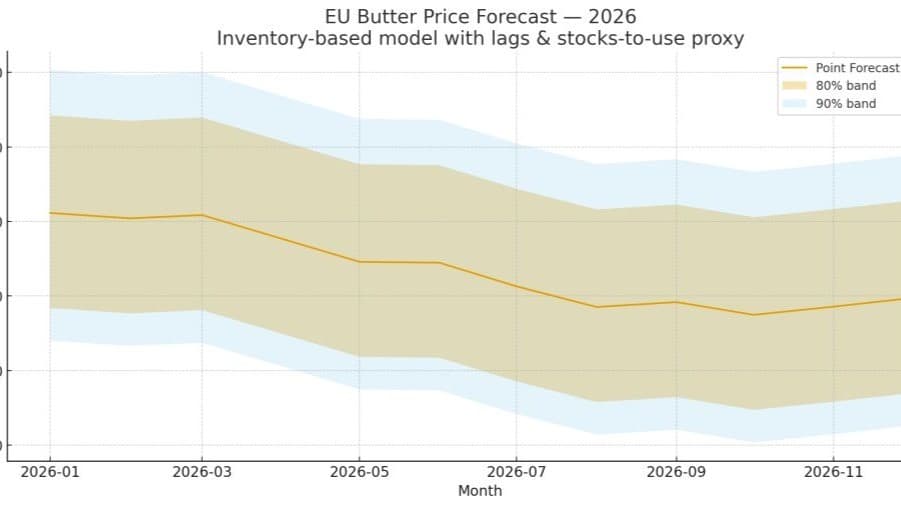
Summer Shopping or Summer Sale?
Last week was again a bit of a bearish week for the entire dairy industry. With cream prices under pressure and milk intake still strong, we keep seeing a market that has more supply than demand. Butter prices took another step lower, cheese prices cracked, and the powder market gave back a bit of its gains again.
The weekly report
Get it before it is anywhere else
Every market report, straight to your inbox the moment it is written. Butter, cheese, powder, liquids — pick what you actually trade.
Roughly weekly · Free · Unsubscribe any time