Bearish Market Fundaments, but a Bullish Market

We have been off for over a week, but we reentered the market yesterday. As announced we will not do our daily updates until the 15th, but we wanted to update you on what we see on the market and what we expect. Conditions since our last update haven't really changed that much, milk supply in most major production areas is strong, consumption seems down and demand for closeby is weak. It seems to be the uncertainty about the market outlook that keeps buyers actively looking to secure supply for Q3 and Q4 and sellers aren't willing to offer that much that far forward. It's creating a big difference in spot prices and prices for further out (both on the physical and future market).
Ok, so why do an update on the market when nothing has changed? We do feel the market has changed a bit. Because those reading our reports regularly know we are bearish on our market outlook, but looking at the dynamics between buyers and sellers we think we need to adjust our view a bit. Because even with immense pressure in the front months, even with warehouses reported to be full to the roof, and even with demand and consumption reported down in combination with China's absence on the world stage, the market is holding up remarkably steady. We should have expected prices to break down weeks ago, but still, the market keeps giving support.
And we think we are not the only ones seeing this. Looking at what producers are paying their farmers, it seems they are confident that we have hit the bottom. Corrections down on farmer payout prices have slowed down, and in Belgium we even see A-Ware keeping the milk price steady. Producers are very reluctant in offering any product for Q3 and Q4 they are staying away. It doesn't feel like sellers are thinking the market will rally 50% from here, it just feels like they are confident they there isn't much downside to be seen. So we take a look at the fundamentals once again.
1. Milk Supply: More is not a problem?
There is clearly more milk in the EU compared to last year, and in all major production regions, more milk is reported. In the EU we are at the peak of the milk flow and we can clearly see spot prices for raw milk, SMC and cream are influenced by this. But it still hasn't led to producers needing to overproduce products they can't sell. It seems the reason for more cream and smc offers on the market is a capacity problem (producers can't produce more) than a demand problem. And still, all these spot volumes find their way to the market and don't put additional pressure on the commodity markets. (or at least, less than we would have expected). France and Ireland are both struggling with their milk intake, and both normally have a big impact on the butter supply in the EU, with to major players producing less butter, the market is balanced, even at its production peak.
But if this higher milk out isn't a cause for concern, the concern for lower milk intake in H2 should also be shaken off a bit. Most partners were fearing a tight H2 due to low milk prices caused by cheap commodity prices in Q2. But if we can keep the current market levels, we expect all major producers to keep their milk price between € 0.40 and € 0.45 continuing to push production at its current levels.
The additional milk we are seeing at the moment isn't causing Irish or Polish producers to dump cheap products on the market as we have seen in the past. Maybe it's the stronger financial position of some important players or a more strategic mindset that is causing this shift. But if we are not going to see pressure on their commodity markets, we think we can conclude that the higher milk intake should be seen less as a concern than we thought. But with this conclusion, the fear of lower milk intake in H2 could also be let go a bit.
2. Demand: Where are goods going to?
The demand side is always the hardest to analyze. Most data we can find comes out months after we needed it and the complex shifts between food service and retail that we have seen over the last COVID years make it hard to compare data. Food service companies still report strong demand, but retail numbers are way down compared to earlier years. The high inflation is a good explanation for the lower demand in retail, but why do we keep spending as much in the food service sector? We hear there is less demand for UHT milk, less demand for butter in Germany and the demand for mozzarella and fresh cheeses this year isn't very strong. But somehow we don't see any huge buildup in cheese stocks (Gouda, Edam, Mozzarella). Maybe export demand in Q1 has absorbed much more than we anticipated. But asking around there have been big export deals done early Jan when EU cheese prices dropped below € 3000 and butter prices dropped below € 4000.
But a big part of the demand seems to come from buyers looking to cover Q3/4. They keep finding ways to use product that is being produced today and allocated against contracts further out. We keep thinking a lot of the demand that is supporting the market comes from H2 demand.
Demand is clearly still down, but we think we underestimated how much demand there has been at prices where SMP drops below € 2200, butter drops below € 4000 and cheese (like Gouda, Edam, Mozza) drops below € 3000,-. The floor for dairy commodities seems to come from internal EU demand for H2 and from outside EU export demand on low prices.
3. Storage + Finance: Did a strong 2023 give some breathing space?
One of the biggest changes compared to 1-2 years ago is the difference in financing and storage cost. Due to higher interest rates financing commodities is taking up a bigger portion of the liquidity of producers/traders/end users. And due to higher energy costs, freezing and storing the goods is also less attractive, or at least that is our theory. But if storing and financing is so expensive, why are the warehouses so full? butter is 40% less expensive compared to a year ago, SMP is almost 50% cheaper and cheese is down 35%-40% since their top. So yes, you pay maybe twice or three times as much interest, but over roughly 40% less. In addition, most traders and producers will have had their best year yet due to the high commodity prices of last year, increasing their cash positions. Most of our partners admitted they are able to take on a bit more compared to a year ago.
The argument for higher cost still stands, we see the spreads between quarters for products you can store is much bigger than in previous years, but somehow these premiums are getting paid. And we even hear end users that normally buy 6 months forward, now storing the goods themselves as they have the capacity to so. It does add to the fact that a lot of demand is getting filled by cash-and-carry schemes and it adds to our doubt how strong demand will be in Q3/4.
We can already see the email and call come, has our market outlook changed completely from bearish to bullish? No, it hasn't completely. But we have to admit that where our expectation was we would see much lower prices during Q2, we might be faced with a much more balanced Q2. Unless producers come agressively to the market in the next two weeks we expect to trade flat for Q2 on the current market prices. Because as long as buyers are fearful of high prices in H2 and sellers aren't willing to offer any product for H2 we will see a clear floor in the market.
We do think the biggest change in our market outlook comes for H2. Adding all the data together we think milk production in H2 is going to be much better than most expect. Speaking to producers the have forecasted a lower milkintake and they havent sold much forward, speaking to buyers they have bought forward, either trought stocking product themselves or via a trader. This seems to be confirmed by the high stocks in the warehouses.
More from the desk
Our Long View Before Our Long Break 
Our Long View Before Our Long Break
Last week the market found a bit of stability. After lower trades on cheese, the cheese market traded slowly up, although a real rally remains absent. Butter prices did dip a bit further, although at the start of this week we see some strength on the back end of the curve. And on powder, our bullish feeling just doesn't go away — and now we can find some confirmation in the market as well.
Dairy Carry Has a Shelf Life 
Dairy Carry Has a Shelf Life
Last week was bearish across the board — every product we broker leaned the wrong way. Powders lost more momentum, cheese slipped well below €3,000 for some products, and butter continues to impress with just how much keeps showing up. Supply, supply, supply.
Summer Shopping or Summer Sale? 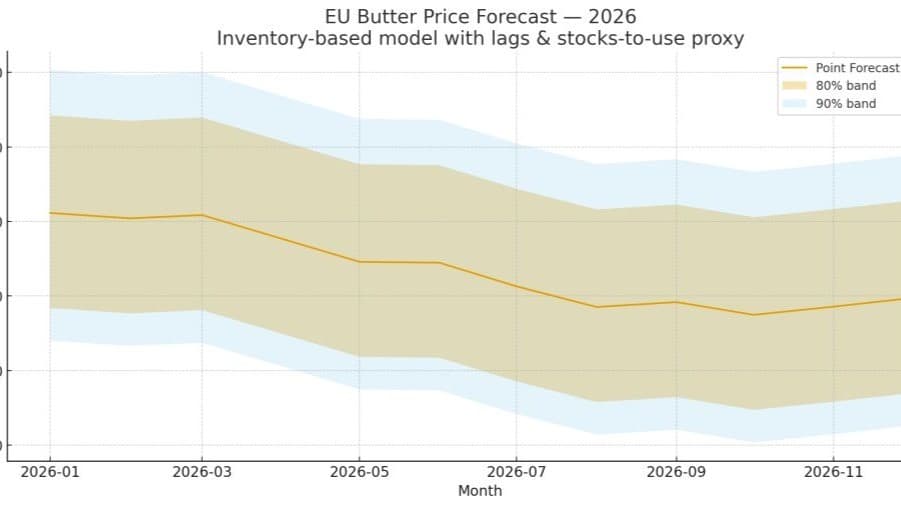
Summer Shopping or Summer Sale?
Last week was again a bit of a bearish week for the entire dairy industry. With cream prices under pressure and milk intake still strong, we keep seeing a market that has more supply than demand. Butter prices took another step lower, cheese prices cracked, and the powder market gave back a bit of its gains again.
The weekly report
Get it before it is anywhere else
Every market report, straight to your inbox the moment it is written. Butter, cheese, powder, liquids — pick what you actually trade.
Roughly weekly · Free · Unsubscribe any time